When is the shortest day of the year? The Winter Solstice is nearly here
The shortest day of the year will see an early sunset at 3:03pm in the UK
The winter solstice, a phenomenon revered by ancient civilisations, continues to hold profound significance today as it heralds the official start of winter.
This annual event marks the shortest day of the year, characterised by the fewest hours of daylight, and conversely, the longest night. It is also the precise moment when the sun reaches its lowest daily maximum elevation in the sky.
The term "solstice" itself is rooted in Latin, combining "sol," meaning sun, with "sistere," which translates to "to come to a stop" or "make stand."
When is the winter solstice?
While the Southern Hemisphere embraces the onset of summer, those residing north of the equator will observe the opposite – the inaugural day of winter. This year, the celestial event is set to occur on Sunday 21 December at 3:03 pm.
Depending on where you are in the UK, the exact length of the day will differ. In London, there will be 7 hours 49 minutes and 42 seconds of daylight. That means it is 8 hours and 49 minutes shorter than the June solstice.


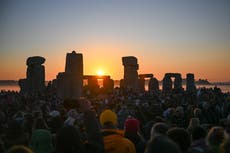
While that means that the day is likely to be dark and dreary, the good news is that it also means that the days will get progressively longer, with more hours of daylight until the climax of the summer solstice.
The variation happens because the Earth orbits the sun at an angle of 23.4 degrees on its axis, according to the Royal Museums of Greenwich.
Arriving on the same day across the globe, a solstice occurs when the sun reaches its lowest or highest point in the sky during the year as a result of the Earth’s axis tilting to or away from the sun.
For the Southern Hemisphere, it’s the opposite case, as 21 December marks the one day of the year with the longest period of sunlight.
What is the history of the winter solstice?
Historically, the winter solstice has been of great importance to many cultures, such as Ancient Egypt and Ancient Rome, often as a marker for the passing seasons, and a possible time of rebirth.
In northern Europe, from the Faroe Islands to Estonia, Germanic peoples have long celebrated the event, which became known as Yule.
While Yule dates back to the Norse people, who celebrated the sun’s rebirth for 12 days, it was also celebrated by Anglo-Saxon pagans.
According to Pliny the Elder, in Britain, druid priests would mark the important date by gathering mistletoe and sacrificing bulls – which was also likely a practical measure to limit the number of mouths to feed during months of famine.
What is the equinox?
During the equinox, the Earth’s axis and its orbit align so that both hemispheres get an equal amount of sunlight.
During the warmer periods, the North Pole is tilted towards the sun in the northern hemisphere, meaning longer daylight hours, while the southern hemisphere experiences the opposite. During winter the situation is reversed as the North Pole tilts away from the sun for the northern hemisphere.
The word equinox comes from two Latin words meaning equal and night. That’s because on the equinox, day and night last almost the same amount of time — though one may get a few extra minutes, depending on where you are on the planet.
The Northern Hemisphere’s fall — or autumnal — equinox can land between Sept. 21 and 24, depending on the year. Its spring — or vernal — equinox can land between March 19 and 21.

What’s the difference between meteorological and astronomical seasons?
These are just two different ways to carve up the year.
While astronomical seasons depend on how the Earth moves around the sun, meteorological seasons are defined by the weather. Meteorologists break down the year into three-month seasons based on annual temperature cycles. By that calendar, spring starts on March 1, summer on June 1, autumn on Sept. 1 and winter on Dec. 1.
Additional reporting by AP.
Join our commenting forum
Join thought-provoking conversations, follow other Independent readers and see their replies
Comments
Bookmark popover
Removed from bookmarks