In Louisiana, a father, a son and a culture of police abuse
As the Louisiana State Police reel from a federal investigation into the deadly 2019 arrest of Black motorist Ronald Greene and other beating cases, dozens of current and former troopers tell The Associated Press of a culture at the agency of impunity, nepotism and in some cases outright racism
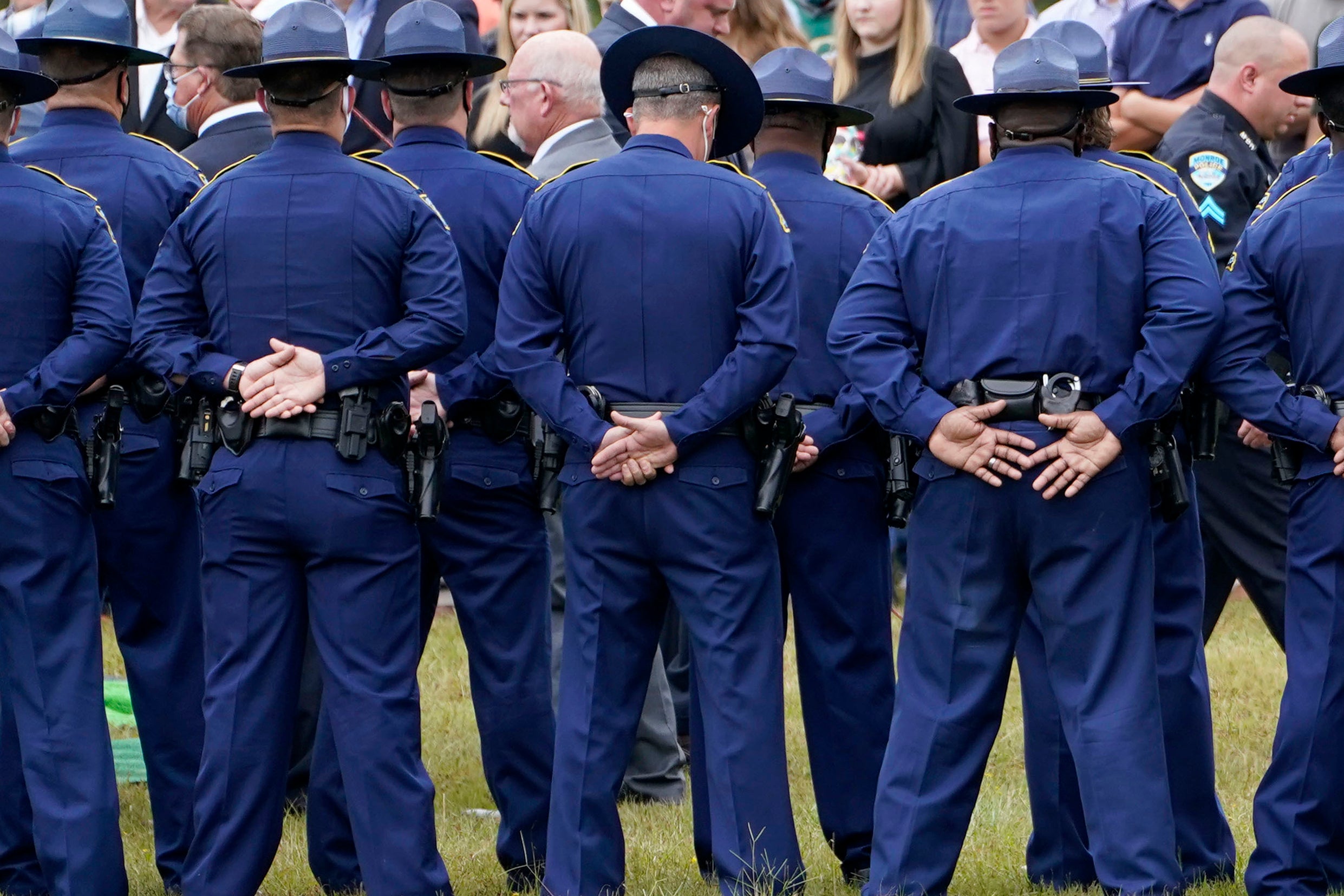
Growing up in the piney backwoods of northern Louisiana where yards were dotted with crosses and the occasional Confederate flag, Jacob Brown was raised on hunting, fishing and dreams of becoming a state trooper.
But within weeks of arriving at the Louisiana State Police training academy in Baton Rouge, instructors pegged Brown as trouble. One wrote that he was an arrogant, chronic rule breaker with “toxic” character traits that should disqualify him from ever joining the state’s elite law enforcement agency.
Fortunately for Brown, the state police was known as a place where who you knew often trumped what you did, and where most introductory chats eventually got around to a simple question: Who’s your daddy?
Jacob Brown is the son of Bob Brown, then part of the state police’s top brass who would rise to second in command despite being reprimanded years earlier for calling Black colleagues the n-word and hanging a Confederate flag in his office. And the son would not only become a “legacy hire” but prove his instructors prophetic by becoming one of the most violent troopers in the state, reserving most of his punches, flashlight strikes and kicks for the Black drivers he pulled over along the soybean and cotton fields near where he grew up.
When friends and colleagues would ask Bob Brown how his first-born was getting along as a trooper, he'd respond with a seemingly innocuous boast:
“He’s knocking heads.”
The Browns’ story is woven throughout the recent history of the Louisiana State Police and represents what dozens of current and former troopers have described to The Associated Press as a culture of impunity, nepotism and in some cases outright racism.
It illustrates the dynamics that have made the agency the focus of a sprawling federal investigation that initially examined the deadly 2019 arrest of Black motorist Ronald Greene and has since expanded to include a string of other cases -- several involving Jacob Brown -- in which troopers are accused of beatings and cover-ups, even when they are caught on video.
“If you’re a part of the good ol’ boy system, there’s no wrong you can do,” said Carl Cavalier, a Black state trooper who was once decorated for valor but recently fired in part for criticizing the agency’s handling of brutality cases.
It’s an us-versus-them culture, they say, in which many troopers and higher-ups are more interested in covering for each other than living up to the agency’s image of honor, duty, courage and “doing the right thing.”
It’s a culture in which troopers who gather for backyard barbecues and church on Sundays feel so insulated from scrutiny that they can banter about their brutality on official channels, including texting each other photos of a battered and bloodied suspect with the quip “he shouldn’t have resisted.”
It’s a culture in which 67% of troopers’ uses of force in recent years targeted Black people — double the percentage of the state’s Black population – and in which troopers kept their badges after sending overtly racist emails with such headings as “Proud to be White.”
And it’s a culture in which state police academy instructors faced with a widespread cheating scandal sought to dismiss an entire recent class of cadets -- including the “legacies” of several high-ranking police officials -- yet nearly all were allowed to graduate to jobs on the force.
“There’s a corruption that allows the reprobates in state police to just sort of do as they damn well please,” said W. Lloyd Grafton, a use-of-force expert who is consulting on the Greene family’s civil case and served on the Louisiana State Police Commission. “Nobody holds them accountable.”
‘WE’VE GOT TO FACE THIS HEAD ON’
A potential reckoning in the Louisiana State Police came in the wake of Greene’s death on a rural roadside near Monroe on May 10, 2019 -- a fatality troopers initially blamed on a car crash at the end of a high-speed chase.
State police later acknowledged Greene was involved in a “struggle” with troopers but officials from Gov. John Bel Edwards on down refused for more than two years to publicly release the body camera video. When it was eventually published by the AP this spring, the footage showed white troopers swarming Greene’s car, stunning, punching and dragging him by his ankle shackles, even as he appeared to surrender, wailing, “I’m your brother! I’m scared, I’m scared!”
Fallout brought federal scrutiny not just to the troopers but to whether top brass obstructed justice to protect them, according to documents and people familiar with the case. Investigators have focused on a meeting that the elder Brown attended in which state police commanders pressured their own detectives to hold off on arresting a trooper seen on body-camera video striking Greene in the head and later boasting, “I beat the ever-living f--- out of him.”
Greene’s death was among at least a dozen cases in the last decade identified by the AP in which state troopers or their bosses ignored or concealed evidence of beatings, deflected blame and impeded efforts to root out misconduct.
Many of those cases involve the state police’s Monroe-based Troop F, which has become notorious for its treatment of Black motorists and counted Jacob Brown among its troopers. In one long-suppressed video, he can be seen pummeling a Black motorist with a flashlight, in another he slams a Black motorist into a police cruiser, and in yet another Brown and other troopers beat a Black man and hoist him to his feet by his dreadlocks. That was followed by troopers exchanging “lol”-peppered text messages bragging that the “whoopin” would give the man "nightmares for a long time.”
“They’re not the people you think they are,” said John Winzer, Greene’s nephew, who shudders every time he sees a state trooper on the highway. “It’s no different than organized crime. They hang together. They eat together and ride at night together. And s--- like this happens.”
Even the agency’s superintendent acknowledged that the state police have lost the public’s trust, due in part to an “old-fashioned culture” in Louisiana’s northern parishes in which some troopers are conditioned to punish anyone who runs from them or disrespects the badge.
“It’s uncomfortable to hear, ‘You guys are bullies.’ It’s uncomfortable to hear, ‘We thought y’all were better than this,’” Col. Lamar Davis, a veteran Black trooper brought in a year ago as a reformer, told AP in an interview.
“We’ve got to face this head on,” he said. “We have to change quite a few things in our agency.”
Davis has reorganized his staff, overhauled use-of-force policies and mandated all troopers attend training on intrinsic bias. But he acknowledged it may not be enough to stave off growing calls for a U.S. Justice Department “pattern and practice” probe of potential racial profiling by a nearly 1,000-trooper force that’s more than three-quarters white men.
One of Davis’ most uncomfortable reform duties came just weeks into his tenure when he called Bob Brown, a man he once worked for, to tell him “out of respect” that he had ordered the arrest of his son Jacob and three other troopers on state charges in the separate beatings of three Black men.
“It wasn’t pleasant,” Davis said, declining to detail the conversation.
’A SOUVENIR’
Bob Brown grew up in Lake Providence, a farming town on the Louisiana side of the Mississippi River.
By the 1990s, he was raising his children in a farmhouse about 20 miles outside Monroe. He began working for the Monroe police before joining the state police as a trooper, investigating car crashes on the same rural roads his son would later patrol.
Former colleagues described him as a loyal friend and skilled investigator who brought country canny to his policing. When a young trooper got his cruiser stuck in the mud, Brown towed him out with his tractor. He was well connected and understood the politics of state police, serving as a sergeant over narcotics before being promoted to a major overseeing statewide criminal investigations.
The elder Brown’s file with the State Police Commission, which acts as a civil service board, makes no mention of any accusations of excessive force. State police so far have not released his full personnel file.
“He was good at what he did but he wasn’t a glory hound,” said Lee Harrell, the former sheriff of Richland Parish who worked alongside the elder Brown at state police. “He wouldn’t talk to the media about his biggest drug bust.”
But in 2000, just months before the state police would name their first Black superintendent, Brown’s choice of words drew a formal complaint from a coalition of Black troopers.
Brown was overheard in the office commiserating with colleagues over the results of a state police promotional exam. Some troopers were mad about how they’d scored and felt the test was flawed.
“I don’t understand how those ‘n-----s’ could pass this test,” Brown was quoted as saying, according to state police disciplinary records. “They’re not smarter than us.”
When questioned by internal affairs investigators, Brown said that while he didn’t recall making the remark, it was possible because the slur remained a part of his vocabulary.
The same complaint noted Brown hung a Confederate flag behind his office door, though it was not clear how long it had been there before it drew scrutiny. State police in northern Louisiana were sometimes called upon to remove Confederate flags that people would drape over highway overpasses, and Harrell said Brown held on to one of them “as a souvenir.”
The former sheriff, who is white, insisted that no one working in the state police’s Monroe office, including himself, objected to the flag’s placement.
“It’s history,” Harrell said, gesturing as he spoke to a Confederate battle flag flapping in his neighbor’s yard.
Brown escaped with a reprimand, and many of his white colleagues said they were unaware of the incident, even after then-Col. Kevin Reeves, a close family friend, promoted him to second in command of the state police in 2020, citing his “phenomenal leadership at every level through the ranks.”
But the story was well known among Black troopers, who passed it on to new Black recruits as part of state police lore.
“Everyone was of the same accord that he was racist and open and out about it,” Cavalier said.
Brown, who has since retired, refused repeated interview requests, telling an AP reporter on one occasion that “a lot has been reported that is wrong.”
“I gave 30 years to this state,” the now 60-year-old Brown said before hanging up.
‘TOXIC EMPLOYEE’
A decade after the Confederate flag in Brown’s office came down, his son followed him into law enforcement.
Jacob Brown grew up with three siblings in Monroe, playing baseball and basketball at a Catholic school. He had perfect attendance for 12 years and volunteered at vacation Bible school. He showed an early interest in enforcing rules, working as an umpire, and loved hunting so much he got a tattoo of 10 flying ducks on his right shoulder.
“My father taught me at a very young age how to be a successful hunter,” he once wrote to a prospective employer. “He has taught me lessons that I wish to pass on one day.”
After high school, he spent two years at community colleges but didn’t graduate and worked for a time as a roofer. In 2010, he was hired by the Ouachita Parish Sheriff’s Office, where he spent two years in corrections before becoming a patrol deputy.
Brown applied to the state police in 2014, writing that he aspired to be a trooper because the agency was the most highly respected in the state and “I like helping others and doing the right thing.”
At the training academy in Baton Rouge, however, Brown quickly demonstrated the type of trooper he would become.
Sergeants scouring the military-style barracks for banned items, such as cellphones, asked Brown if he had any contraband and he said no, according to an instructor's memo recounting the incident. Then, after a sergeant pulled two bags of chewing tobacco from the ceiling tiles near his bunk, Brown lied again, claiming he had not shared any of it with his classmates.
Sgt. Len Marie, who oversaw the cadet class, said the issue wasn’t about banned tobacco so much as it was about integrity. And Marie was certain Brown had none.
“He is willing to cut corners and express himself in a disrespectful and deceptive manner,” Marie wrote in seeking to have Brown kicked out. “These are traits of a toxic employee that should not be allowed to continue with his training.”
“These character flaws are a strong indication of the type of trooper Cadet Brown will ultimately become,” he added.
Marie, who declined to comment, was chastised by higher ups in state police for writing the memo, according to several people who worked with him. Nothing ever came of his request to kick Brown out.
“No one from up above ever said, ‘We’re not terminating him because he’s related to someone,’ but that’s certainly what you were led to believe,” said David Ryerson, a retired lieutenant who worked closely with Marie at the academy. “It’s all about who you know.”
Other cadets caught breaking the rules were treated far more harshly, said Cavalier, who went through the same class with Brown and described him as “untouchable.”
“A select few cadets in the academy carried themselves with a certain swagger, a vibe that said they were sure they’d make it through,” Cavalier said. “They didn’t have any doubts.”
Before resigning last year, Brown racked up 23 uses of force dating to 2015 -- 19 on Black people -- tying him for the most recorded by a state trooper in that period.
With a shaved head and often clad in a leather jacket, Brown cut an imposing figure for his 5-foot-10 stature, and his disciplinary file shows he was repeatedly counseled for unprofessional conduct and profanity as he enforced what he once described as the state police’s “code of righteousness.”
“Why the f--- are you going so god---- fast,” he asked one motorist traveling 92 mph in a 55-mph zone.
In May 2019, Brown responded to a traffic stop in Monroe and struck Black motorist Aaron Larry Bowman 18 times with a flashlight, leaving him with a broken jaw, three broken ribs, a broken wrist and a gash to the head. Brown then mislabeled his body camera footage in what investigators concluded was “an intentional attempt to hide the video.”
When that video eventually was obtained and published by AP earlier this year, it showed Bowman on the ground pleading for mercy and repeatedly shouting between blows, “I’m not resisting!”
Brown, 31, pleaded not guilty this month to a federal civil rights charge in Bowman's beating and has not responded to repeated requests for comment. Said his attorney Scott Wolleson, “We will reserve our comments for the courtroom.”
‘THEY’RE OUT THERE WORKING’
Favoritism toward the family members of top brass is so entrenched in the Louisiana State Police ethos that it is a part of state law. In 2017, the Legislature carved out an exception to Louisiana’s nepotism ban to allow a trooper to remain on the force after his father becomes superintendent.
It was passed specifically for then-Superintendent Kevin Reeves and his son, Kaleb, who would go on to be suspended for 4 ½ months without pay this year for causing a rear-end crash that killed two sisters, ages 18 and 11. Investigators determined Reeves had been driving recklessly, including going 22 mph over the speed limit, yet he was not prosecuted.
Some at the state police training academy say another glaring example came with the class of 2019, when instructors sought to dismiss more than 50 cadets -- including at least five with high-ranking relatives in the agency -- after a search of laptops turned up signs of possible cheating that included widely shared answer keys and copies of exams on law, use of force and ethics.
Documents obtained by AP and interviews with officials showed some of the material dated to 2014, suggesting to instructors that cadets may have been cheating for years.
But in a meeting with the instructors, Kevin Reeves refused to kick out the whole class.
“That’s not going to happen,” he told them, according to several people who were there. “I’d rather take a sniper rifle approach than use the shotgun method.”
State police internal affairs issued a report three months later, just before graduation, that rejected the idea that the cheating was widespread.
Even though records show two cadets were fired for cheating and another who was under scrutiny quit, investigators concluded that the tests and answers cadets obtained from classmates, troopers and even a state judge were merely “study materials.”
Mark Richards, a retired captain who oversaw the training academy in 2019, said the cheating “was covered up” and the agency never adequately examined whether years of troopers skated through the academy with pilfered test questions.
“There’s a laundry list probably of cadets in the last six classes that got by, got through by cheating,” Richards said. “And they’re out there working.”
State police spokesman Capt. Nick Manale disputed that characterization, saying there was no indication the cheating was widespread and that the investigations were conducted “in accordance with policy and procedures.”
‘FAIL POINTS’
Davis, the current head of the state police, says the actions of a few bad troopers shouldn’t overshadow the good work done by the majority of his agency every day. But he acknowledged to the AP that he still doesn’t have a full grasp of how pervasive excessive force may be among his officers.
That’s in part because supervisors have for years failed to review thousands of hours of body camera footage, including that of Brown and other troopers with troubling records. It’s one of the “fail points” Davis listed among the “overwhelming” array of problems he confronted when he took over last year.
Asked whether he is confident there isn’t another Ronald Greene case out there that state police brass -- and the public -- don’t yet know about, Davis didn’t hesitate.
“No, I’m not,” he said. “We’ve not looked at every video.”
—-
Video Journalist Allen G. Breed contributed to this report.
Bookmark popover
Removed from bookmarks