Strange Viking Age burial with shells covering woman’s mouth leaves archaeologists perplexed
Scallop shells were associated with cult of St James in Middle Ages
A metal detectorist has discovered a strange Viking Age grave in Norway with scallop shells covering the mouth of the skeleton, raising questions about its symbolism.
Archaeologists are perplexed about the burial’s symbolism, but suspect the remains belong to a “free and probably married woman” from the 9th century.
“The Viking Age grave contains what we believe to be a woman, buried with a typical Viking Age costume and jewellery set from the 800s,” said Raymond Sauvage from the Norwegian University of Science and Technology.
“This indicates that she was a free and probably married woman,” he said, adding that the most remarkable find was “two scallop shells placed at the dead woman’s mouth”.
Archaeologists suspect the buried woman was likely “the mistress of the farm” where the grave was found.
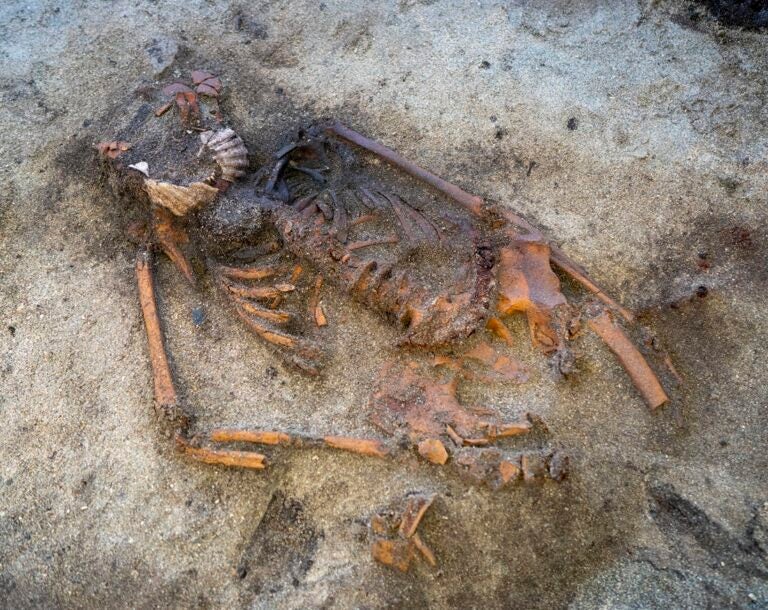
The practice of placing shells on a dead person’s mouth has previously not been documented from any pre-Christian grave in Norway.
In the Middle Ages, scallop shells were associated with the cult of St James, but they have rarely been found in pre-Christian graves.
“We don’t yet know what the symbolism means,” said Mr Sauvage, head engineer at the Norwegian university’s Department of Archaeology and Cultural History.
The shells were placed with their curved sides facing outwards in a way that they partially covered the deceased woman’s mouth.
Among other artefacts found in the grave are two oval brooches that attach to the straps of a suspender dress and a small ring buckle closing the neck opening of a petticoat.
Some bird bones, likely from the wings, were also found, researchers said, adding that these artefacts likely communicated some symbolic meaning to those who witnessed the burial.
Archaeological excavations at the site began after metal detectorist Roy Søreng first discovered an oval brooch in Trøndelag County and reached out to researchers.
A previous excavation in the area had found another skeleton, which researchers said likely belonged to an individual two to three generations older than the latest find.
Scientists hope to examine the latest skeleton further, analyse DNA samples, preserve the objects, and take more samples for dating.
They hope to learn more about the woman and her possible kinship to the previous find.
Join our commenting forum
Join thought-provoking conversations, follow other Independent readers and see their replies
Comments
Bookmark popover
Removed from bookmarks