US official time slowed down by a few microseconds last week due to power outage, watchdog says
Atomic clocks went out of sync after a severe windstorm knocked out power at a Denver laboratory and a backup generator failed
A power outage at a key atomic clock facility led to the US official time slowing down by just under five millionths of a second last week, the country’s time watchdog said.
A severe windstorm knocked out power at the Denver laboratory of the National Institute of Standards and Technology (NIST) on 17 December and a backup generator subsequently failed, disrupting systems critical for maintaining the time standard.
The official time is calculated as the weighted average of the NIST’s 16 atomic clocks, which use the natural resonant frequencies of atoms to tell time with extremely high accuracy.
The power disruption resulted in the NIST universal coordinated time slowing down by 4.8 microseconds, NIST spokesperson Rebecca Jacobson said in a public email.
For comparison, it takes a person about 350,000 microseconds to blink.
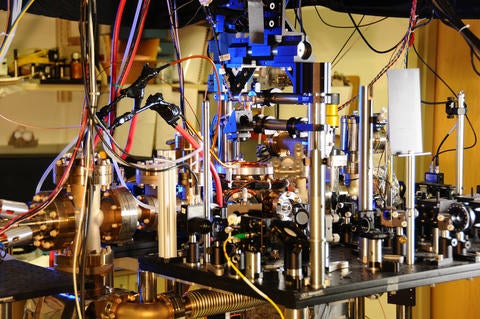
It was only a tiny deviation in the reference time scale maintained by NIST, which said it immediately informed organisations to reference other sources.
Battery backup kept individual atomic clocks running uninterrupted, but disrupted the sync between the clocks and systems measuring and disseminating the official time.
The NIST said it was quick to restore backup power by activating a diesel generator the facility had kept in reserve.
“We regained some monitoring ability, showing that the disseminated UTC signal likely did not deviate by more than 5 us (five millionths of a second) and appeared stable,” Ms Jacobson said in the email.
Although the deviation was much smaller than what most organisations would notice, it could matter for some "high-end" systems relying on extremely precise timing, such as GPS and satellite navigation, telecommunications networks, and high-frequency financial trading.
“Such precision is important for scientific applications, telecommunications, critical infrastructure, and integrity monitoring of positioning systems,” Jeff Sherman, NIST group leader, said in an email.
“However, the most popular method based on common-view time transfer using GPS satellites as ‘transfer standards’ seamlessly transitioned to using the clocks at NIST's Ft. Collins campus as a reference standard.”
This feature, Mr Sherman said, mitigated the impact to many users of the high-precision time signal.
Join our commenting forum
Join thought-provoking conversations, follow other Independent readers and see their replies
Comments
Bookmark popover
Removed from bookmarks