Blue sharks can change colour like chameleon, scientists find
Study finds skin colour of blue shark grows darker when it swims deeper
Unique structures on the skin of the blue shark suggest it may be able to change colour like a chameleon, according to a new study.
The study, presented this week at the Society for Experimental Biology conference in Antwerp, reveals tiny nanostructures in the skin of the blue shark, Prionace glauca, that produce their colouration. The secret to the shark's colour lies in the pulp cavities of the scales that armour the skin, known as dermal denticles.
“Blue is one of the rarest colours in the animal kingdom, and animals have developed a variety of unique strategies through evolution to produce it, making these processes especially fascinating," Viktoriia Kamska, a researcher who participated in the study, said.
Crystals of the molecule guanine within the pulp cavities act as blue reflectors. In addition, cell components containing the pigment melanin absorb other wavelengths to produce the shark’s characteristic colour.
“These components are packed into separate cells, reminiscent of bags filled with mirrors and bags with black absorbers, but kept in close association so they work together," Dr Kamska explained.
The melanin collaborates with guanine crystals of specific thickness and spacing to enhance the shark’s colour saturation of the skin.
"When you combine these materials together, you also create a powerful ability to produce and change colour," Mason Dean, another researcher, said.
"What's fascinating is that we can observe tiny changes in the cells containing the crystals and see and model how they influence the colour of the whole organism.”
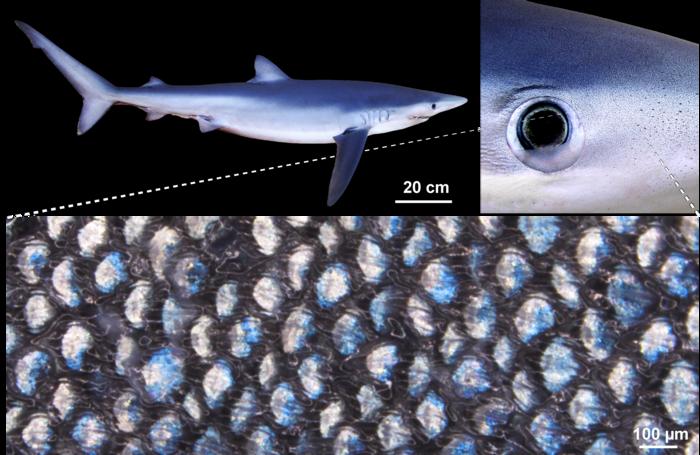
The research was made possible by advanced imaging techniques to characterise the form, function and architectural arrangements of the tiny colour-producing structures.
"We started looking at colour at the organismal level, on the scale of meters and centimetres, but structural colour is achieved at the nanometer scale, so we have to use a range of different approaches," Dr Dean said.
Researchers then used computational simulations to confirm which structural parameters of the tiny skin structures were responsible for producing the observed appearance.
They showed that this mechanism of colour change could also be driven by environmental factors that would affect the guanine crystal spacing.
"In this way, very fine-scale alterations resulting from something as simple as humidity or water pressure changes could alter body colour, which then shapes how the animal camouflages,” Dr Dean said.
When the shark swims deeper, for instance, more pressure acts on the skin, causing the guanine crystals to be pushed together and darken the shark's colour to better suit its surroundings.
The mechanism by which these tiny structures behave may also be changing the shark’s skin colour. "Such a multi-functional structural design – a marine surface combining features for high-speed hydrodynamics and camouflaging optics – as far as we know, hasn't been seen before,” Dr Dean said.
Join our commenting forum
Join thought-provoking conversations, follow other Independent readers and see their replies
Comments
Bookmark popover
Removed from bookmarks