‘Cyborg’ beetles could help rescue crews locate survivors after natural disasters
Australian researchers were able to control darkling beetles with removable electronic backpacks
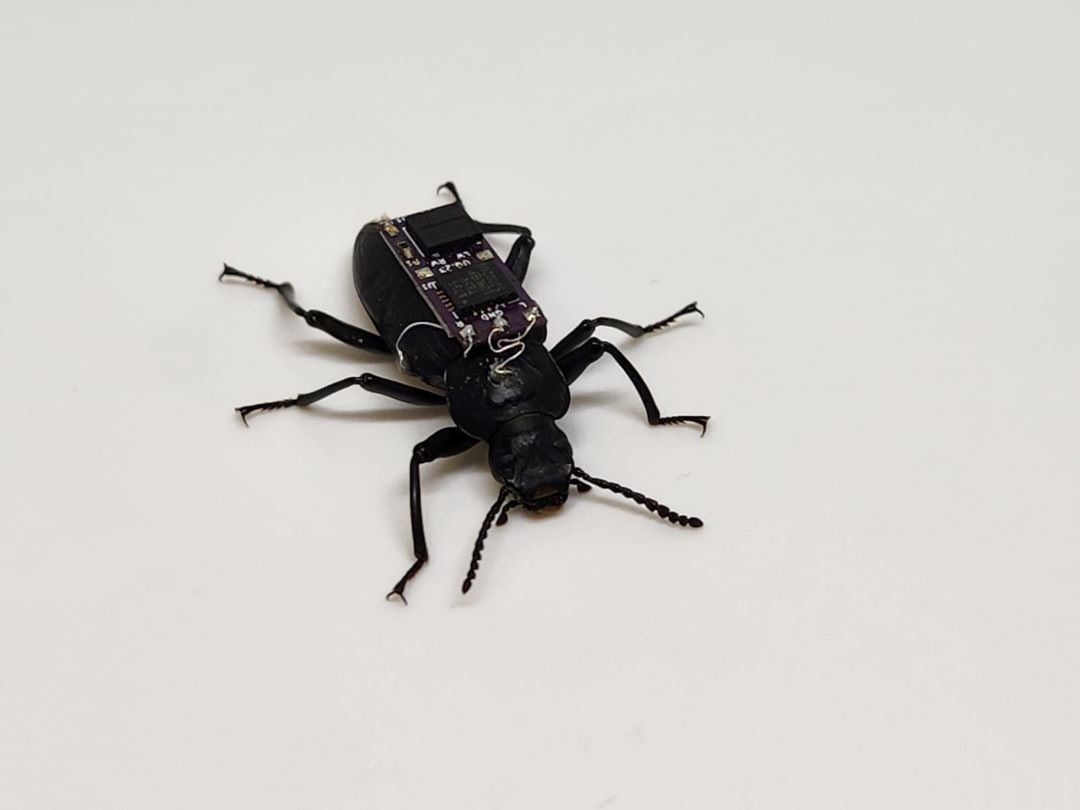
Remote-controlled “cyborg beetles” could be used to help discover people trapped in collapsed buildings or mines, research has revealed.
Australian scientists equipped darkling insects with removable backpacks which could be controlled with a video game remote.
University of Queensland researcher Dr Thang Vo-Doan, who led the study, said the backpacks controlled the insect’s antenna and forewings through the use of electrodes.
“Beetles possess many natural gifts that make them the masters of climbing and manoeuvring in small, complex spaces such as dense rubble, that are difficult for robots to navigate,” Dr Vo-Doan told Scimex.
“Our work harnesses these gifts and adds programmable controls that allow for precise directional guidance, without affecting the lifespan of the beetle.”
Research Assistant Lachlan Fitzgerald added that the insects could be guided to move side-to-side and up vertical walls.
“While robots at this scale have made strides in locomotion, the transition from horizontal surfaces to walls remains a formidable challenge for them,” Mr Fitzgerald said.
He said the insect’s “sophisticated sensing capabilities” and “soft environmental interactions”, which a synthetic bug would not have, are perfect for disaster environments.
Dr Vo-Doan said while a tethered power supply had been used for the climbing test, the beetles had also demonstrated the ability to climb with a battery equivalent to its own body weight.
“If people have been trapped under an extensive amount of rubble, you want to be able to find them as quickly as possible and start planning how to get them out,” Dr Vo-Doan said.
“We hope to produce a tool that can easily move through chaotic environments to pinpoint a person’s exact location, provide clues to any injuries, and give rescuers a picture of what needs to be done to free them”.
In 2016, Singaporean scientists were able to control stag beetles by attaching a similar device to the insect’s back.
Professor Hirotaka Sato, who worked on both projects, said at the time: "This technology could prove to be an improved alternative to remote-controlled drones as it could go into areas which were not accessible before."
"For example, it could be used in search-and-rescue missions as it could go into small nooks and crevices in a collapsed building to locate injured survivors."
Join our commenting forum
Join thought-provoking conversations, follow other Independent readers and see their replies
Comments
Bookmark popover
Removed from bookmarks