Study finds homosexuality surprisingly common among primates
Same-sex intimacy more common in species living in harsh environments or complex social systems
Some 60 primate species, including baboons, chimpanzees and vervet monkeys, express homosexuality, according to a new study that sheds further light on the evolutionary origin of same-sex intimacy.
The findings add weight to the argument that homosexuality doesn’t defy nature and evolution.
Although homosexuality is documented in many animal species, the evolutionary and environmental factors behind it remain unclear.
Studies indicate ecological factors, the life history of the individual and the social structure of a population play a role in its expression.
But a collective analysis of the behaviour across multiple species and their shared drivers is limited so far.
The new study analysed data from 491 non-human primates and found same-sex intimacy in 59 of them, with evidence of repeat occurrence of the behaviour in 23.
The study defined same-sex intimacy as any sexual behaviour directed towards an individual of the same sex – including acts like mounting, genital contact, courtship, copulation-like displays – regardless of whether reproduction was possible.
“It includes all behaviour where the intent is seen to be clearly sexual,” study author Chloe Coxshall, who studies homosexuality in Rhesus macaques, said.
“This can be mounting, genital inspection and stimulation, and also fellatio – all typically considered sexual behaviours between members of the same sex,” Ms Coxshall told The Independent.
The researchers say same-sex intimacy is more common in species living in harsh or dry environments with limited food, like Barbary macaques, as well as those in areas with high predation risk, like vervet monkeys.
Homosexual behaviour is also more common in species with significant differences in size or appearance between the sexes like mountain gorillas, species that live long like chimpanzees, and those with complex social systems and hierarchies like baboons.
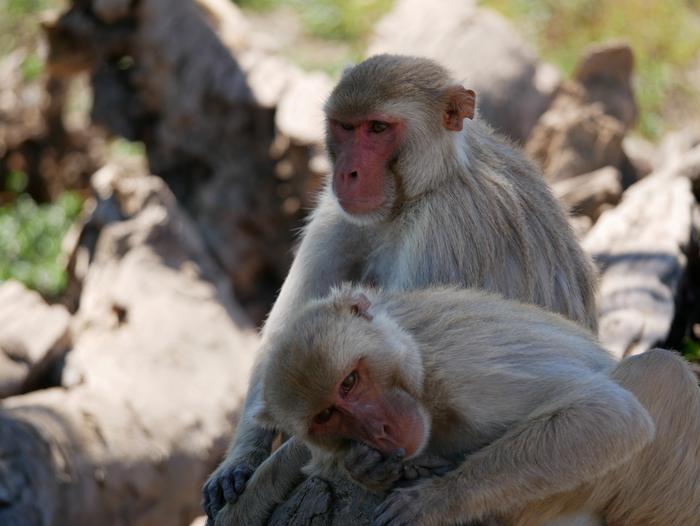
“What we find when we look at species overall is that it is more common in animals that have complex societies, like a strong hierarchy, and complex mating systems where they don’t mate in pairs but will have multiple partners,” Ms Coxshall, who is a PhD candidate at Imperial College London, said.
“So same-sex intimacy seems to be facilitating competitive scenarios, helping keep group harmony in stressful situations like when there are many predators around and making sure the group communicates well together.”
The findings confirm that homosexuality is not straightforward, driven by genetics or any one environmental factor.
Instead, scientists say it emerges from complex interactions between environmental and genetic factors.
The sexual behaviour may be helping primates manage group dynamics given that it is documented in social contexts such as alliance formation and tension reduction.
Due to the commonality of these factors among primates, the researchers speculate a similar set of complex factors may explain homosexuality in modern humans and their extinct ancestor species.
“At one point like 1.5 million years ago there were lots of hominid species living at the same time and they must have experienced the same sort of harsh environments. Here same-sex sexual behaviour may have been expressed in the same way we document in our analysis,” another study author, Vincent Savolainen, tells The Independent.
Scientists, however, caution that in the case of modern humans, self-identity plays a part in sexual orientation.
“In humans, it may not be food scarcity or rigid social hierarchies that drive these patterns, but rather the pressures of modern social living,” they noted in the study published in Nature.
“But how same-sex intimacy is linked to modern humans,” Dr Savolainen said, “we leave that to psychologists and anthropologists to take a look.”
The study also stresses that evolutionary hypotheses “neither determine the validity of individual identities nor diminish their inherent value”.
“We must emphasise that these points remain speculative, and it is critical to guard against misinterpretation or misuse of our findings, for example, a misguided notion that social equality might eliminate SSB in humans,” it concluded.
Join our commenting forum
Join thought-provoking conversations, follow other Independent readers and see their replies
Comments
Bookmark popover
Removed from bookmarks