Charity to expand work to clear explosives in Gaza amid ‘immense’ devastation
The Halo Trust said vast areas are ‘contaminated’ with unexploded bombs, missiles, shells and improvised devices.
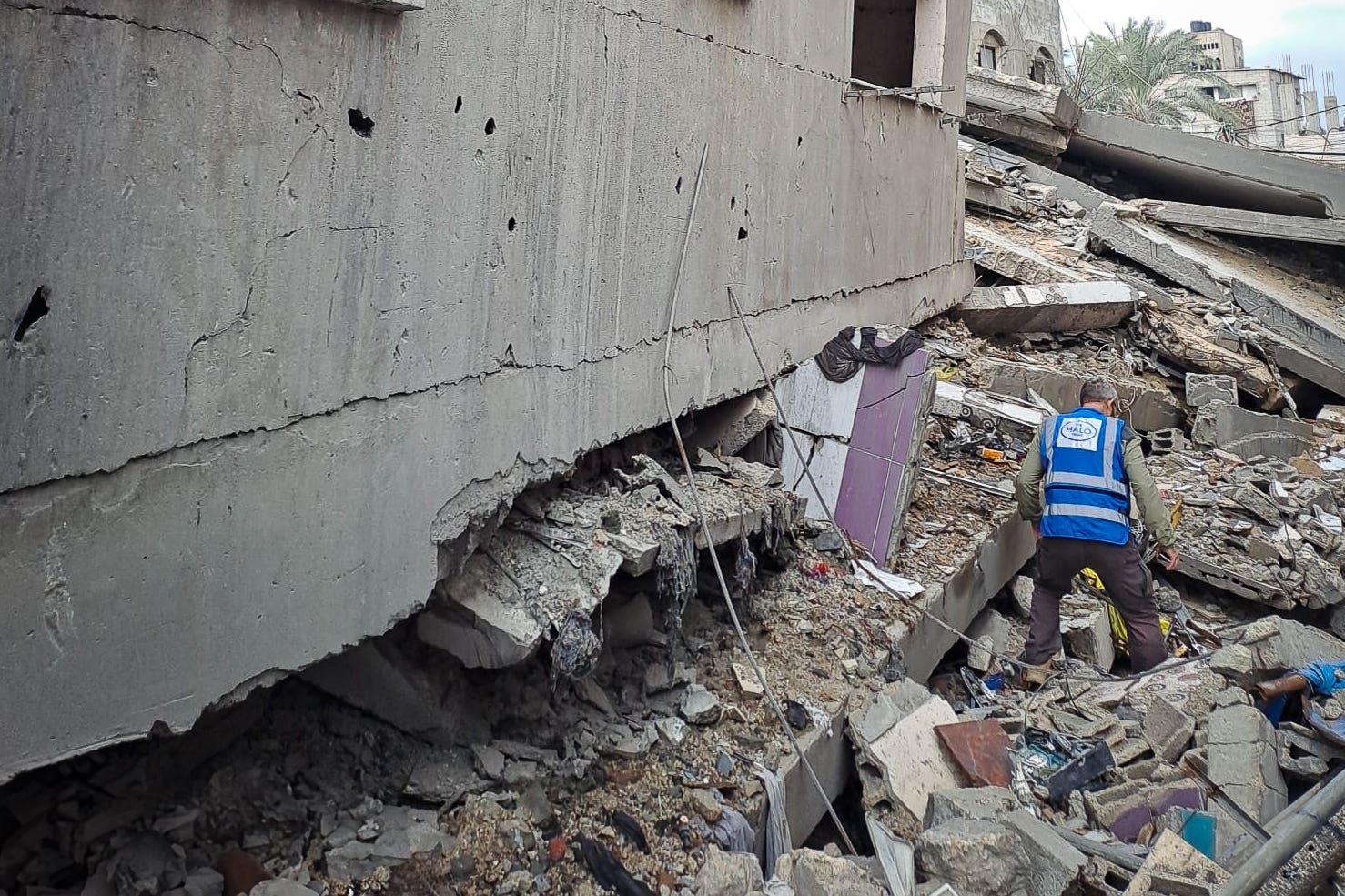
The Gaza Strip will need extensive work to remove explosives and reconstruct amid the “immense” level of devastation caused by the war, the world’s largest landmine-clearing charity has said.
The Halo Trust will be expanding its activities in the Palestinian enclave in 2026, helping to keep people safe from explosives and dangerous debris, as it looks towards reconstruction efforts.
However much depends on the status of the ceasefire in the Israel-Hamas war, which came into effect on October 10.
Palestinian health officials say hundreds of people have been killed by Israel’s military operations since the ceasefire began.
The Halo Trust, which is headquartered in Dumfries-shire, began operating in Gaza this year.
Large areas of the enclave have been “contaminated” with dangerous remnants of the war, such as unexploded bombs, missiles, shells and improvised devices.
The intense nature of the conflict has left large parts of Gaza in ruins, with estimates that 80% of buildings are damaged.
Paul McCann, the Halo Trust’s global head of communications, said the organisation will likely encounter modern military weapons as well as more rudimentary devices as part of efforts to clear dangerous explosives from the rubble.
He told the Press Association: “There’s very modern, very sophisticated air-dropped weapons that take a good amount of understanding to deal with and to safely destroy.”But then at the other end of the scale, you have improvised explosives that there’s no handbook, there’s no manual for them.
“They are often made in small workshops using parts gleaned from other devices and you don’t quite know what you’re dealing with.”
Mr McCann said the densely-populated nature of Gaza will make the decontamination work difficult.
He said: “The challenge there is that it’s so densely populated, so extensively destroyed, that some of the traditional methods – of using a wide cordon, excluding people and destroying something – will be complicated.
“Because you have so many people in such a confined space and nowhere for them to go.”
Nobody knows the extent of the explosive contamination as yet, he said, as work has not begun to dig through the rubble.
He continued: “The destruction is so immense and wide-ranging that the expectation is that there will be an extensive amount of explosive contamination that needs to be dealt with before the place can be safely rebuilt.”
Small teams from the Halo Trust have been operating around areas near where displaced people are sheltering to check for any explosive threats.
He said these teams will expand in January.
Work began this month to spread awareness of the threats through “risk education training”.
This involves teaching trusted locals in the area to show people what kind of hazards to avoid.
The Halo Trust says a five-year reconstruction effort would require it to scale up its operations in Gaza to around 100 bomb disposal teams, though this would cost around £60 million a year.
Mr McCann, a former journalist from Glasgow, said: “The model in Gaza, because of the complexity, is likely to be that we are like a service provider to the reconstruction efforts.”
The Halo Trust has also recently marked one year since the fall of the Assad regime in Syria.
This has led to the area it can operate in expanding significantly and the organisation has been kept busy by the demands of clearing explosives from a civil war which lasted more than a decade.
In the last 12 months, there have been around 1,600 civilian casualties from unexploded bombs, of which around 600 were children.
Mr McCann, who was in Syria recently, said the speed of the clean-up operation there will largely depend on international donor funding.
He said: “The thing that’s been most hopeful is the resilience of the Syrian population in the face of a long civil war.
“My colleagues – the effort they put in, the pride they take in the work – is something that really makes your heart sing.”
The Halo Trust has destroyed around 9,000 mines, bombs and other explosive devices, including just over 7,000 in the year since Assad fell.
Of its 253 staff in the country, 71 are women – with 62 trained in operational roles such as survey and bomb disposal.
Bookmark popover
Removed from bookmarks