Why is a by-election for the Welsh Senedd so important for the UK?
Voters in Caerphilly go to the polls on Thursday in a contest that points the way for Wales – and possibly the whole of Britain at the next general election, writes John Rentoul


This week’s by-election in Caerphilly may end up being the only one in the history of the Wales Senedd. Caused by the death of Labour member Hefin David, it is the first since the Welsh assembly changed its name to the Senedd five years ago; next year, a new Senedd will be elected by a new proportional system that abolishes by-elections. Under the closed list system, any vacancy will be filled by the next person on that party’s list.
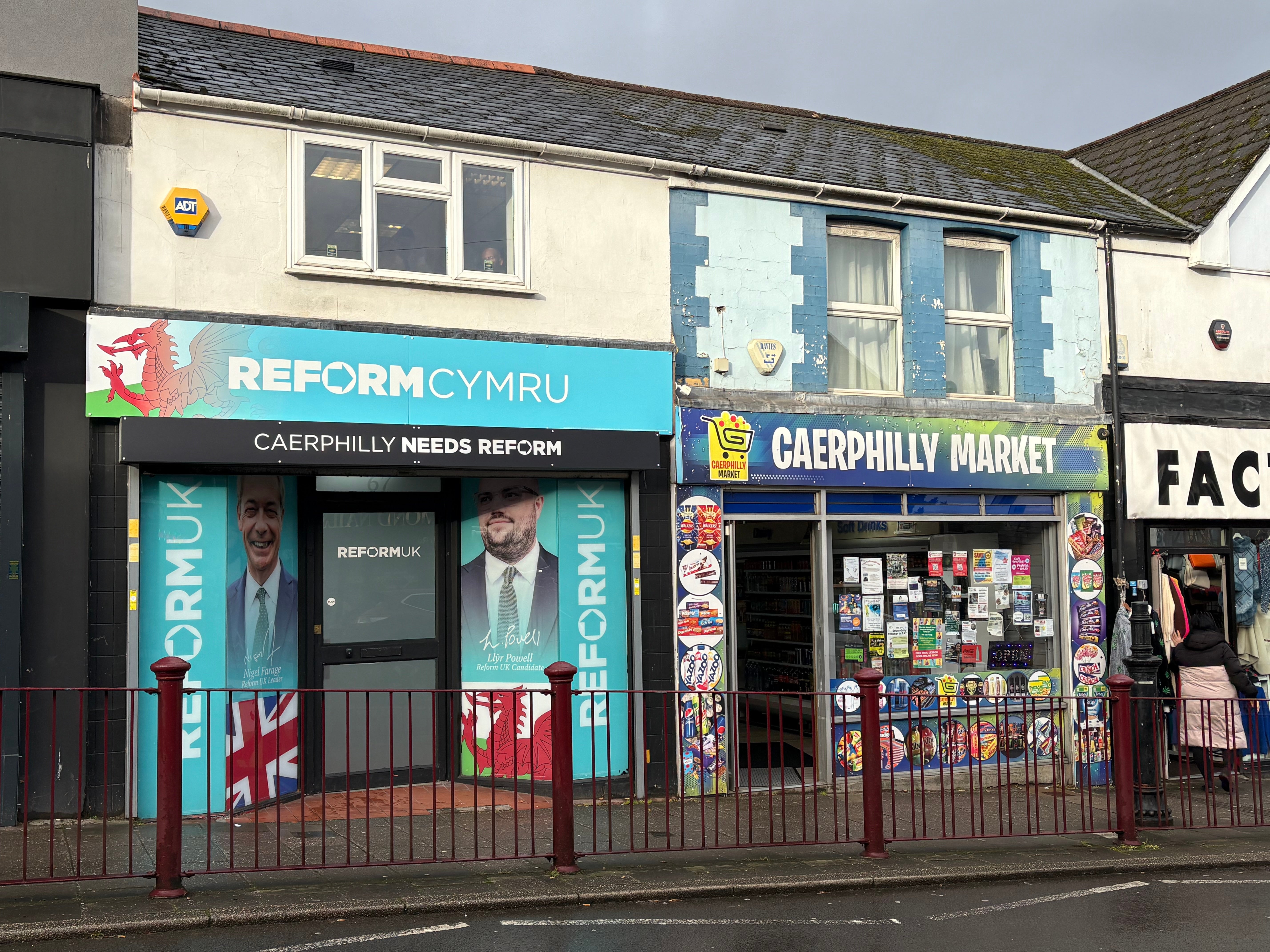
The contest has also become a significant pointer to the changing shape of Welsh politics, where the rise of Nigel Farage’s Reform party could have implications for the next general election in the whole of Britain.
Why is Wales a Reform target?
Nigel Farage launched Reform’s manifesto – sorry, its “Contract” – in Merthyr Tydfil in the general election campaign last year, after he made the shock decision to return to the leadership of the party. Even then, Farage could read the opinion polls and judge that Wales was promising territory for Reform.
Since the general election, Reform has gained ground in Wales, as has Plaid Cymru, the Welsh nationalist party. The two parties are vying for the lead in the opinion polls, while Labour has dropped below 20 per cent support and the Conservatives to below 10 per cent.
Labour’s Eluned Morgan is first minister, governing with 30 of the 60 seats – neither a majority nor a minority government. An agreement by which Plaid gave Labour limited support came to an end last year. Morgan has been able to carry on, but Labour’s prospects at the elections for a new Senedd next May look bleak.
Who is going to win the by-election?
Probably not Richard Tunnicliffe, the Labour candidate. There has been only one opinion poll in the constituency. Survation put Reform four points ahead of Plaid, with Labour far behind. A Wales-wide poll by Beaufort Research this month put Reform ahead of both its rivals, seven points ahead of Plaid, which was in turn just one point ahead of Labour, which has been the leading party in Wales for most of recorded history.
Constituency polling is difficult, so it is hazardous to predict who will win, but it would be quite an upset if Labour, which has won every election in this seat for a century, were to hold on. The Independent’s Holly Evans interviewed one resident who said: “I don’t know anyone who is voting Labour.”
What will happen next year?
It looks likely that Labour, which has formed the government of Wales since the devolution of power to the assembly in 1999, will lose control. It is an open question this far out from the Senedd elections whether Plaid or Reform will come top, but if Labour does badly in the Caerphilly by-election it will point towards Rhun ap Iorwerth, the Plaid leader, becoming first minister next May.
This is because, even if Reform becomes the largest party in the new Senedd, it is unlikely to win a majority of the seats. To do so under the new proportional system it would have to win more than 50 per cent of the votes.
As things stand in the opinion polls, Reform and the Tories together account for only 37 per cent of the vote. A “rainbow coalition” of Plaid, Labour, Liberal Democrats and Greens would probably have a majority, and so the Plaid leader, at the head of the largest party in an anti-Reform alliance, would have best claim to be first minister – and a historic breakthrough for the nationalists.
And what would that mean for the UK?
The ideal result for Farage would be for Reform to be the largest party, so that he can claim to have “won” the election, without having to take responsibility for government – including the NHS in Wales, which has long been held up by the Tories as an example of Labour mismanagement.
Even without the burden of office, however, Reform politicians in Wales have not been a great advert for the party. Nathan Gill, a former MEP who was the leader of Reform in Wales until 2021, pleaded guilty last month to bribery, in relation to pro-Russian and anti-Ukrainian statements he made in the European parliament.
Farage claimed to be “stunned” by the case, and said: “I didn't know anything about it.” So far, the scandal has not stopped Reform’s rise in Wales. On the contrary, a victory in the Caerphilly by-election would set Farage up for a further advance.
Join our commenting forum
Join thought-provoking conversations, follow other Independent readers and see their replies
Comments
Bookmark popover
Removed from bookmarks