Fear in Minneapolis as ICE agents terrorise city: ‘I haven’t left my home in five weeks’
Maria* tells chief international correspondent Bel Trew how she dare not leave her home despite living in the US for 25 years and having an American-born son. Schoolchildren and US veterans are among thousands of residents in Minneapolis unable to go about their lives as ICE agents continue their crackdown

Pastor Sergio Amezcua scans the cars lining this residential street in Minneapolis, to check whether ICE agents might have followed. He looks up at a helicopter circling overhead.
“Do you think that’s been tracking us?” he asks, concern edging his voice.
From the back of his truck, he pulls out a large box of supplies and scans the street again.
He is here to deliver food to a Latino member of hingregation at Dios Habla Hoy Church who, despite living in the United States for 25 years and having a son with an American passport, has been too afraid to go outside for five weeks.
Maria* (not her real name) fears she could be seized by some of the thousands of federal agents deployed to the city under president Donald Trump’s deadly immigration crackdown.
So when the pastor knocks at her apartment, she is nervously hiding behind the front door, shaken by an unknown man standing there, who claims to be a delivery driver but is acting strangely.
“I was scared he was trying to get in. I am terrified. I can’t sleep at night,” she says, after finally being convinced to let us in.
As she speaks, she is trying to calm her dog, who has barely been outside for weeks and is running frantic loops around her tiny apartment.
She is running out of money as she hasn’t been able to work since December.
“One man I know was grabbed from his job inside McDonald’s. His son can’t even get his medicine to him inside the detention centre.
“I feel like I’m in jail here. Sometimes I cry and hide so my son doesn’t see me.”
The Department of Homeland Security says in the last few weeks alone more than 3,000 people have been detained. Among them children as young as five and US citizens.
Journalists covering protests have been arrested, and at least two citizens have been shot dead while witnesses told The Independent they were acting as observers.
Pastor Amezcua, who initially voted for Trump, prays with a sobbing Maria, helping her to calm down.
He says that since the launch of the administration’s “Operation Metro Surge”, his church is now feeding around 150,000 people, most of them too terrified to leave their homes for fear of arrest, despite some being US citizens or having legal paperwork.

“They’re racially profiling people, especially Latinos. This is the huge problem.
“Attendance at Latino churches in Minnesota is down 80 per cent because people are afraid to come out. But half of my congregants are born in the US, and they are still afraid to come out. That is not just immigrants, this affects the entire community.”
It’s so bad, he continues, “it feels like ethnic cleansing.”
This is Minneapolis – a vibrant city of nearly half a million people – where fear and suspicion now crackle through the streets. The situation is so bad that residents have likened it to living under an authoritarian regime.
This is since the city became a central target of Trump’s promised immigration crackdown. Citing crime control, he has deployed federal law enforcement to several Democrat-led cities, including Los Angeles, Chicago, Washington, DC, and Portland, Oregon.
The Department of Homeland Security has hailed the Minnesota operation as a “huge victory for public safety,” claiming more than 3000 “criminals” have been arrested, including “vicious murderers”.

Minnesota’s attorney general has unsuccessfully sought to block the operation (a federal judge declined to issue a halt order on Saturday).
But fury at the crackdown has gripped the state – and the nation – sparking mass protests and country-wide strikes.
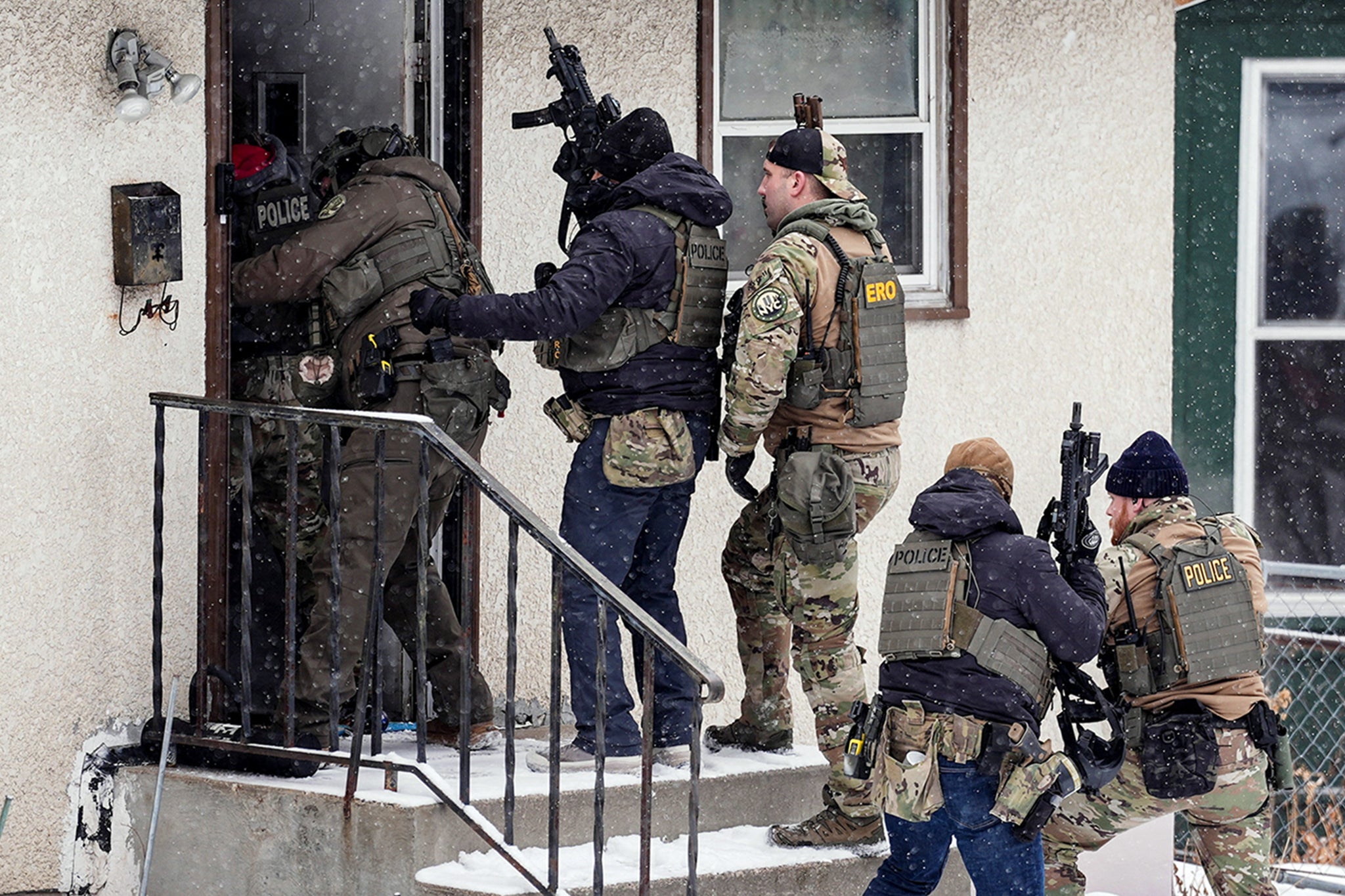
In the last few weeks, ICE operations have only intensified: disturbing footage has emerged showing federal agents violently seizing people, shooting observers, firing on civilians, and tear-gassing crowds. The Independent reached out to the DHS for comment on the criticism but has yet to receive a reply.
The rage has inspired an underground network of volunteers. Working through encrypted messaging apps, and in code, they track federal agents’ movements to warn at-risk communities, and deter agent activity.
Others, like Pastor Amezcua’s church, try to keep people too afraid to leave their homes fed and alive.
The schools have stepped in, especially after Liam Ramos, a five-year-old Ecuadoran asylum seeker, was photographed in a bunny hat and a Spider-Man backpack being taken away by ICE agents as his father was seized during school drop off.
Zena Stenvik, the superintendent for Liam’s school district, said neighbours witnessed ICE agents even try to use Liam as “bait” to lure his mother out of their home. Liam was deported with his father to a detention centre in Texas.
After nationwide outrage, he was finally released back to Minnesota on Sunday.
But he is one of seven students from Stenvik’s district alone who have been detained in recent weeks by ICE. And so the schools are taking no chances.
‘We feel hunted. We are under siege’

Stenvik says the teachers are now chaperoning children to school, organising ride-shares, banning outside recess and patrolling streets near school grounds, to ensure parents and children are not abducted on route to class. Twenty per cent of their students are learning online at home.
“We feel hunted. We are under siege,” Stenvik continues, describing armed ICE patrols circling the school perimeters.
“Young children are asking if their parents will be home when they return from school, or if they might be snatched on the way.”
Jason Kuhlman, principal of Liam’s school, says the school was forced to deliver two children into custody on Thursday when their mother, also an asylum seeker, was arrested outside a courthouse following a mandated check-in for an asylum plea.
The boys had no other family in the country. Their mother had an impossible choice: allow her children to be swallowed into state foster care while she is deported, or be reunited in prison.
“All we could do was pack their backpacks with food and supplies. We were crying with them,” Kuhlman says, describing the moment he was forced to take them into Minnesota’s Whipple detention centre.
“We don’t take children to jail. That’s not our job. Our job is to educate,” he adds with emotion.
“We were afraid we’d never see them again.”
‘I am a white female veteran – if it can happen to me, it can happen to you’

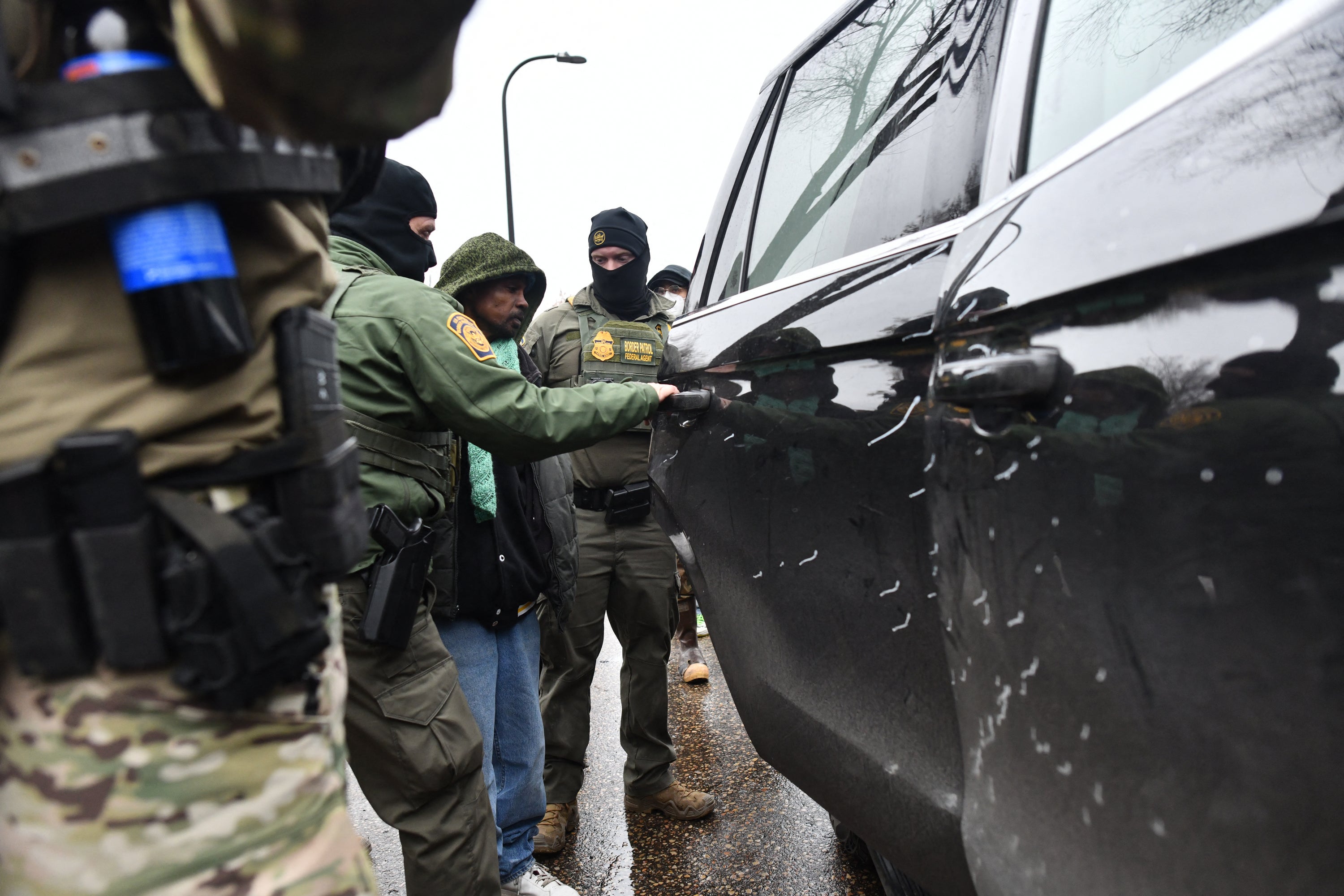
“You f**king move, I’ll f**king taser you. Get the f**k out of the car right now,” screams the masked and armed agent, giving contradictory orders as he points a Taser just a few centimetres away from the face of the passenger, who is filming.
This mobile phone footage was shot by a US veteran, who, together with her friend Skye, a disabled Marine veteran, was patrolling areas of Minneapolis following ICE convoys on 11 January.
Moments earlier – as seen in the video – Skye, who is in her 30s, says agents had smashed the driver’s window next to her.
In the footage, agents can be seen dragging her headfirst from the car and aggressively pinning her to the ground.
“They had me on my stomach, kneeling on me,” Skye tells The Independent, showing the bruises still on her arm. “My arm was wrenched back right up my head, my ankles in a lock.”
She is still shaken by the experience which happened just four days after Renee Good, a mother of three, was shot dead in Skye’s neighbourhood while, city leaders later said, she had also been acting as a legal observer of ICE activity. (Citizens have a First Amendment right to film law enforcement doing their job as long as they don’t interfere.)
Skye was held briefly held at Whipple detention centre, questioned and later released. She does not know whether she faces formal charges.
She left town for a week, worried she might be picked up by agents again. On her return, she found another masked agent parked outside her apartment.
“He aggressively approached me and started taking photos,” she continues, showing me a photograph of the officer.
”It’s a constant worry they’ll come back. I haven’t been able to take a breath or relax.”
As we drive around town, she clocks the telltale signs of ICE agents, like cars with out-of-state number plates or no front plates.
She adds quietly that she is afraid she’ll “end up in a concentration camp”.
“I am a white female veteran: if it can happen to me, it can happen to you,” she warns.
‘When the president calls your community garbage, you worry’
At the sprawling Karmel Mall – famously the largest Somali shopping centre in the country – even US passport holders are afraid to move around.
In this once-bustling hub in the southern area of the city, businesses are shuttered; the owners of those stores still open are reluctant to speak.
ICE agents have already staged raids here: there are posters everywhere saying “ICE out” and telling federal agents they cannot enter.
“It feels dystopian,” says Khalid, 24, a Somali-American student, whose mother has not left the house in a month, despite being a US citizen.
One of Khalid’s cousins was detained during an ICE raid on their apartment building, then later released without explanation. His mother also fears the administration may begin denaturalising citizens like her who were born outside of the US.
“Most of us are American-born citizens. But when the president calls your community ‘garbage’ and targets people based on how you look, you worry.”
Trump – who called America’s Somali population “garbage” and Somalia a “sh**hole” in December – initially blamed the deployment of federal agents to Minneapolis on an investigation into alleged multi-billion-dollar fraud within Somali-run daycares.
Minnesota is home to more than 120,000 Somali residents, the largest population outside of Somalia, says Jaylani Hussein, a community leader and executive director of the Minnesota chapter of the Council on American-Islamic Relations.
The overwhelming majority are citizens, green-card holders, or have paperwork, he explains.
“There has been mass panic since Somali refugees were suddenly targeted two weeks ago, despite arriving legally and being on lawful pathways to citizenship,” he continues, as we sit in the mall.
“Many were shipped immediately to detention in Texas. We were able to get a lot of them back through legal challenges, but it sent shockwaves through the community.”
A few days ago, a federal judge issued a temporary restraining order, blocking the arrest and detention of lawfully admitted refugees in Minnesota, providing some relief, he continues. But fear persists.
“It’s chaos.”
‘This is about terrorising, not only undocumented people, documented people and residents’
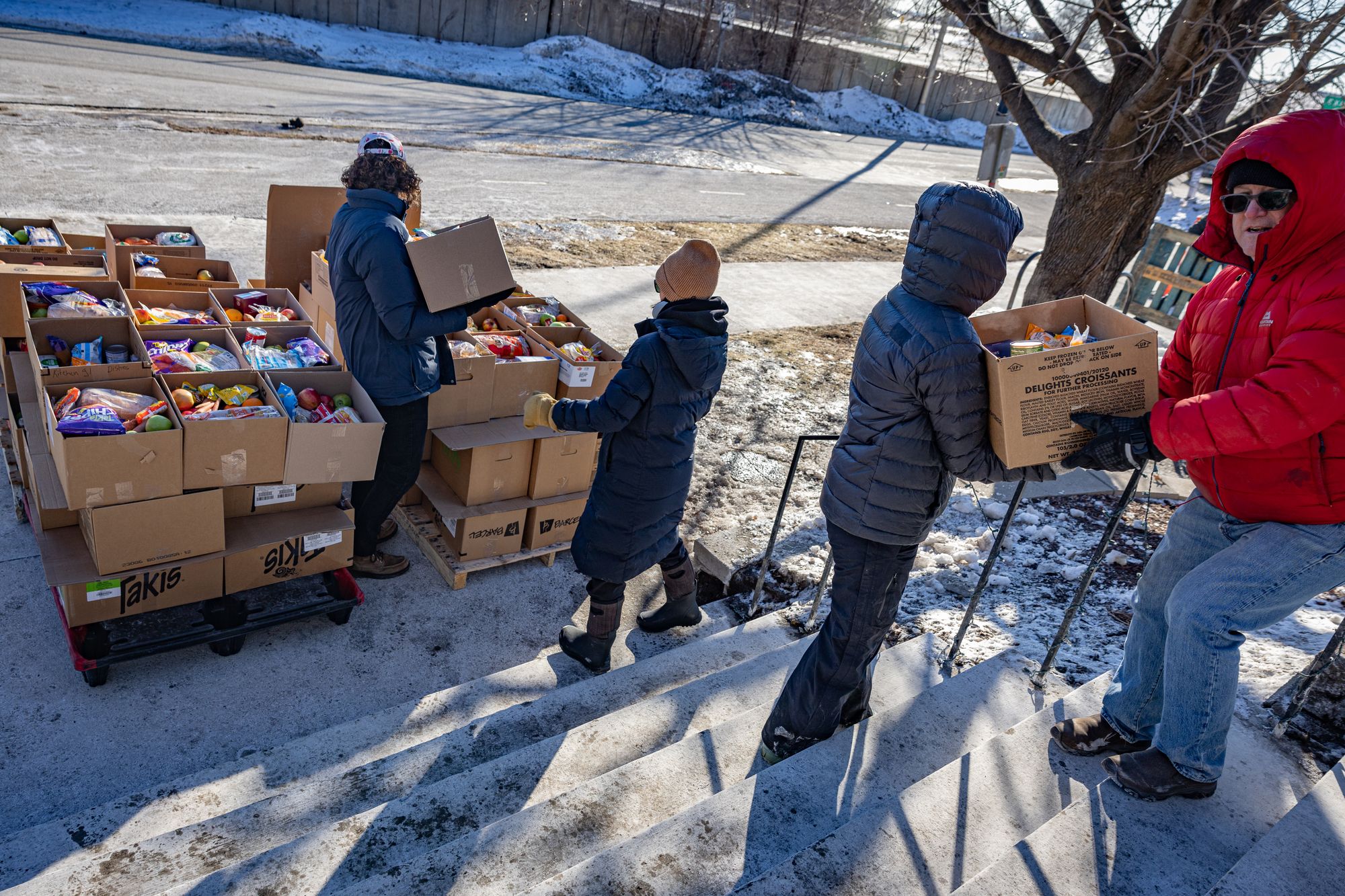
Back at the Dios Habla Hoy Church, volunteers with their own cars are ready to ferry supplies to those who are too afraid to go to the grocery store.
All of them have been vetted and trained in techniques like evading ICE surveillance to protect the vulnerable people they are visiting. They line up to receive the Signal group chat of the day, and code names for addresses in case those chats are infiltrated.
Laura, 64, a resident of Minneapolis, is volunteering 60 hours a week now.
Like many people The Independent has spoken to, she believes this is not only about immigration but about punishing Minneapolis, which, since Trump’s first term in office – with the protests against the murder of George Floyd – has been a heartland of dissent.
“This is about terrorising, not only undocumented people, but documented people and residents. This is authoritarianism,” she continues.
Pastor Amezcua says they will keep going for as long as it takes, but they need Congress and the Supreme Court “to do their jobs”.
“We want our kids to be able to go outside and play or go to school,” he concludes, at the end of another busy day.
“We need checks and balances of the executive branch. [Congress] needs to stop being cheerleaders of this agenda. So we can continue to keep the American dream alive.”
Join our commenting forum
Join thought-provoking conversations, follow other Independent readers and see their replies
Comments
Bookmark popover
Removed from bookmarks