From dramatic capture in Venezuela to a New York courtroom: How Maduro’s extraordinary arrest unfolded minute by minute
Nicolas Maduro was snatched from Venezuela by the U.S. military, throwing the country’s future into chaos. James C. Reynolds reports on how operation Absolute Resolve was planned and executed
Donald Trump’s operation to oust Venezuelan president Nicolas Maduro at the weekend stunned the world, drawing condemnation and support alike.
The deposed dictator was removed from power in the early hours of Saturday morning, when U.S. operatives swooped on Caracas and airstrikes rained down on military bases and airfields.
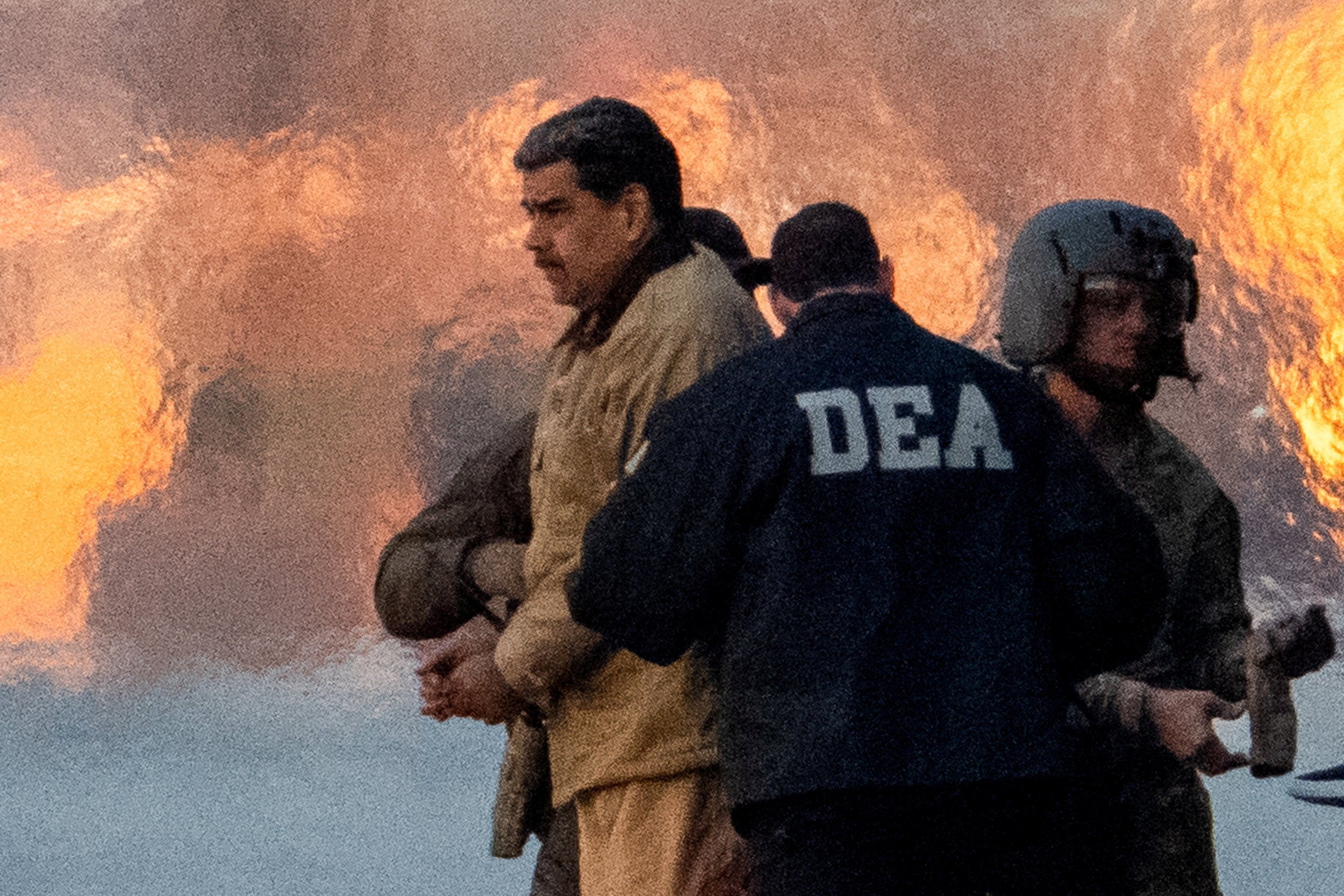
Maduro and his wife Cilia Flores were hauled out of the capital and moved to an assault ship in the Caribbean, passing through Guantanamo Bay before flying on to New York to face narco-terrorism charges.
The former president appeared in court in Manhattan Monday to plead not guilty to federal charges, his first appearance in what is likely to be a drawn-out legal fight.
The Independent looks at how the U.S. snatched one of the most closely-guarded leaders in the world from his home, and the key moments of the past few days.
All times are in Eastern Standard Time (GMT-5) unless stated otherwise.
Friday, 2 January
10.46pm: Trump gave the go-ahead for U.S. air strikes in Venezuela after months of planning for an operation dubbed ‘Absolute Resolve’.
A small team of U.S. spies had been monitoring Maduro’s every movement, from where he ate to what he wore. Forces trained for the mission using a full-size replica of his home compound and blowtorches capable of cutting through steel walls.
With plans finalised in December, the mission had been set back by poor weather conditions for days, officials told NBC. But with Trump’s signal just two days into the new year, some 150 aircraft took off for Caracas from 20 bases on land and sea.
Bombers and fighters were flanked by reconnaissance and surveillance planes as U.S. forces closed in under the cover of night. Aircraft took out Venezuelan air defences to clear a path for helicopters.
The whole operation took around two-and-a-half hours to execute from start to finish.

Saturday, 3 January
1.01am: Strikes were simultaneously reported at multiple locations in Caracas including La Carlota airport as well as the Port of La Guaira and Higuerote airport. They lasted around 30 minutes, the Venezuelan government said.
U.S. forces arrived at Maduro’s compound in Fort Tiuna, Caracas, after power to the city was cut. Trump later described the building as a “heavily fortified military fortress”.
An elite special forces unit called Delta Force gained access to the compound to capture Maduro. The president tried to escape into a steel safe room as special forces breached the compound, but was unable to shut the heavy metal door in time, according to Trump.
A firefight broke out as Maduro was snatched, and a U.S. helicopter was hit in the fracas. Several American troops were injured but were in a stable condition, officials said.
Cuba said 32 of its citizens were killed during the operation, falling “after fierce resistance, in direct combat against the attackers or as a result of bombardments of installations”.
Venezuelan first lady Cilia Flores allegedly suffered “significant injuries” during her arrest, including a possible rib fracture and bruising, her lawyer later claimed.
3.29am: American forces were “over the water”, on their way back from Venezuela and headed for ships stationed in the Caribbean.
4.21am: Trump posted on Truth Social to say the U.S. had carried out a “large scale strike” in Venezuela and captured Maduro.
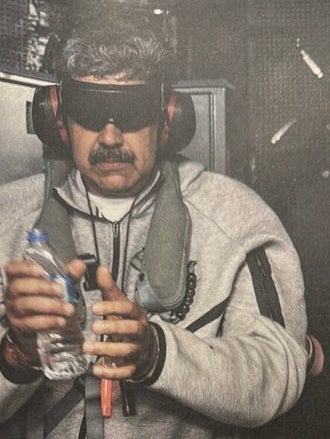
Confusion ensued as Delcy Rodriguez, then vice president, demanded proof of life. Maduro was pictured on board the USS Iwo Jima, blindfolded and in handcuffs.
Trump’s secretary of state, Marco Rubio, would later call Rodriguez to discuss her role in governing the country.
11:40am: Trump hosted a press conference from Mar-a-Lago, outlining a vague plan to “run” Venezuela until a transition of power can occur.
He told taxpayers the U.S. will “get reimbursed for everything that we spend”, noting that “the money coming out of the ground is very substantial” in oil-rich Venezuela.
“We'll have the greatest oil companies in the world going in, invest billions and billions of dollars. ... And the biggest beneficiary are going to be the people of Venezuela,” he insisted.
Maduro was then flown out to the United States via Guantanamo naval base. He was met by the FBI, who had a 757 government plane waiting on the airstrip to bring them to Stewart Air National Guard Base, north of New York City.
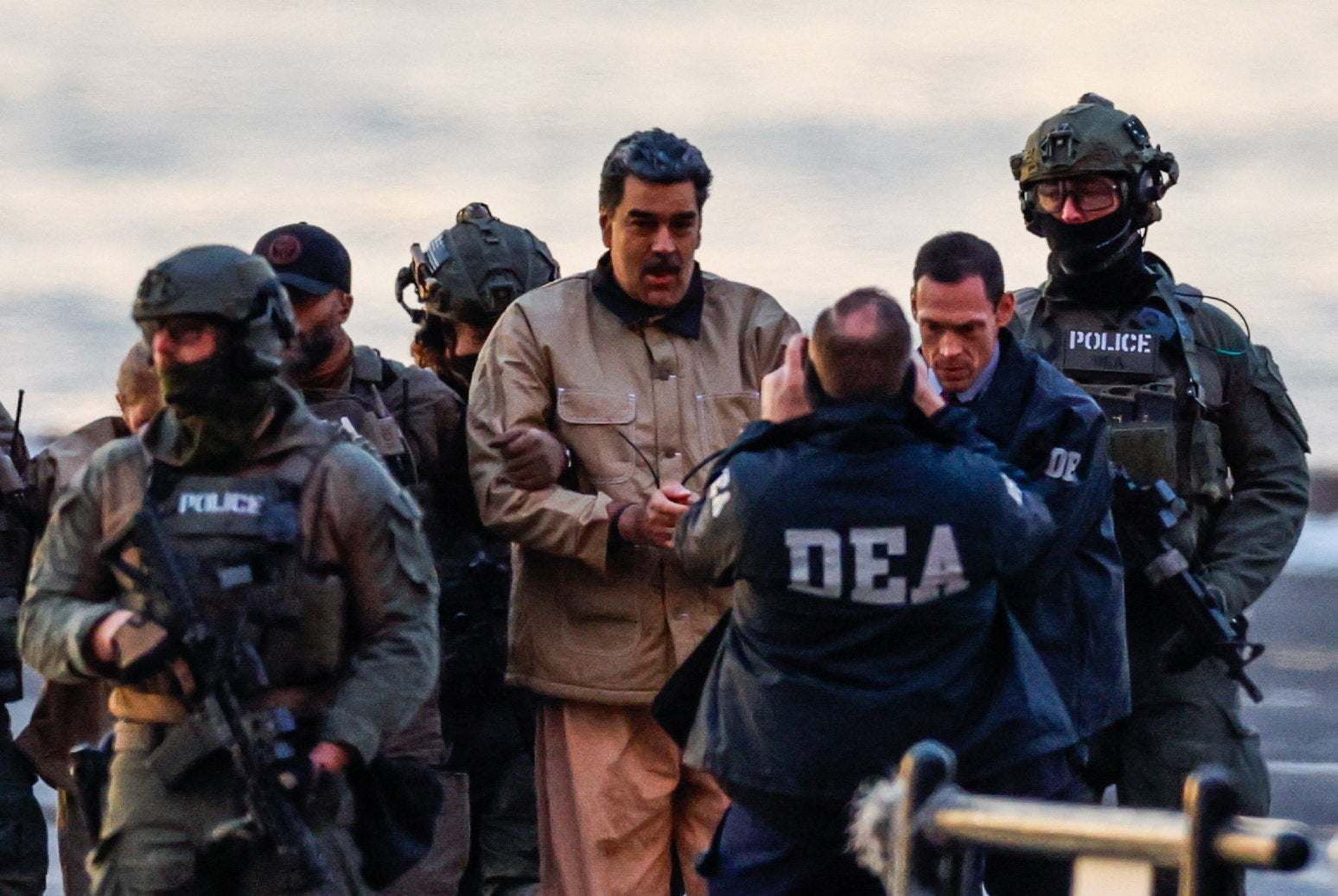
4.31pm: Maduro arrived in New York, landing at Stewart Airport in New Windsor, north of New York City some 2,100 miles from Caracas.
He was taken to Drug Enforcement Administration in Manhattan around 7pm, then on to the Metropolitan Detention Center in Brooklyn by 9pm.
Sunday, 4 January
Speaking to reporters on board Air Force One, Trump said that Venezuela was “sick” and needed U.S. support.
He threatened that “Colombia’s very sick too. Run by a sick man who likes making cocaine and selling it to the United States.”
Asked whether that could spell a future intervention to oust socialist leader Gustavo Petro, Trump said: “Sounds good to me.” Petro later vowed he will “take up arms” for the homeland if called upon.
The same day, Trump revived talk of taking over Greenland amid growing concerns over his next moves. He said the U.S .needs the semi-autonomous Danish community for ‘national security’ reasons, provoking Europe.
Monday, 5 January
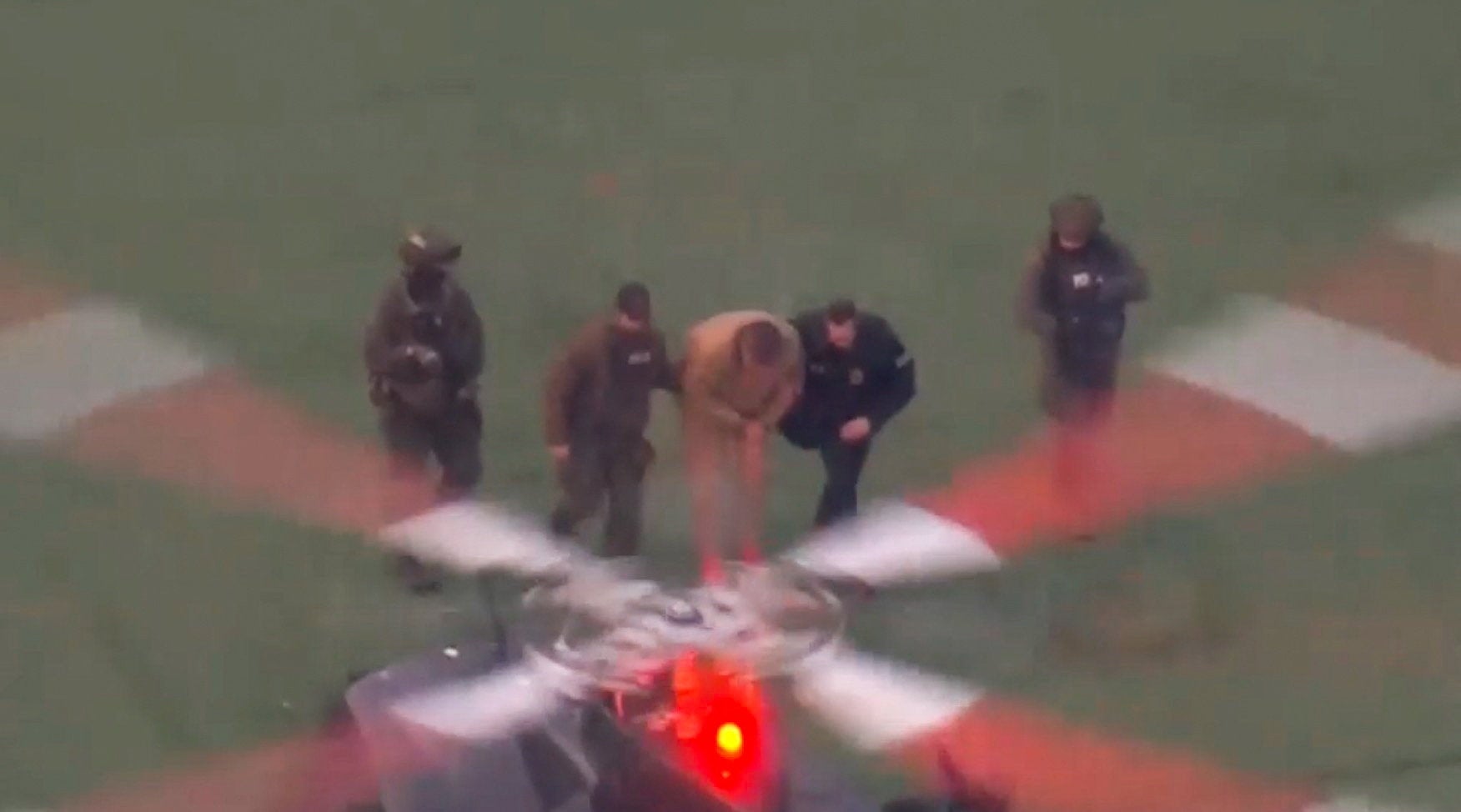
Maduro was flown by helicopter from Brooklyn to Manhattan to attend court. Surrounded by armed guards, he was seen limping and was driven to the courthouse in an armoured vehicle.
12.00pm: Maduro appeared before a judge, charged with various weapons and drug offences. Court sketches showed the ousted leader and his wife wearing blue prison outfits. He was represented by Barry Joel Pollack, best known for defending Wikileaks founder Julian Assange.
“I was captured,” Maduro said in Spanish as translated by a courtroom interpreter before being cut off by the judge.
Asked later for his plea to the charges, he stated: “I am innocent. I am not guilty. I am a decent man, the constitutional president of my country.”
He and his wife pleaded not guilty to all charges.
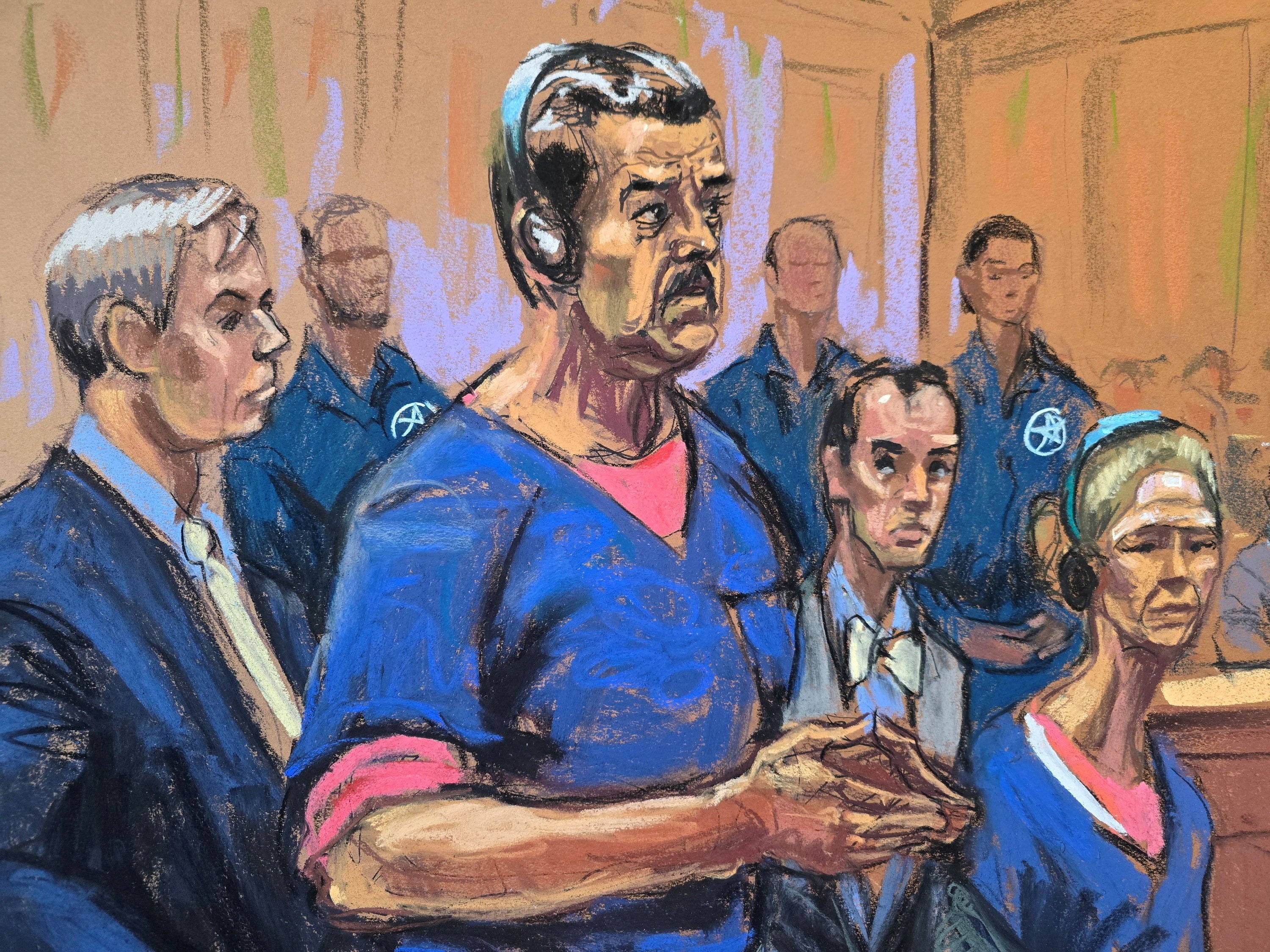
12:45pm: Maduro’s brief arraignment ended, with the next court hearing scheduled for 17 March. Maduro did not asked for bail.
2:08pm: Rodriguez was sworn in as Venezuela’s interim president at the National Assembly in Caracas.
On Monday night, Trump warned the U.S. still could launch a second attack on Venezuela if newly Rodríguez does not cooperate.
“We’re prepared to do it,” Trump said. “We anticipated doing it, actually.”
Join our commenting forum
Join thought-provoking conversations, follow other Independent readers and see their replies
Comments
Bookmark popover
Removed from bookmarks