Icelandic orcas have been including baby pilot whales in their groups – but scientists aren’t sure why
Scientists have come up with several possible reasons for the unusual behaviour

An unusual encounter with a group of orcas near Iceland led researchers to discover a new and complex behaviour - they had taken in baby pilot whales, and not necessarily to eat them.
Scientists watched two encounters between killer whales and weeks-old baby pilot whales in 2022 and 2023 in a new paper published in Ecology and Evolution, and examined an earlier case in 2021, to come up with three possible reasons for the unusual behaviour.
Firstly, it could have been predatory behaviour, but the researchers noted the groups of whales in question largely eat fish only. Another reason was for play, or for hunting training.
But the third possible reason could be that the orcas were caring for the calves, and had potentially adopted the pilot whales.
But the researchers, led by Cherine Baumgartner, stressed they had not seen the beginning or end of the interactions, and more close observation would be needed to unpick what exactly was happening between the two whale species.
Orcas are apex ocean predators, and normally only interact with other species to hunt them, the researchers said.
But researchers in 2022 spotted a group of killer whales travelling with a very young pilot whale calf.
At times, the researchers notice a killer whale keeping its head very close to the calf’s body, “seemingly nudging the calf towards the surface with the pilot whale calf appearing to respond often with tail slapping”.
Then in 2023, a team noticed a different group of killer whales traveling with another very small pilot whale calf, which was repeatedly seen swimming near an adult female in an echelon position, which is a behaviour that has been seen in both aggressive context and more caregiving contexts. The calf was later seen being lifted out of the water by a killer whale.
The researchers said while the activity appeared to be “playful”, that doesn’t mean play was the main reason for the orcas interacting with the pilot whale calves. A related potential explanation was practice hunting.
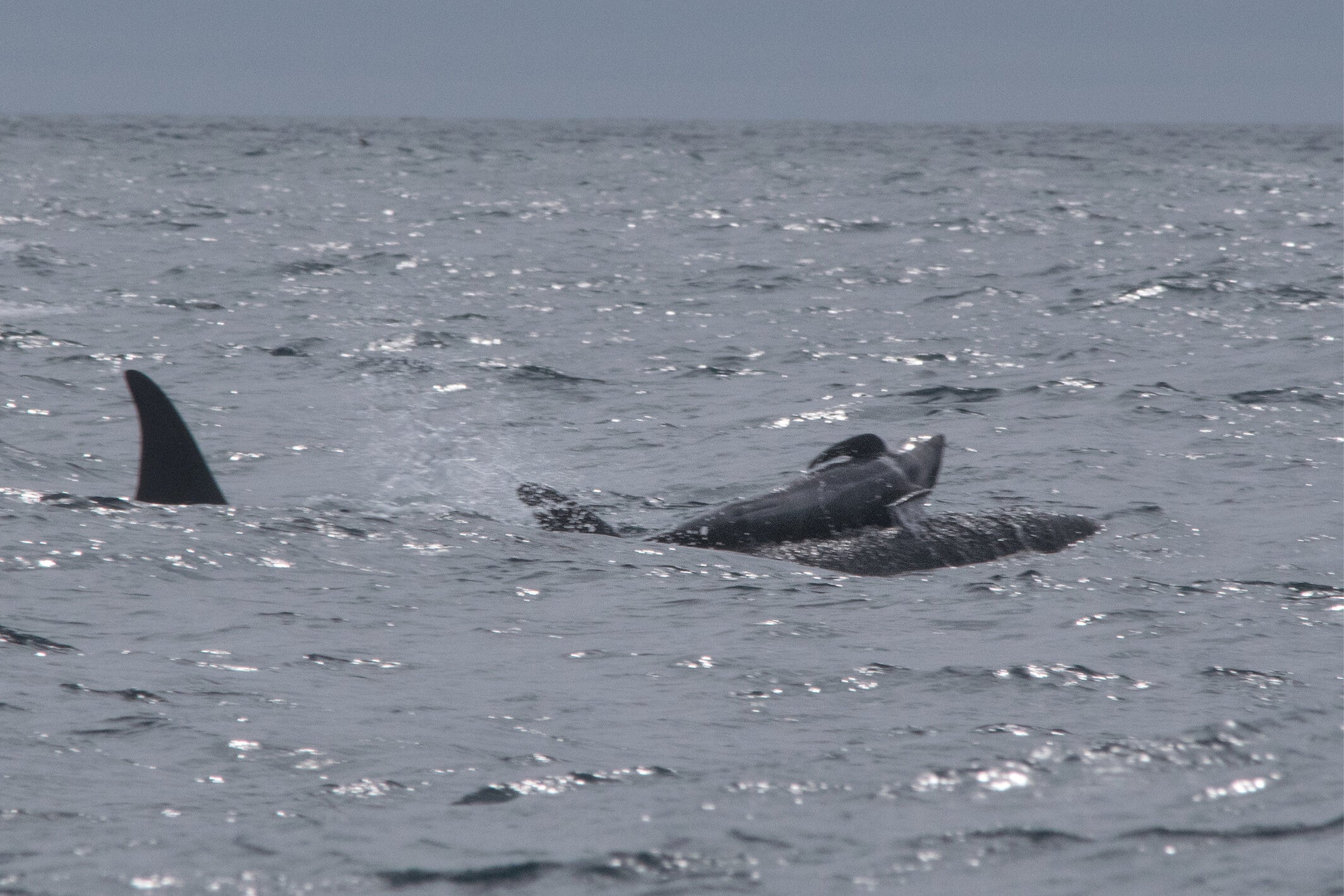
“Observations of a female and a juvenile swimming on either side of the pilot whale calf may indicate training exercises aimed at preventing prey from evading,” the researchers said.
“Such coordinated behaviour could serve as practice for herding techniques used during actual feeding, though this remains untested.”
The final possible explanation offered by researchers is that the orcas had potentially adopted the pilot whale calves, in what is called epimeletic behaviour or alloparental care.
“During our longer encounters … we observed behaviours that could be interpreted as caregiving, such as pushing the pilot whale calf from underneath - potentially to keep it afloat,” the paper said.
But they warned that all three encounters reported to date had been brief - a matter of hours, or less - and probably only showed part of a longer series of events.
One of the co-researchers told Scientific American that how the calves ended up with the killer whales to begin with, and what happened to them afterwards, were key questions.
“Was it lost or abandoned?” said Filipa Samarra, from the University of Iceland and the principal investigator at the Icelanding Orca Project. “Or did the killer whales actively approach to take the calf away?”
Another key question is how many different orca groups have done similar things.
“So far, different killer whale groups have been involved in all three events reported, but we do not know how widespread this behaviour is within the population,” they said.
Join our commenting forum
Join thought-provoking conversations, follow other Independent readers and see their replies
Comments
Bookmark popover
Removed from bookmarks