Stay up to date with notifications from The Independent

Notifications can be managed in browser preferences.

Scientists are baffled by this powerful gamma ray explosion outside our galaxy

This unique burst of high-energy radiation is unlike anything previously witnessed
Marcia Dunn
Tuesday 09 September 2025 16:58 BST
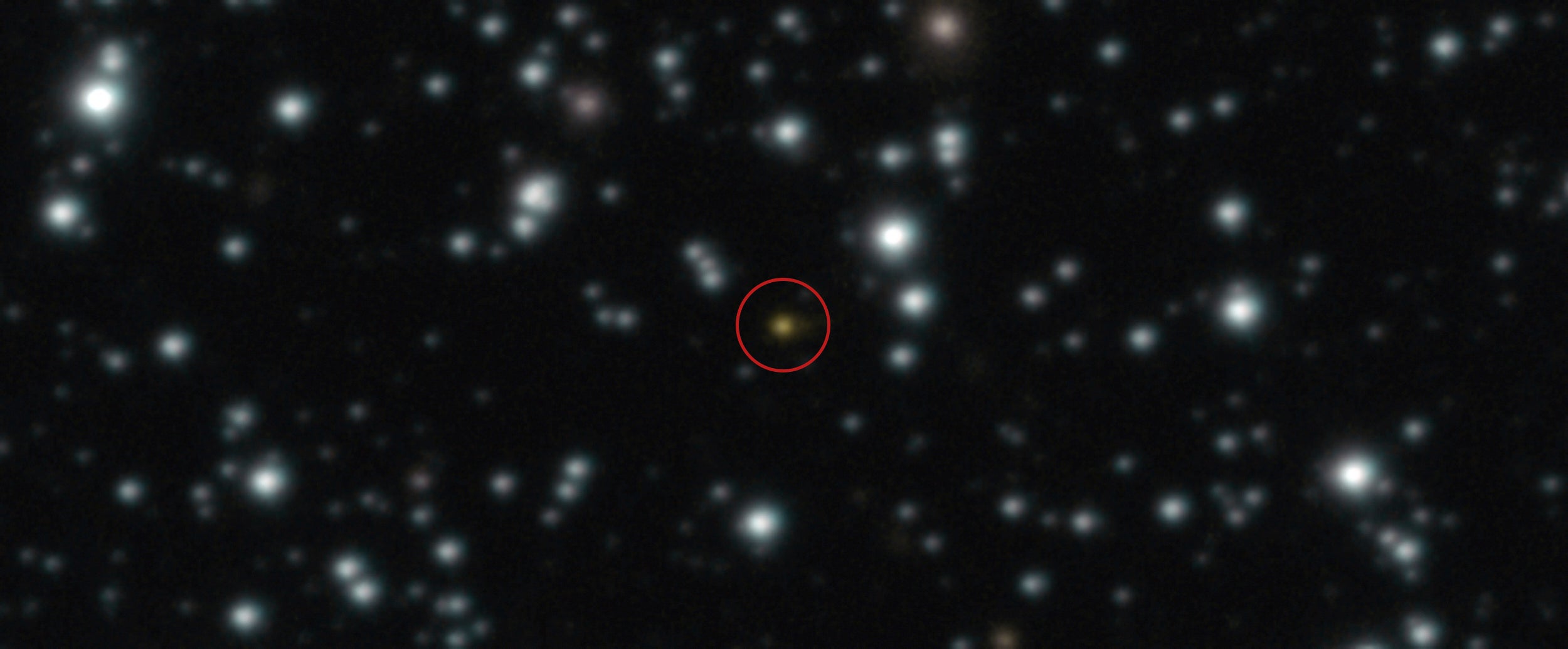
This image provided by the European Southern Observatory shows a powerful explosion, orange dot at the center of the image, that repeated several times over the course of a day, The image, taken with ESO's Very Large Telescope (VLT), allowed astronomers to determine that the explosion didn't take place in the Milky Way but in another galaxy

Astronomers have reported the discovery of an exceptionally powerful and long-lasting gamma-ray explosion beyond our galaxy.

First observed in July, this unique burst of high-energy radiation is unlike anything previously witnessed. Telescopes, including Hubble, are studying this unprecedented cosmic event.

The repeated bursts of gamma rays were detected over the course of a day, according to scientists. That’s highly unusual since these kinds of bursts normally last just minutes or even milliseconds — rarely no more than a few hours — as dying stars collapse or are torn apart by black holes.

Scientists said such a long and recurrent gamma ray explosion is puzzling — a cosmic whodunit, at least for now. More observations are needed to confirm its precise whereabouts.

This image provided by the European Southern Observatory shows a powerful explosion, orange dot at the center of the image, that repeated several times over the course of a day, The image, taken with ESO's Very Large Telescope (VLT), allowed astronomers to determine that the explosion didn't take place in the Milky Way but in another galaxy. (European Southern Observatory via AP)
This image provided by the European Southern Observatory shows a powerful explosion, orange dot at the center of the image, that repeated several times over the course of a day, The image, taken with ESO's Very Large Telescope (VLT), allowed astronomers to determine that the explosion didn't take place in the Milky Way but in another galaxy. (European Southern Observatory via AP) (European Southern Observatory)

The European-led team announced its findings in the Astrophysical Journal Letters in August.

Gamma ray bursts are singular outbursts of high-energy radiation with durations typically lasting from milliseconds to minutes and, in extreme cases, a few hours. They are attributed to the catastrophic outcomes of stellar-scale events and, as such, are not expected to recur

The burst was described as “unlike any other seen in 50-years of GRB observations,” according to Antonio Martin-Carrillo, astronomer at University College Dublin, Ireland, and co-lead author of a study on this signal recently published in The Astrophysical Journal Letters.

Adding: “More importantly, gamma-ray bursts never repeat since the event that produces them is catastrophic.”

Thank you for registering

Please refresh the page or navigate to another page on the site to be automatically logged inPlease refresh your browser to be logged in