Scientists thought a planet in our solar system could support life. But new study changes that
Jupiter’s moon Europa may be less hospitable to life than scientists once hoped
Jupiter’s moon Europa, long considered a prime candidate in the search for extraterrestrial life due to its vast subsurface ocean, may not be as habitable as once believed, according to new research.
A study published in Nature Communications suggests that Europa’s rocky seafloor is likely too mechanically strong to support the tectonic and volcanic activity crucial for generating life-sustaining nutrients and chemical energy.
Such geological processes facilitate vital interactions on earth between rock and seawater, producing essential chemicals for microbial life. However, after modelling Europa’s specific conditions, researchers concluded that its seafloor probably lacks these dynamic features. The study considered factors including Europa’s size, the makeup of its rocky core, and the immense gravitational forces exerted by Jupiter. Their evaluation, indicating little to no active faulting at the moon’s seafloor, suggests this environment would be challenging for life.
"On Earth, tectonic activity such as fracturing and faulting exposes fresh rock to the environment where chemical reactions, principally involving water, generate chemicals such as methane that microbial life can use," explained planetary scientist Paul Byrne of Washington University in St. Louis, the study’s lead author. "Without such activity, those reactions are harder to establish and sustain, making Europa’s seafloor a challenging environment for life."
Life may have emerged on Earth billions of years ago in the dynamic environment around seafloor hydrothermal vents, features that Europa may lack. "Based on our findings, the seafloor would probably not contain major tectonic landforms, such as long ridges or deep troughs. There would likely not be any underwater volcanoes or seamounts, and we would not have any hydrothermal activity such as black smokers. Having said that, I hope I will stand corrected one day," said University of Georgia geologist and study co-author Christian Klimczak.
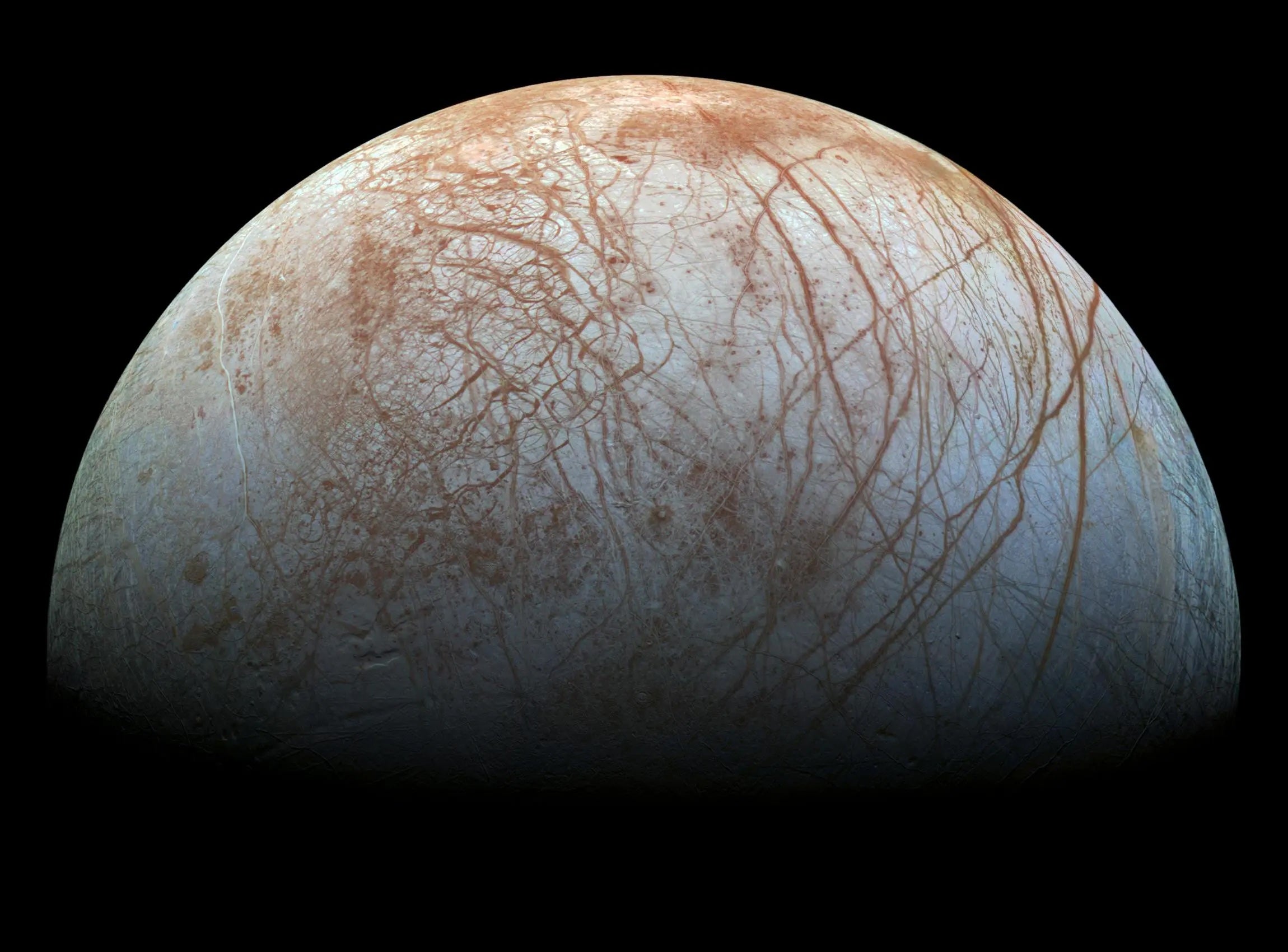
Despite these new findings, Europa possesses several traits that have long fuelled hopes of habitability. Its subsurface ocean is believed to be 40-100 miles deep, potentially holding double the water present in Earth’s oceans, beneath an icy shell 10-15 miles thick. It is slightly smaller than Earth’s moon, with a diameter of roughly 1,940 miles.
"There are three major factors thought to be critical for supporting life: liquid water, organic chemistry and energy," Mr Byrne noted. "Europa’s subsurface ocean satisfies the first requirement. We’ve identified organic chemicals on this moon’s exterior icy shell, and there may very well be such chemicals inside the ocean. So that’s the second requirement. And Europa’s particular orbit means that Jupiter drives tidal heating within Europa – requirement three."
NASA’s robotic Europa Clipper spacecraft, launched in 2024, is set to conduct dozens of close flybys starting in 2031, specifically to examine whether Europa has conditions suitable to support life, underscoring the continued scientific interest.
Jupiter’s gravitational pull significantly influences its moons. Io, the innermost large moon, is the solar system’s most volcanically active body due to intense tidal forces. However, Europa orbits much further from Jupiter. "The effect of this tidal heating drops off quickly with distance, so although there’s enough tidal heating to keep Europa’s ocean from freezing solid, according to our calculations at least there’s not nearly enough to tectonically deform the ocean floor. So, in short, there probably isn’t the kind of thing happening on Io taking place deep within Europa," Mr Byrne explained.
The study focused solely on Europa’s current conditions. Mr Byrne suggested a nuanced possibility: "There are reasons to think that Europa might once have been much more geologically active than it is today, albeit a few billion years ago. So perhaps for a time that world really was just not habitable but actually inhabited, before those conditions changed and the chemical energy for life ran out." Despite these new insights, Mr Klimczak maintains that "Given what we know about Europa, it is still the best place to look for extraterrestrial life."
Join our commenting forum
Join thought-provoking conversations, follow other Independent readers and see their replies
Comments
Bookmark popover
Removed from bookmarks