Scientists track ‘dust devils’ bouncing around on surface of Mars
Tornado-like whirlwinds shows that winds can rage at up to 160 kilometres per hour
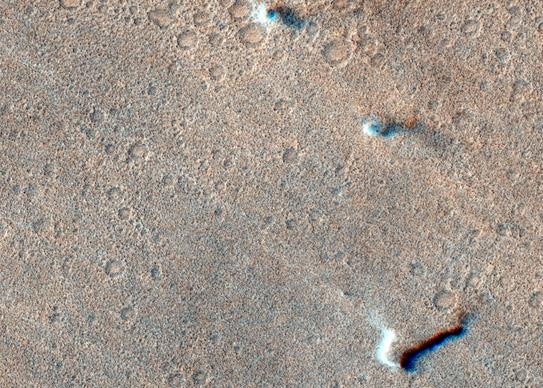
Dust devils whirling across Mars show that the wind on the planet can reach up to 160 kilometres per hour, according to a new study.
Researchers used the European Space Agency’s Mars Expressand ExoMars Trace Gas Orbiter spacecraft to examine 1039 tornado-like whirlwinds as they swept across the red planet.
They showed that the strongest winds on Mars blow much faster than we thought, as well as helping beginning a catalogue of these “dust devils” that could aid further study.
That catalogue represents the first time that the speeds and directions of motion for dust devils across Mars has been gathered together.
Scientists have watched dust devils whip across Mars for decades, using orbiters and rovers that land on the planet. But the new study actually tracked their motion to better understand how they move across the surface.
“Dust devils make the normally invisible wind visible,” said Valentin Bickel from the University of Bern, who led the work. “By measuring their speed and direction of travel we have started mapping the wind all over Mars’s surface.
“This was impossible before because we didn’t have enough data to make this kind of measurement on a global scale.”
Dust is important not only for understanding the wind, since it serves an important function in itself. Dust can work as a shield against the Sun during the day, cooling the planet, and keep heat in during the evening to preserve warmth, and it can also represent the beginnings of clouds.
Dust on Mars also stays around for a lot longer, since it is not washed away by rain like it is on Earth. As such, researchers are keen to understand how all that dust interacts with our planet’s atmosphere.
The new study used an artificial intelligence system to recognise dust devils and then look through images taken of Mars to spot them. That added up to 1039-strong catalogue, 373 of which had information about their direction.
Researchers found that they were moving up to 158 kilometres per hour. That is much faster than previously thought.
All of that information about the Martian wind and other parts of its atmosphere could prove key to future exploration.
“Information on wind speeds and directions is also really important when planning the arrival of future landers and rovers at Mars,” mentions Valentin.
“Our measurements could help scientists build up an understanding of wind conditions at a landing site before touchdown, which could help them estimate how much dust might settle on a rover’s solar panels – and therefore how often they should self-clean.”
Join our commenting forum
Join thought-provoking conversations, follow other Independent readers and see their replies
Comments
Bookmark popover
Removed from bookmarks