Scientists spot something on Moon’s far side that’s not thought to be naturally occurring
Findings indicate Moon has undergone surprisingly complex chemical processes
Chinese scientists have discovered tiny carbon nanotubes with walls just one atom thick in Moon rock samples, marking the first time the material has been found in nature.
Advanced carbon structures such as carbon nanotubes are thought to form only under very specific conditions, such as carefully controlled lab or industrial environments. On Earth, these structures are usually made only in laboratories for use in electronics, batteries, and nanotechnology.
In comparison, all forms of carbon found naturally on the Moon, are thought to come from external sources like meteorites and comets, which are not carefully controlled.
Now, researchers from Jilin University in China have found evidence of naturally occurring single-walled carbon structures embedded within soil samples returned by China’s Chang’e-6 mission from the less-studied lunar far side.
In the study, scientists identified thin, tube-like graphitic carbon structures using advanced microscopy techniques.
Further chemical analysis revealed these were carbon atoms arranged in a highly ordered, cylindrical form only one atom thick.
“This study presents the first identification of graphitic carbon in lunar samples taken by Chang’E-6 (CE-6) mission from the far side of the Moon,” scientists wrote in the study published in the journal ACS Nano Letters.
“Specifically, single-walled carbon nanotubes were identified in the CE-6 lunar samples,” they wrote.
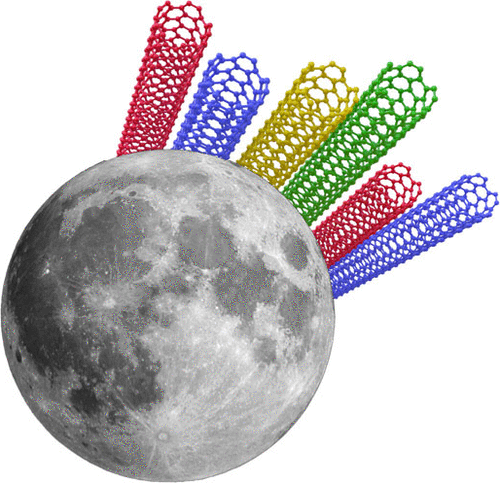
Chemical signatures found along with these carbon nanotubes along with the presence of lunar mineral grains, ruled out that they are not contamination from Earth.
“Although CNTs have been predominantly assumed to require artificial preparation, the study findings demonstrate that these materials exist in nature,” scientists wrote.
Researchers suspect the carbon nanotubes formed on the Moon from small meteorite impacts, catalysed by iron in the lunar soil likely under early volcanic activities and solar wind irradiation.
In such conditions, scientists say, carbon atoms can reorganise themselves into stable, highly ordered nanotubes even without industrial control.
“These findings, together with previously reported natural few-layered graphene on the Moon’s near side, may inspire a paradigm shift in carbon science and offer new pathways for designing Human-fabricated novel and emerging materials,” researchers wrote.
They also show that the Moon was never an inert rock, but has undergone surprisingly complex chemical processes.
Join our commenting forum
Join thought-provoking conversations, follow other Independent readers and see their replies
Comments
Bookmark popover
Removed from bookmarks