Here are all the places in the US that you can see the northern lights tonight
The colorful light display is the result of a blast of solar material headed toward Earth.
People in some parts of the U.S. may be able to see the northern lights this evening.
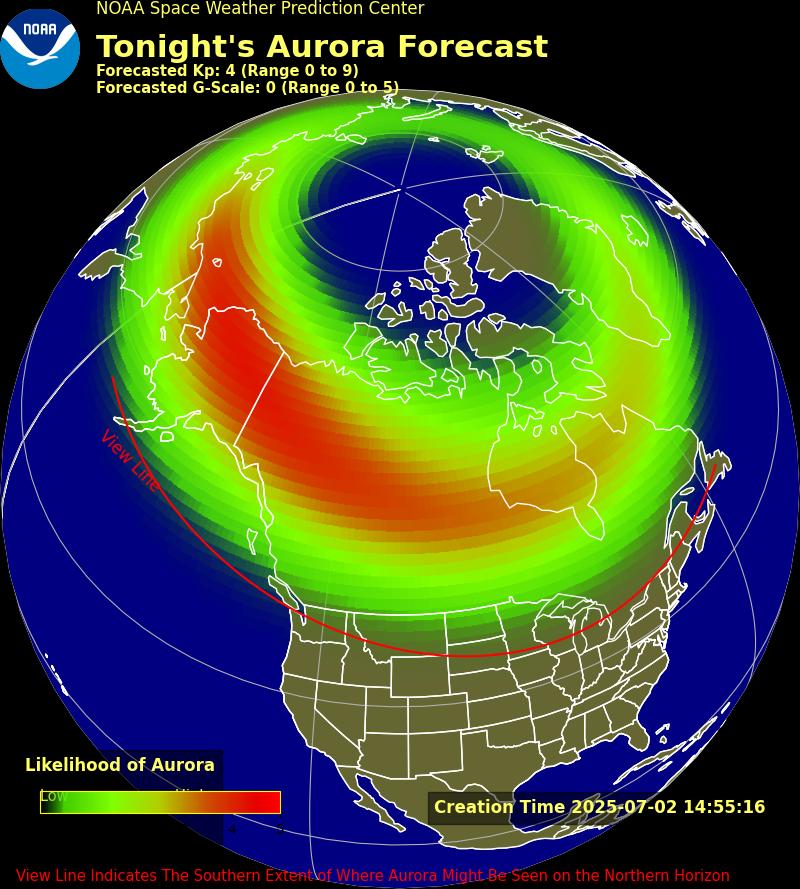
Weather permitting, residents of more than a dozen states could hit the jackpot, according to the most recent forecast from the National Oceanic and Atmospheric Administration’s Space Weather Prediction Center - Alaska, Idaho, Montana, Minnesota, the Dakotas, Michigan, Wisconsin, Maine, Vermont, New Hampshire, Washington, and New York.
For the best chance to catch the phenomenon, skywatchers should head to areas away from light pollution at around 2 a.m. local time. However, auroras can be fickle, showing up in areas other than where they are expected.
The dazzling display is caused by an incoming coronal mass ejection: a burst of plasma and solar material released by the sun and headed our way. The result of this celestial event is often a geomagnetic storm, which is triggered when the eruption travels through space and interacts with Earth’s magnetic field.



“A G1 (Minor) geomagnetic storm watch has been issued for 02 Jul (UTC day) due to the arrival of a CME that left the Sun on 28 Jun,” the center said in a post on social media.
Geomagnetic storms are what create the aurora borealis, which is light produced when particles from space collide with atoms and molecules in the upper atmosphere centered on Earth’s magnetic pole.
A G1 geomagnetic storm is the weakest on the scale of storms, which goes up to G5. In this minor storm, weak power grid fluctuations can occur, and a minor impact on satellite operations is possible.
Stronger solar flares and coronal mass ejections can lead to radio blackouts and more severe spacecraft operation impacts, such as problems with orientation and tracking satellites. A radio blackout was observed earlier this month thanks to a strong flare.
The sun is in what is known as its solar maximum period, meaning an increase in solar activity that has led to the most intense solar storm in decades and stunning displays of the northern lights across the country.
Scientists have warned there may be “much bigger” and disruptive storms en route in the coming years.
Join our commenting forum
Join thought-provoking conversations, follow other Independent readers and see their replies
Comments
Bookmark popover
Removed from bookmarks