Scientists make major breakthrough in search for ‘ghost particles’
Neutrinos are one of the most mysterious particles in the universe, and get their name because they hardly interact with anything else
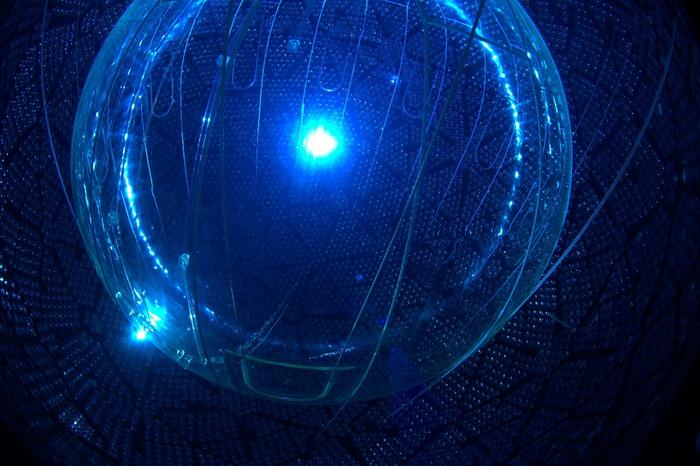
Scientists say they have made a major breakthrough in detecting “ghost particles”.
The name is given to neutrinos, which are one of the most mysterious particles in the universe and remain largely unknown because they seldom interact with anything else.
They come about in nuclear reactions, including those from our Sun. And they surround us at all times, with trillions of them passing through our body in each second.
They leave behind no trace, however, which has meant that they have remained difficult to actually find. Detecting them could help answer questions about the processes behind our Sun and how the universe has evolved – but doing so has proven elusive.
Scientists now say however that they have watched them transforming carbon atoms into nitrogen. To do so, they had to build a vast detector underground.
That equipment – based in SNOLAB, a Canadian facility in a working mine – allows researchers to shield their detectors from cosmic rays and background radiation that might otherwise overpower the very faint signals from the neutrinos.
“Capturing this interaction is an extraordinary achievement,” said Gulliver Milton, a doctoral student at the University of Oxford. “Despite the rarity of the carbon isotope, we were able to observe its interaction with neutrinos, which were born in the Sun’s core and travelled vast distances to reach our detector.”
In the new work, researchers watched for carbon-13 nuclei being hit by high-energy neutrinos, and then transforming into radioactive nitrogen-13 that then decays. That process can be observed through the flash from the first collision and then the second flash from the radioactive decay.
Researchers watched that happen multiple times during their research, which took place in 2022 and 2023 and is announced today in a new paper.
That work, ‘First Evidence of Solar Neutrino Interactions on 13C’, is published in the journal Physical Review Letters.
Join our commenting forum
Join thought-provoking conversations, follow other Independent readers and see their replies
Comments
Bookmark popover
Removed from bookmarks