Why women hold the key to rugby fulfilling its American dream
As the sport’s governing body prepares to invest heavily in the run-up to two World Cups in the USA, Harry Latham-Coyle speaks to World Rugby’s chief executive to find out more about their plans


It would be easy for Alan Gilpin to bask in the afterglow of what he described this week as the “greatest Rugby World Cup of all-time” but rugby’s top figurehead is already back to work. No doubt, there will be some time for celebration and reflection for World Rugby’s chief executive after a tournament that may come to transform the women’s game but his mind is already whirring about the years to come.
The World Cup surpassed even optimistic internal expectations. More than 90 per cent of tickets sold; record television audiences recorded; the net promoter score, which tracks satisfaction among attendees at major events, is high at 84. “I’ve been involved in World Cups for a long time, and they are big beasts to deliver,” Gilpin explains. “I think we’ve surpassed expectations on just about every metric.”
But Gilpin has not agreed to talk merely to accept commendation; he wants to look forward to the future. It is a fascinating time to sit down with the power-broker of a sport still, really, in its infancy – 30 years after men’s rugby union first went professional, there is a sense of something of a reset to iron out kinks that have too often held the game back.

Externally, plenty of focus is falling on the possible threat posed by rebel league R360, a disruptive force welcomed by some nonetheless facing real opposition for how it could dramatically impact a fragile ecosystem. Broadly speaking, World Rugby welcome investment into the game – provided it is injected appropriately. But it is working itself to refurnish the structures of the sport. The Nations Championship is finally set to be fully unveiled in the coming weeks, while the next men’s World Cup, now just two years’ away, has been expanded to 24 teams. That kicks off a couplet of major tournaments in Australia, which will also host the 2029 Women’s World Cup.
Yet it is the two major events beyond that which are arguably of far greater intrigue. Eyebrows were raised when it was announced that the 2031 Men’s World Cup and the 2033 women’s equivalent would be hosted in the United States, a territory that plenty of sports have tried to crack with limited success. Cricket perhaps serves as a cautionary tale – the ICC have suspended the USA’s national body little more than a year after hosting part of a T20 World Cup there.


But World Rugby believe it is commercially imperative to make their expansion work – and now have sign-off to do so. At a council meeting last week in London, their plans were officially rubber-stamped with perhaps more than $250m (£186m) invested in fulfilling the American dream over the next eight years.
“It’s all about investing now in the growth of rugby in the US so that when we get to the big moments in 2031 with the men and 2033 with the women, we’ve built great audiences so that it becomes a key market for rugby,” Gilpin explains.

“Part of that was a learning from the 2019 Rugby World Cup in Japan, which was a wonderful tournament. Japan is now a really important player market, really important audience and commercial market for the sport, but in hindsight we could have done more with the Japanese union to build those audiences in advance.”
There are problems to be solved. Rugby remains a niche sport in the USA, with extremely limited cut-through. While the men’s Eagles have qualified for the 2027 World Cup, they missed out on the last tournament, while the nation’s women failed to progress from the pool stages. Major League Rugby (MLR), America’s domestic league, has gone from 11 teams to seven in a matter of months.
It is understandable, then, that there are plenty within the sport who question World Rugby’s plans. Only last week, Chile head coach Pablo Lemoine took a thinly-veiled dig at the governing body for prioritising investment in the US over the burgeoning scene in the continent directly to the south. “There is passion for rugby in South America,” the Uruguayan said. “We don't need to buy it or pay for it as they are trying to do in the USA.”

Yet with World Rugby now having their plans in place, a concerted effort will be made to ensure sustained growth. Rugby has taken a number of international and club fixtures to the United States in the past but, Gilpin insists, a cohesive, joined-up plan of action is vital if their gamble is to pay off.
“We know the opportunity in the US is to put some of the investment in advance. We’ve got a lot of member unions who want to take international match content or club content to the US market. How do we ensure that they are not one-off games and we all collectively really amplify it?”
Ireland and New Zealand again meet in Chicago this November, and other international sides are expected to visit in the coming years. At the club level, England’s Prem Rugby – who are sponsored by US insurance broker Gallagher – are understood to be in discussions over a first trip across the Atlantic since 2017. Rumours abound of potential American involvement in the United Rugby Championship (URC), which already spans two continents, and Super Rugby Pacific.

The women’s game, though, might be rugby’s best opportunity at cracking America. Representatives from potential host cities for the men’s and women’s World Cups were at last week’s final, along with investors in female-led football franchises in the National Women’s Soccer League (NWSL). Michele Kang, owner of Lyon and the London City Lionesses in football, donated $4m to the USA women’s sevens programme having first caught sight of rugby at the Olympics last year. LA 2028 could be another key stepping stone.
Where the men’s sporting space is highly congested – the World Cup looks set to clash directly with the National Football League (NFL) and college football – there is a belief that the lack of a high-profile contact sport played professionally by women could provide a mechanism for growth.
“We’ve done a lot of work over the last couple of years understanding where the pockets of opportunity are,” says Gilpin. “If you look at college rugby in the US, there are some great foundations there but how can that drive participation and visibility in the women’s game more quickly? There’s a real opportunity because there isn’t another contact sport, other than ice hockey, for female athletes. There are more and more girls playing rugby at the high school level.
“I hate to use this term, but pound-for-pound or dollar-for-dollar, the return on investment will be higher in the women’s game in terms of building audiences and players than it probably will be in the men’s game in the US in that period.”
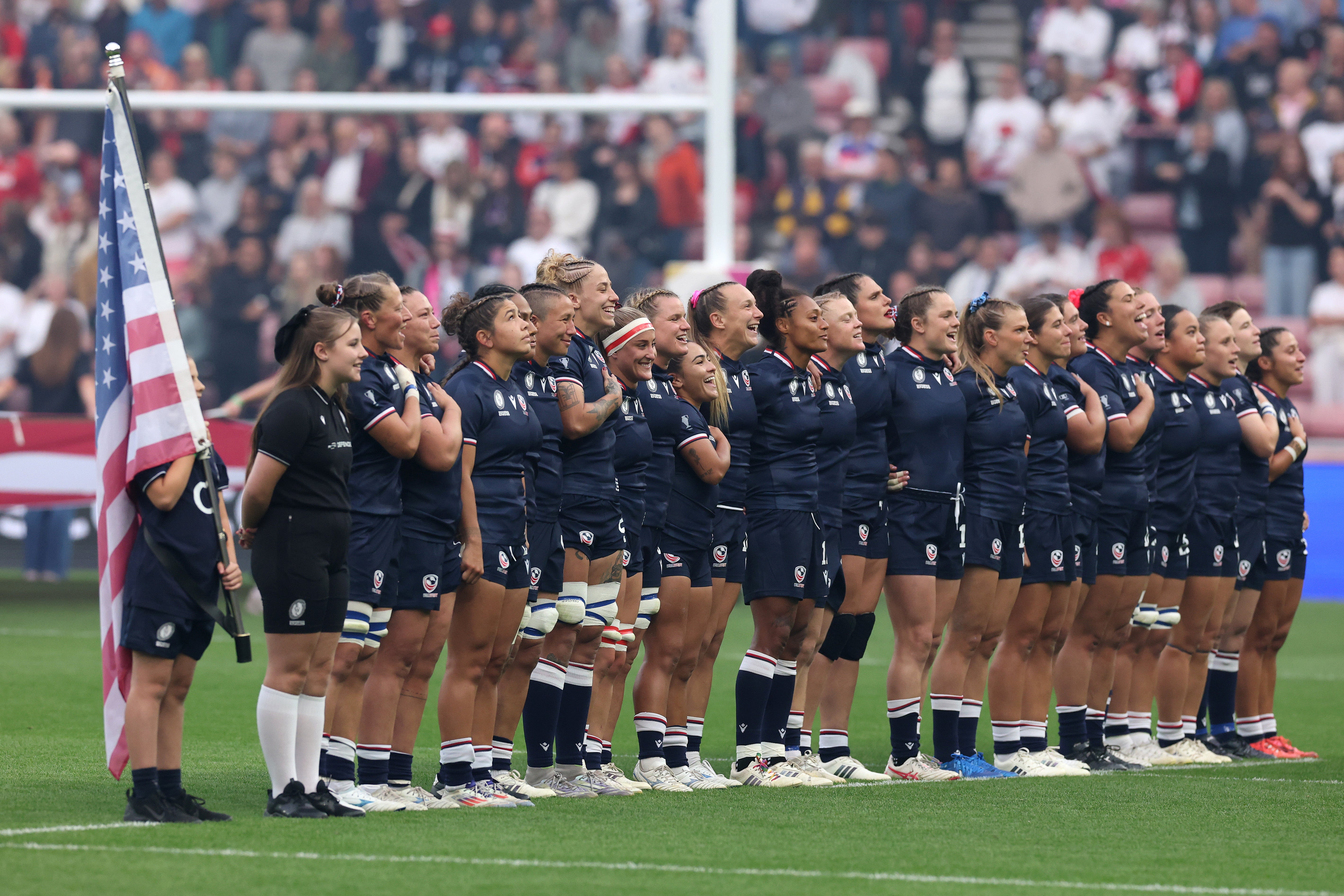
Already, there is one major success story. Ilona Maher’s catapulting into the spotlight at Paris 2024 was an organic tale of an individual weaponising the platform and profile afforded them to challenge perceptions and attract new interest. Outside of rugby, figures like basketball’s Caitlin Clark have shown a new generation of supporters identifying more with players than franchises. Gilpin believes that is replicable. “This Women’s World Cup really showcased the power of player personalities,” he stresses. “We know that is so important in the US market with the way fans are following individual athletes across team sports. Noone epitomises that more than Ilona Maher, really.”
It feeds into a wider project to ensure that the recently-concluded World Cup is used as a springboard. Throughout the tournament there has been a feeling of collaboration and cooperation that can sometimes lack in rugby, all too prone to being inhibited by infighting.
“There’s an appreciation in the men’s game that there is a lot of conflict in the calendar between different stakeholders,” Gilpin concludes. “That’s not to say we’re not making progress, because we absolutely are with the Nations Championship in the next couple of years a key part of that and a 24-team Rugby World Cup in two years’ time.

“But I think we’ve got a different type of opportunity in the women’s game, it’s a cleaner slate that we can all work towards. It needs us at this juncture to be collaborating and make some compromises that maybe we haven’t made in the past in the men’s game.”
Join our commenting forum
Join thought-provoking conversations, follow other Independent readers and see their replies
Comments
Bookmark popover
Removed from bookmarks