How BYD just overtook Tesla to become the world’s most popular EV seller
Elon Musk’s firm has seen its sales drop for the second straight year. Anthony Cuthbertson charts the company’s recent decline, as well as the meteoric rise of China’s BYD

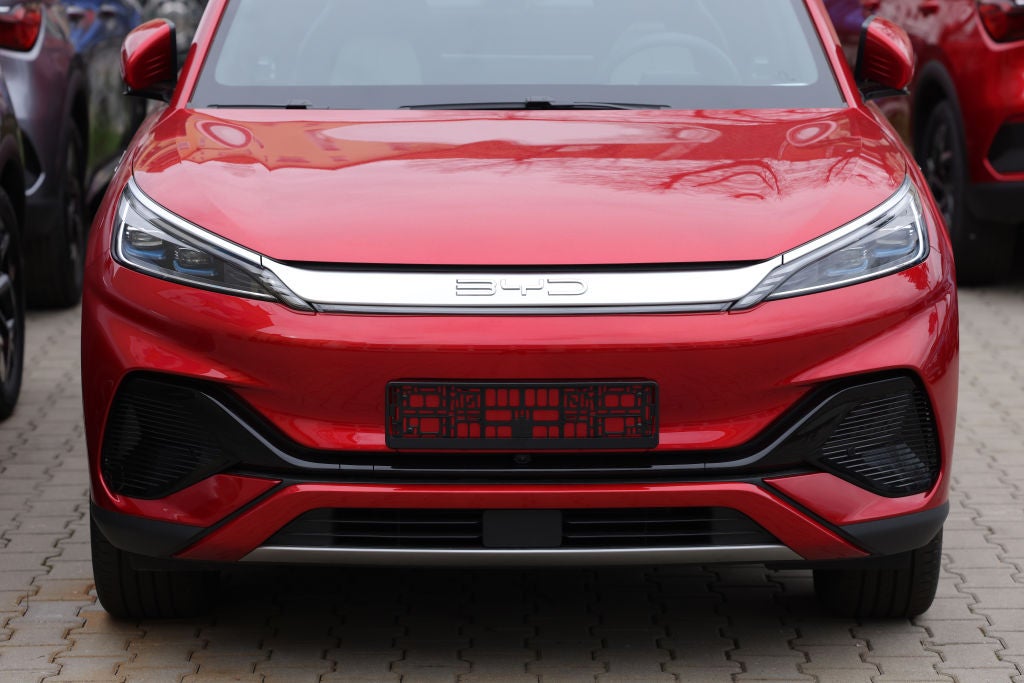
Fourteen years after Elon Musk laughed at the idea of BYD being a competitor to Tesla, the Chinese automaker has dethroned its American rival as the world’s biggest electric car seller.
BYD’s latest sales figures show that it sold 2.26 million vehicles in 2025, beating Tesla’s sales by nearly 700,000. It represents a 28 per cent rise in sales of battery-powered cars since 2024, while Musk’s company has experienced an 8 per cent drop in that same period.
It marks the second straight year that Tesla’s sales have fallen. having risen every year for a decade before that.
BYD’s dominance has been boosted by recent technological breakthroughs, as well as Tesla’s declining reputation globally.
Last year, the Shenzhen-based firm achieved what some industry experts have described as the “holy grail” for electric vehicles: a battery capable of charging in the same time it takes to fill up a petrol tank.
The Super E-Platform offers a range of 400 kilometres (249 miles) from just five minutes of charging – roughly four-times the range provided by most Tesla Supercharger stations in the same time.
BYD said the system, which is currently only available for its flagship ‘L’ series of cars, will “completely solve users’ range anxiety when travelling”.
BYD’s technological breakthroughs have coincided with calls for boycotts of the Tesla brand due to the actions of Musk.
Support of far right politicians in Europe, as well as the tech billionaire’s alignment with the Trump administration, provoked protests at Tesla showrooms and charging stations in the UK, Europe and US last year.
Musk’s polarising political views saw Tesla’s brand reputation plummet last year, according to a poll from Axios Harris.
The company placed last in ‘character’ in a ranking of America’s 100 most visible companies, while also placing near the bottom for ‘ethics’ and ‘citizenship’.
Musk is yet to publicly address the latest sales figures. The Independent has reached out to Tesla for comment. In May 2025 interview with CNBC, he described Chinese EV makers as “incredibly competitive”, but claimed he does not follow news about BYD.
“I don’t really think about competitors,” he said. “I just think about making the product as perfect as possible.”
TESLA’S ROBOT TRANSITION
In recent years, the Tesla boss has attempted to reposition his company as an AI and robotics company, rather than just an electric vehicle maker. In 2022, he claimed that the robot Optimus would eventually be worth more than its car business.
This pivot comes despite accelerating demand for electric vehicles around the world, most notably in China and Europe.
Tesla’s Optimus bot is designed to navigate the world in a similar way to humans in order to fill a wide range of manual labour roles.
“Essentially, in the future, physical work will be a choice,” Musk said at the humanoid robot’s unveiling in 2021. “If you want to do it, you can, but you won’t need to do it... It has profound implications for the economy, given that the economy at its foundational level is labour.”
Early Optimus units are expected to operate in Tesla factories, though Musk claims it will eventually “do anything you want.”
Speaking at the company’s We, Robot event in 2024, he said: “It can be a teacher, babysit your kids; it can walk your dog, mow your lawn, get the groceries; just be your friend, serve drinks. Whatever you can think of, it will do.”
Such a vision has been questioned by some robotics experts, who claim that demand for robots will be for specialised machines that excel at specific tasks, rather than a general-purpose robot that has to be reprogrammed.
MIT roboticist Rodney Brooks, who co-founded Roomba maker iRobot, described Musk’s ideas about a general-purpose humanoid assistant as technologically and economically unfeasible.
”The general plan is that humanoid robots will be ‘plug compatible’ with humans and be able to step in and do the manual things that humans do at lower prices and just as well,” he wrote in a September blog post.
“In my opinion, believing that this will happen any time within decades is pure fantasy thinking.”
Join our commenting forum
Join thought-provoking conversations, follow other Independent readers and see their replies
Comments
Bookmark popover
Removed from bookmarks