America is staying put: Relocations have dropped by half in last five years
‘Fewer Americans are packing up each year, yet when they do move, they overwhelmingly stay in their home region,” a Bank of America study noted
The rumble of moving trucks through neighborhoods isn’t nearly as common as it was five years ago.
The number of Americans moving has dropped by more than half since 2021, according to a new migration study from Bank of America. While moves are becoming rarer, so are long-distance relocations. Instead, people are swapping state-to-state moves for city-to-city transitions within regions depending on their financial situation, the study noted.
“Fewer Americans are packing up each year, yet when they do move, they overwhelmingly stay in their home region,” the study said. “The big story isn't a national reshuffle - it's people trading one nearby city for another that fits their budget and lifestyle a little better.”
The study did not address why the moving rate in the U.S. has plummeted by more than 50 percent. However, a report last year, from the Federal Reserve Bank of Richmond, suggested that a combination of factors, including an aging U.S. population and women’s pay trends, has led to a significant slowdown in moves.
“Some of the explanations for the decline in mobility involve long-term trends - such as population aging or increased earnings opportunities for women - that make moving costlier,” the study said. “Others appeal to changes in the geographic distribution of earnings, urban amenities and housing prices, all of which make moving less rewarding.”
.jpg)
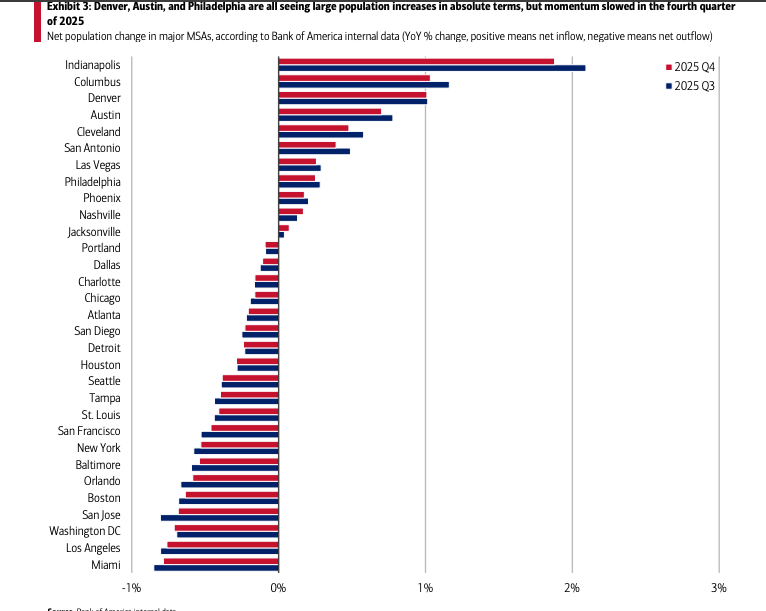
For those who do choose to relocate, the Midwest has been a hot spot. Indianapolis, Columbus (Ohio), Denver, Austin and Cleveland saw the biggest population increases in the last three months of 2025.
On the flip side, Miami, Los Angeles, Washington D.C., San Jose and Boston lost the most residents over the same time period.
Lone Star love
Austin, in particular, represented the national trend of moving to a nearby city rather than switching states. A quarter of Austin’s new residents came from Texas’ other major cities of Houston, Dallas and San Antonio.
“In our view, Austin is likely a target locale for people looking for a growing city that retains a small town feel with comparatively less expensive housing,” the study noted.
Leaving La La Land
Further West, Bank of America found that the style and sparkle of Los Angeles wasn’t enough to keep residents from moving. The West Coast culture hub saw its net population (those coming minus those going) decline by 0.8 percent year on year.
It lost its biggest share of residents to two California metropolitan areas: San Francisco/San Jose, which took 6 percent of L.A.’s outbound migration, and San Diego, which brought in 5 percent of those who left L.A.
A bite out of the Big Apple
New York City lost 0.5 percent of its residents year on year. Instead of people moving to other parts of New York, though, the Big Apple’s residents converged on Philadelphia and the South. Some 7 percent of the city’s outgoing residents moved to nearby Philadelphia, while another 7 percent went to Miami and 3 percent put down roots in Washington D.C. and Atlanta.
Join our commenting forum
Join thought-provoking conversations, follow other Independent readers and see their replies
Comments
Bookmark popover
Removed from bookmarks