What’s the point of the International Criminal Court if it won’t give Myanmar justice?
The ICC is at risk of irrelevance due to its dithering over launching prosecutions against the Myanmar junta, writes Christopher Gunness


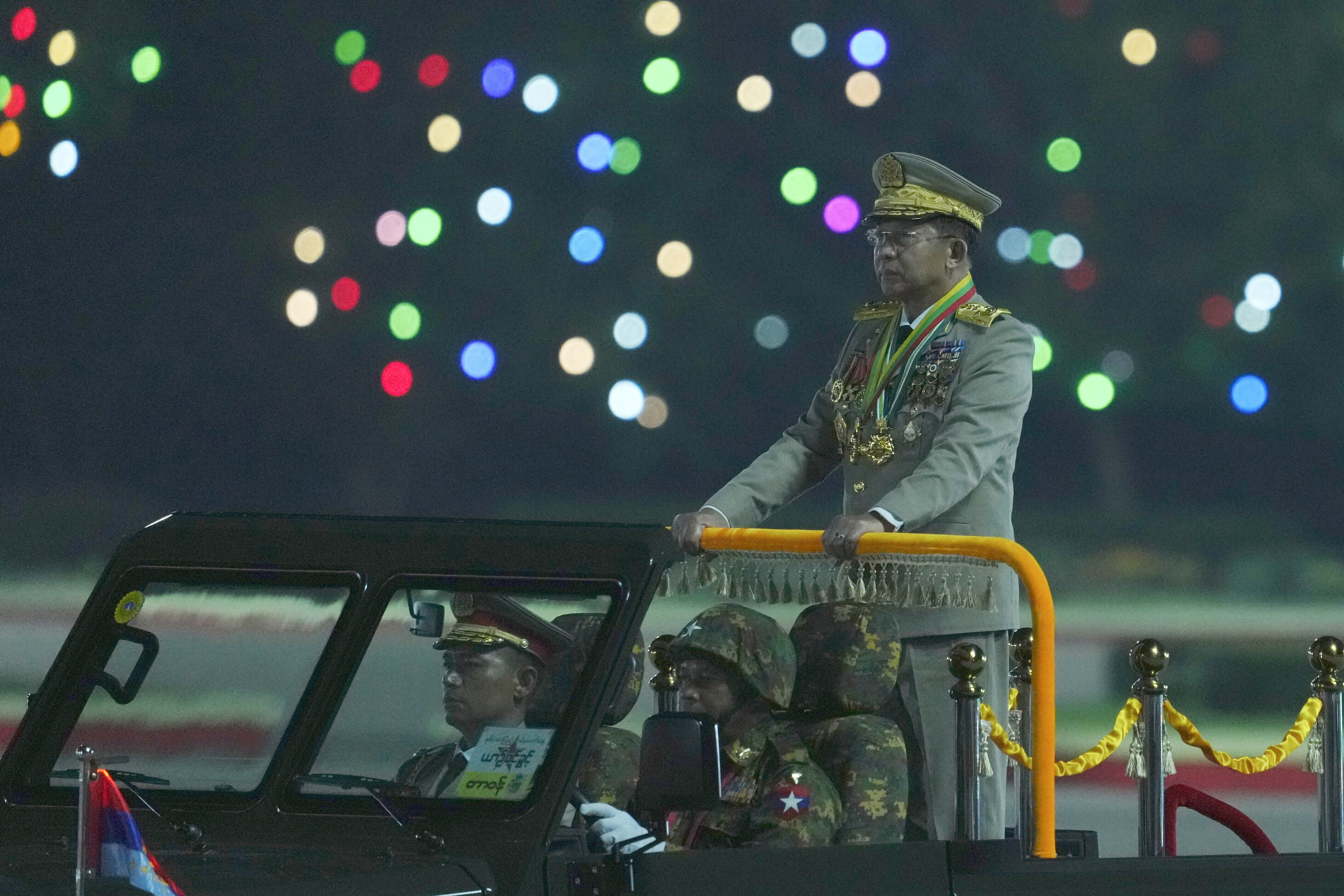
It is over a year since Karim Khan, the International Criminal Court prosecutor and British KC, announced that he had requested a warrant for the arrest of Myanmar dictator Min Aung Hlaing for “crimes against humanity of deportation and persecution”.
Khan’s announcement was already a full seven years after the “clearance operations” in Myanmar’s Rakhine State, the worst mass violence in Southeast Asia since Pol Pot’s reign of terror in 1970s Cambodia, and which the US designated a “genocide” against the Rohingya people: industrial-scale slaughter, gang rape and systematic arson attacks against entire villages, which drove 750,000 people into Bangladesh.
Yet the anniversary of Khan’s request came and went without the ICC’s Pre-Trial Chamber 1, the body charged with considering it, issuing a warrant, or even making a pronouncement on the matter. Such a delay is unprecedented in the history of the court and compounds a growing sense that the ICC is failing to abide by the commitments of its founding statute: “the effective prosecution” of perpetrators and an end to impunity for “international crimes”.
The ICC’s credibility is on the line, particularly inside Myanmar and in the Rohingya camps in Bangladesh, home to 1.2 million people, where human rights abuses are rampant and refugees face acute malnutrition and starvation. The court is also increasingly hamstrung by US sanctions imposed by President Trump for issuing an arrest warrant against Israel’s Benjamin Netanyahu and authorising an investigation into the conduct of US service personnel in Afghanistan. The ICC rejects Trump’s executive order, accusing the US of seeking to “harm its independent and impartial judicial work”. Deepening the sense of crisis at the ICC, there are sexual misconduct allegations – unproven – against Prosecutor Khan.
A year ago, Karim Khan promised further arrest warrant requests “in weeks or months”. These must be issued immediately, particularly as Min Aung Hlaing and his clique are accelerating military operations before the elections scheduled over the next two months. The junta is using the new Election Protection Law to ban and silence political parties, while imprisoning, torturing and executing democratic politicians and their supporters.
To be clear, Min Aung Hlaing is staging the vote to legitimise his illegitimate rule, rebranding the State Administration Council – the junta – as the civilian State Security and Peace Commission. But a costume change by Myanmar’s top brass into civilian clothes will fool no one, particularly inside the country, where outrage has further galvanised the nationwide revolution sparked by the 2021 coup.
A key battleground is Rakhine State, the Rohingya’s homeland, where the United League of Arakan (ULA) and its armed wing, the Arakan Army (AA), have gained control of most of the territory. According to reliable sources on the ground, from January to September this year, the Myanmar air force and navy launched indiscriminate airstrikes against over a dozen townships under the control of the AA. Grassroots organisations documented more than 180 civilian deaths during one five-month period alone.
Diaspora Rohingya groups accuse the AA of working from the junta’s playbook by forcibly recruiting civilians and massacring opponents. However, a new report published by the authoritative Transnational Institute (TNI) challenges this narrative and reveals a more nuanced picture, while calling for accountability and the protection of all peoples.
According to the TNI, the ULA and AA have established governance structures in a broad range of sectors, from health, education and social affairs, to the environment, legal affairs, technology and media. “These developments,” says the TNI, “have led to significant differences in the quality of lives and livelihoods in the three remaining towns which are junta-controlled and the 14 townships which are now ULA-controlled”.
Figures released by the UN in September attest to at least 6,764 civilian deaths and over 29,000 political arrests since the coup. Nearly half of all verified civilian fatalities between April 2024 and May 2025 resulted from aerial attacks. The UN also cited deliberate targeting of civilian objects, including markets, schools, homes, places of worship and camps for displaced people. “Widespread destruction of property by airstrikes with no discernible military objective,” says the UN, “raises concerns of war crimes”.
So where is the ICC? Three of the four core international crimes it was established to punish are committed daily, and thousands of victims who have given evidence to the ICC and the UN’s investigative body, the Independent Investigative Mechanism for Myanmar, are crying out for justice. The court cannot abandon them.
All agree that for the Myanmar junta to be forced from power, three things must be cut: money, weapons and impunity. Russian and Chinese support for the junta will always guarantee the first two. The ICC is uniquely placed to deliver decisively on the third. But will it?
The alternative is for the court to be condemned to irrelevance by the people of Myanmar, victims of atrocities the ICC has been investigating for more than six years. How much longer must they wait?
Christopher Gunness is director of the Myanmar Accountability Project
Join our commenting forum
Join thought-provoking conversations, follow other Independent readers and see their replies
Comments
Bookmark popover
Removed from bookmarks