The Nazis on trial: The enduring lessons of Nuremberg, 80 years on
Between 20 November 1945 and 1 October 1946, the Allied Forces tried 22 senior Nazi officials and six organisations – and, in the process, demonstrated that holding power to account is the firmest proof of humanity, writes Rob Rinder


When I appeared as a lawyer at The Hague, what struck me wasn’t the grandeur of international justice but its ordinariness. The room looked like any other courtroom: bad coffee, flickering strip-lighting, piles of paper stacked with the usual optimism that someone might read them. Yet this was the place where the world tries to answer its darkest chapters with the thin, steady light of procedure. I remember thinking how strange it was that something meant to answer the worst things human beings can do to one another could be met with something so mundane as a judge adjusting their glasses or a translator clearing their throat.
It was in that ordinariness that I felt the real legacy of Nuremberg; not in rhetoric or ceremony but in the quiet habits of law. The belief that even the worst acts must be confronted with evidence, argument and record. And all of it traces back to a courtroom assembled from rubble in the winter of 1945.
In that courtroom, built amid the wreckage of Europe, the world attempted something without precedent: to replace destruction with deliberation. The International Military Tribunal at Nuremberg was not vengeance disguised as justice but an act of reconstruction, the first time law was asked to confront the collapse of morality itself. It sought to prove that even after mass murder, reason and process could still hold atrocity to account.
From its first day, Nuremberg was shadowed by contradiction. Among the judges sat representatives of the Soviet Union, a regime that had executed thousands at Katyn and operated its own machinery of repression. Justice was being administered by victors who were themselves implicated in lawless acts. The tribunal was an uneasy mixture of moral courage and political convenience. Yet that audacious attempt to hold individuals to account remains one of the defining moments of modern civilisation.
Nuremberg’s justice was narrow. It fixed its gaze on the perpetrators, not the victims. Six million Jews were annihilated, yet in that courtroom they appeared as evidence rather than as people. Their names and lives were folded into the files. The tribunal exposed the mechanics of destruction, but failed to grasp the singular nature of the Holocaust: the systematic annihilation of a people not for what they had done, but for what they were.
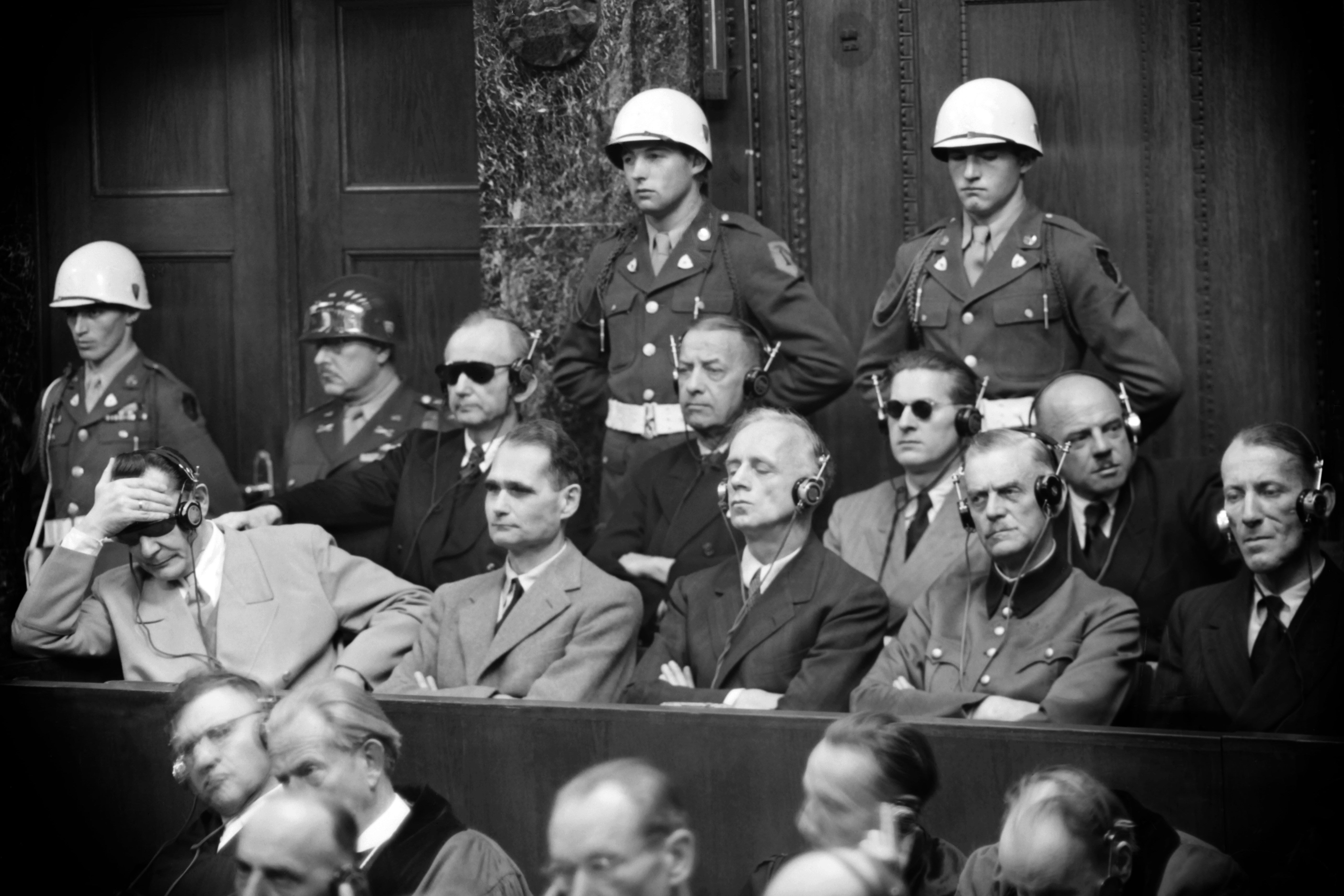
That omission was the result of limitation, not indifference. The legal vocabulary of 1945 was still being invented. Raphael Lemkin had coined the term genocide only months before, and it would not be codified until 1948. The prosecutors spoke of crimes against humanity through a framework still tethered to wartime aggression rather than ideology. They could establish the facts, but not yet articulate their moral dimension.
Even so, Nuremberg achieved something extraordinary. It created an evidentiary record so complete that denial – it was confidently imagined – would become impossible. For the first time, atrocity was proven in law rather than left to moral rhetoric. That remains its greatest bequest: the idea that truth (however contested) can be demonstrated; that facts have a standing of their own.
Yet the meanings forged at Nuremberg are now under strain. The language it gave us – of war crimes, crimes against humanity and genocide – is invoked across public life and often stripped of its legal precision. Terms once reserved for the gravest crimes in human history are now used loosely, even strategically. The result is a kind of moral inflation, rhetoric untethered from evidence. Law, when used carelessly, risks becoming not the guardian of truth, but another instrument of politics.
That tension is not new. Nuremberg itself revealed that law is always negotiated between ideals and power. But it also proved that legal discipline is what prevents morality from becoming mere performance. Having defended people accused of the worst acts imaginable, I have seen how due process is not an obstacle to justice, but its foundation. Fairness, the insistence that every accusation meets the standard of proof, protects truth itself. Without it, outrage corrodes into theatre.
Recent research from the UCL Centre for Holocaust Education shows how limited our public understanding of the Holocaust remains. Many cannot explain who designed the policies, how they were executed, or why so many became complicit. Ignorance here is not harmless: it distorts judgement. Holocaust education is therefore not simply about remembrance. It is a continuation of the Nuremberg project; the pursuit of truth through evidence, context and accountability.
Jonathan Sacks wrote that “to defend a civilisation, you need education”. The essential element of that education was an attempt to establish a language for crimes beyond description. That is what Nuremberg did. It rebuilt the moral vocabulary of the modern world. It reminded us that words like law, justice and truth must be used with care, because when they lose meaning, civilisation loses its compass.
Law is not morality, but without law, morality is powerless. Nuremberg embodied that uncomfortable truth. It was compromised, political and incomplete, yet it marked the moment when humanity decided that atrocity must be answered with argument, not silence.
The tribunal did not tell the whole story of the Holocaust; it could not. But it ensured that the world could never again claim ignorance. Eighty years later, its lesson endures: that justice, however limited, remains the most civilised way of facing the worst in ourselves, and that the effort to hold power to account is still the firmest proof of our humanity.
Rob Rinder was called to the bar in 2001 and continues to practise law alongside broadcasting and publishing work. In 2021, he and his mother, Angela Cohen, were made MBEs for services to Holocaust education
Join our commenting forum
Join thought-provoking conversations, follow other Independent readers and see their replies
Comments
Bookmark popover
Removed from bookmarks