If the ICJ fails the Rohingya, international law will be irreparably weakened
A trial at the International Court of Justice will decide whether the Rohingya’s suffering is legally genocide – and whether international law still matters, says Matthew Smith, chief executive of Fortify Rights. The evidence is extensive; the stakes are existential


Above the wooden door of the Peace Palace in The Hague hangs Albert Besnard’s vast oil painting Peace and Justice. Justice, robed in red, listens to two advocates – one animated, the other restrained. Beneath them stands Peace, carrying a naked infant and an olive branch: a reminder that peace is not an abstraction but the condition that allows life and prosperity to endure. At the canvas’s foot, two men on horseback turn away from one another, weapons lowered; their conflict is pushed to the margins and replaced by adjudication.
The International Court of Justice – often called the “World Court” – rests on the idea that disputes between states can be resolved by law rather than force. Yet, while global attention is scattered across wars and crises, a historic trial is unfolding here largely out of view: The Gambia v Myanmar, a case about Myanmar’s responsibility for genocide against the Rohingya.
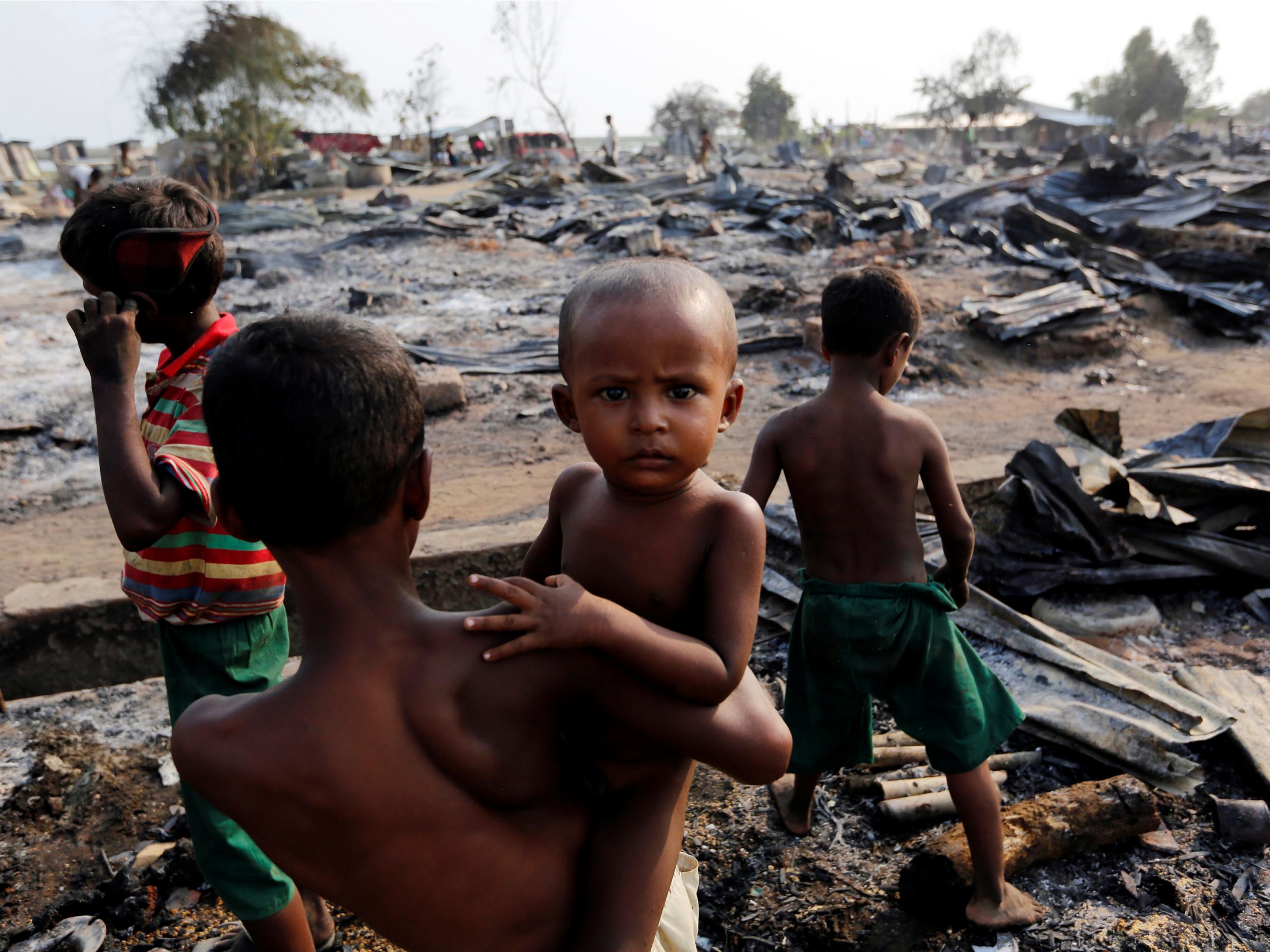
What is at stake is not only justice for the Rohingya – a long‑persecuted ethnic and religious minority – but the credibility of international law itself. The case concerns the 2017 campaign in Rakhine State: a coordinated assault that razed more than 390 villages and drove over 700,000 people into Bangladesh. Families were destroyed. Survivors were permanently scarred.
I investigated the violence as it unfolded, meeting hundreds of Rohingya at the Myanmar-Bangladesh border while smoke still rose from villages behind us. Survivors described soldiers throwing infants into fires, burning people alive, raping women and mutilating victims. We documented evidence that the military had prepared months in advance for the campaign.
Myanmar now tells the Court that violations were minimal excesses of otherwise legitimate counter‑terrorism operations against the Arakan Rohingya Salvation Army – a ragtag militant group – and that any wrongdoing was isolated. The Gambia says otherwise: the atrocities were not episodic but part of a policy and sustained pattern of genocidal violence prohibited by the 1948 Genocide Convention.
In the first week of hearings, The Gambia’s lawyers presented extensive evidence from United Nations investigators, the UN Special Rapporteur Tom Andrews, and non‑governmental organisations, including my own, Fortify Rights. The Gambia filed the case in 2019; in earlier proceedings the court ordered Myanmar to take provisional measures to prevent genocidal acts, preserve evidence and report on compliance. That order did not decide the merits, but it sent a rare signal: the risk of genocide was plausible, and international law could still act before destruction was complete.
The central legal question is intent. The Gambia argues that genocide is “not a numbers game” – even when the numbers are vast: tens of thousands killed and nearly one million Rohingya forced to flee, now living in miserable conditions in the world’s largest refugee camp in Bangladesh. Intent, the evidence shows, can be inferred from patterns: the scale and nature of killings; the systematic use of sexual violence designed to destroy families and prevent births; the razing of villages; and decades‑long policies that stripped the Rohingya of citizenship, freedom of movement and the basic conditions of life required to survive. This approach is rooted in the court’s jurisprudence.
The Gambia also pointed to dehumanising rhetoric from Myanmar’s state organs, including inflammatory speeches by Senior General Min Aung Hlaing, commander-in-chief of Myanmar's armed forces and the architect of the atrocities. An affidavit from a senior Meta executive detailed how the company banned Min Aung Hlaing’s Facebook page and scores of military‑linked accounts for promoting anti‑Rohingya hate and violence.
In court, Myanmar’s counsel refused to call the Rohingya by their name and instead referred to them as “Bengali Muslims” – a deliberate erasure. They did not deny social media’s role in promoting hate; they claimed, implausibly, that hate speech is irrelevant to genocidal intent. Myanmar acknowledged that government employees and security personnel created fake Facebook accounts, some using military email addresses and computers, and then suggested – without evidence – that these acts were unauthorised.
That suggestion drew a pointed response from The Gambia’s counsel, Arsalan Suleman: how likely is it that security personnel would post tens of thousands of messages calling for hate and violence from hundreds of accounts, using military infrastructure, over many years, without instruction or approval? For an institution known for rigid hierarchy and control, he said, the idea is “unimaginable”.
Myanmar has advanced other bad‑faith arguments: that all Rohingya can access education – contrary to a decade of UN reporting – and that the presence of more than 130,000 Rohingya in internment camps proves genocide did not occur because they were not killed. Its lawyers have sought to dismiss evidence collected by my organisation, only to then invoke our work when convenient.
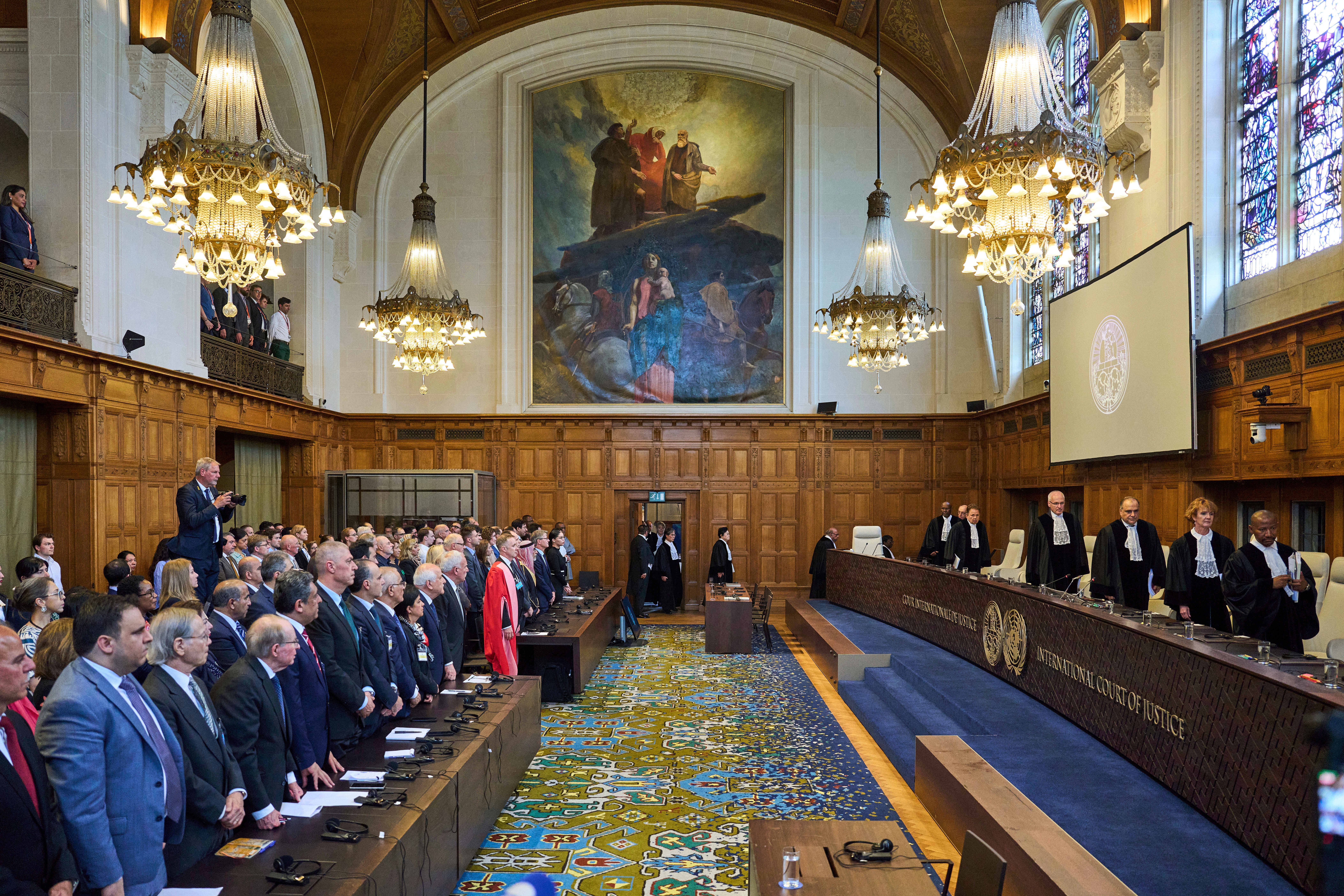
I sit in the courtroom daily as part of The Gambia’s delegation. What strikes me is not rhetoric but restraint. The Gambia argues with discipline and care, grounded in evidence and law – the very qualities international justice needs if it is to command legitimacy rather than provoke outrage.
That legitimacy is under strain. Around the world, and in Davos where leaders meet, international law is tested by powerful states that flout it, by conflicts that seem immune to accountability, and by growing cynicism about whether legal institutions can restrain violence.
If the world’s highest court cannot credibly adjudicate a genocide claim supported by extensive documentation and survivor testimony, the promise embodied in the painting above the judges’ door begins to fade. Each day, as the judges file into the courtroom, I look again at Peace and Justice. Painted in 1914, on the eve of the First World War, it is more than decoration; it is the room’s thesis statement. Peace is not a slogan. It is argued into being, measured carefully and made durable through judgement.
This case tests that future – and it is one the world cannot afford to abandon.
Matthew Smith is the chief executive and a founder of Fortify Rights
Join our commenting forum
Join thought-provoking conversations, follow other Independent readers and see their replies
Comments
Bookmark popover
Removed from bookmarks