Palestinians are returning home – the challenges they now face are immense
Putting the pieces back together of a society that has been devastated by two years of war will be frighteningly difficult, says Robert Fox – while Israel’s own domestic politics could make the challenge even harder


Hundreds of thousands of Palestinians are trying to return to the piles of rubble that once were their homes, aid trucks are ready to move tons of medicine and food, and the tanks and artillery of the Israeli Defence Force (IDF) have been pulling out of Gaza City. These are the first signs that the initial phase of the Trump peace plan for Gaza is underway.
But we have to wait until noon local time on Monday to have a real clue that the opening provisions of the plan are working. That is the deadline for the release of some 20 Israeli hostages still thought to be alive, and for the handing over of some 28 bodies of Israeli captives – though it is feared that some cannot be located now.
The success or failure of the Trump plan in the long-term pivots on one word, and one concept – stabilisation. The plan itself is a strange mixture of blunt practicality and lofty, pious ambition. “Gaza will be a deradicalised terror-free zone that does not pose a threat to its neighbours,” states the first point. The last point, number 20, declares, “The United States will establish a dialogue between Israel and the Palestinians to agree on a political horizon for peaceful and prosperous co-existence.” This is an aspiration that has eluded national powers, insurgent movements and international bodies almost since Arthur Balfour raised the issue of a Jewish homeland in the Middle East in his letter to Lord Rothschild 108 years ago.
How do you manage stabilisation and security in a shattered Gaza? The Strip has long been one of the most densely populated places on earth. It is also one of the places least favoured by nature and the tangled web of history. Today it is one of a dozen sites of human disaster in most need of peace and security across the world – Lebanon and Syria, shattered by years of civil war, the mind-boggling destruction, bloodshed and famine from Yemen, Ethiopia and Sudan to the Congo and the Sub Sahara in Africa – to say nothing of the misery caused by the wars in Ukraine and Myanmar.
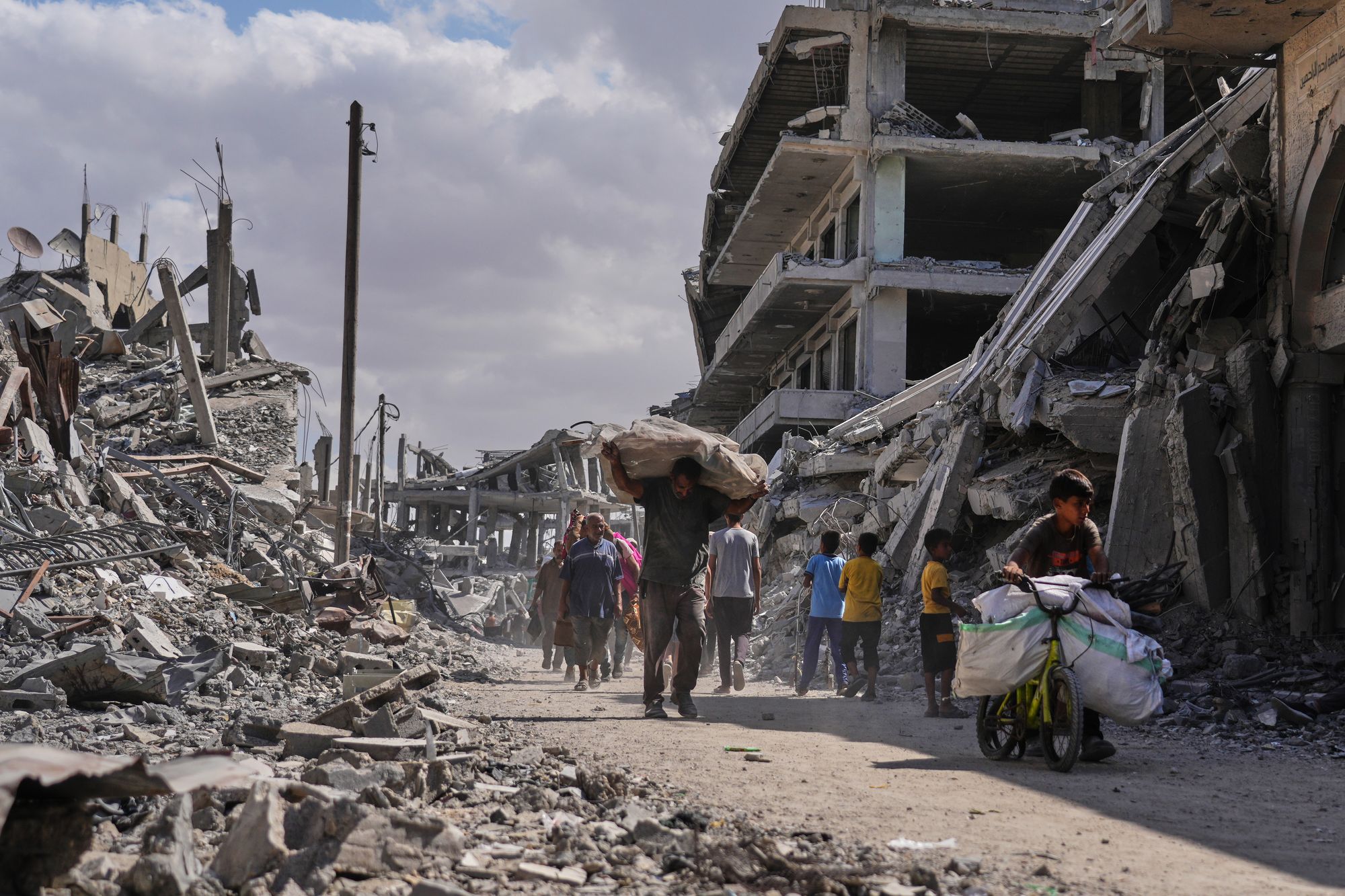
The immediate stabilisation mission for Gaza is food, medicine, shelter and security protection. Under the plan, Hamas must disarm within days and decommission their weapons. The Israeli forces must pull back to the notional “yellow line” just inside the Gaza Strip at the Erez Crossing in the north. This means a security vacuum. Heavily armed gangs of no known ideological affiliation have looted and hoarded aid. The distribution of the limited aid brought in by the Israeli-American Gaza Humanitarian Foundation, GHF, has been accompanied by scenes of chaos and violence, and the shooting of civilians.
The raw statistics of the challenge are stark. In two years of conflict, some 67,000 Gazans have been killed, and roughly 150,000 injured. Since 7 October 2023, 1,980 Israelis have been killed, including some 1,200 in the atrocity and massacre carried out by Hamas on that fateful day. According to latest figures from the UN, 1.07 million Gazans are in “a condition of hunger. A number are extremely ill and in need of emergency treatment. Shelter now becomes a priority as the nights turn chilly”. Some 90 per cent of the population of 2.1 million is displaced and more than three quarters of all buildings damaged or even wrecked.
Fresh water supplies are a priority – and water management has been a growing problem for Gaza for decades. This is quite apart from the five bouts of war visiting the Strip since Israel ended its occupation in 2006. Natural resources, underground aquifers were drying up for some time – and the UN Development programme predicted a serious crisis in water supplies and sanitation by 2025.
The biggest headaches are military and political. The Trump plan envisages a “temporary International Stabilization Force (ISF) to immediately deploy in Gaza”. It will be supervised by a Peace Board, chaired by Trump himself and with former British prime minister Tony Blair as principal member. The force will have to be scramble together in days from now – an unlikely prospect, even with the fairest of following winds.
Once the hostages and the Palestinian prisoners are released, Hamas will lay down their arms, according to point six of the plan, “and will be given amnesty. Members of Hamas who wish to leave Gaza will be provided with safe passage to receiving countries.”
This risks colliding with the grim reality of Middle East history, politics, and ideological conflict. Hamas has been shattered – but still has military capability as a guerrilla force – as the current commander Izz ad-Din Al Haddad’s hold -out tactics against the Israeli forces suggest. It also has deep roots in Sunni Islamic militancy through the Muslim Brotherhood across the Arab Islamic world. Benjamin Netanyahu vowed to destroy Hamas, and he has largely destroyed the militants of the Qassam Brigades, perpetrators of the October 7 atrocities. But Hamas looks set to persist as a movement, based on its peculiarly self-destructive ideology, honed by Yahya Sinwar.
There is also the risk that the Trump plan for Gaza gets caught in the crossfire of Israeli politics. Netanyahu knows that the hardliners in his government – the settler wing led by the likes of Ben Gvir, Smotrich and Strook – vehemently oppose the Gaza peace plan. Trump, however, has given him little alternative. He knows, too, he faces a general election next year. And he is still on trial on three corruption charges.
The issues of stabilisation and security addressed by the Trump plan are vital for Gaza, but go well beyond. They have to be addressed across the world, in Africa and in Eastern Europe. They are an old challenge to nations, alliances and international organisations in newer and more lethal forms. Peacekeeping and approaches to aid security and delivery need an urgent rethink.
The question of who governs Gaza and can guarantee at least some prospect of enduring peace and security is not one for Gazan Palestinians and Israelis alone. It affects the peace and security of us all.
Join our commenting forum
Join thought-provoking conversations, follow other Independent readers and see their replies
Comments
Bookmark popover
Removed from bookmarks