Nnena Kalu’s Turner Prize win is momentous – and not only for learning-disabled artists
The sculptor’s victory is a seismic moment for the Turner Prize, but equally as significant, writes Mark Hudson, is her emphasis on the visual, tactile and experiential – qualities that the award has lost sight of in recent years


Nnena Kalu, a Glasgow-born neurodivergent artist who produces improvised sculptures from miles of old video tape and other discarded materials, was the surprise winner of the Turner Prize 2025, announced at a gala dinner in Bradford last night.
Much has been made, and rightly so, of the fact that Kalu is the first learning-disabled artist to be nominated for the Turner Prize, let alone win it. Her victory, though, is seismic not only for equality and diversity reasons, but for the emphasis her work places on the visual, tactile and experiential in art – values that have lost primacy in recent years, when the prize has been dominated by artists recontextualising existing objects. Last year’s recipient, Jasleen Kaur, won with a Ford Escort draped in a giant doily. This most recent incarnation of Britain’s biggest art prize seems to herald the welcome return of artists physically making things.
Also in the business of making things is Iraq-born Mohammed Sami, who had been the bookies’ clear favourite to win. A leading figure in what is widely regarded as a “revival” in British painting, Sami creates enigmatic meditations on his home country’s war-torn history. Reviewing his exhibition in September this year, I singled out a vast and eerily peopleless battlescape, The Hunter’s Return, as feeling like “Apocalypse Now via computer games, with a touch of Monet”. While many of the new works in Britain’s painting revival are more than a shade slapdash, Sami’s mastery of texture and mood is evident even to viewers who are not fully attuned to contemporary art.
-Mohammed-Sami--Installation-view-at-Turner-Prize-2025-Cartwright-Hall-Art-Gall.jpg?quality=75&width=230&crop=3%3A2%2Csmart&auto=webp)

.jpeg?quality=75&width=230&crop=3%3A2%2Csmart&auto=webp)
Yet if Sami appeared to many – including, I have to say, myself – to be a “shoo in” for the prize, a reward for his technical accomplishment would have seemed a painfully retrogressive move for an institution that has made a virtue of championing the obscure, the difficult, and the downright perverse.
Kalu’s art – in total contrast not only to Sami’s, but to just about everything else that has been promoted by the Turner Prize in recent years – revolves, literally, around an apparently artless joy in the business of making. The London-based, Nigerian-heritage artist, who is autistic and has complex support needs, winds random discarded materials – cloth, cling film, paper, tape, card – around a central core to create entirely abstract structures, which are endlessly reconfigured and suspended throughout the gallery like so many raggedy, writhing caterpillars. If this eternally repetitive winding rhythm is “innate” to Kalu, as one of the facilitators who support her work observed in an accompanying video, it is, as they also concede, “always the same rhythm”.
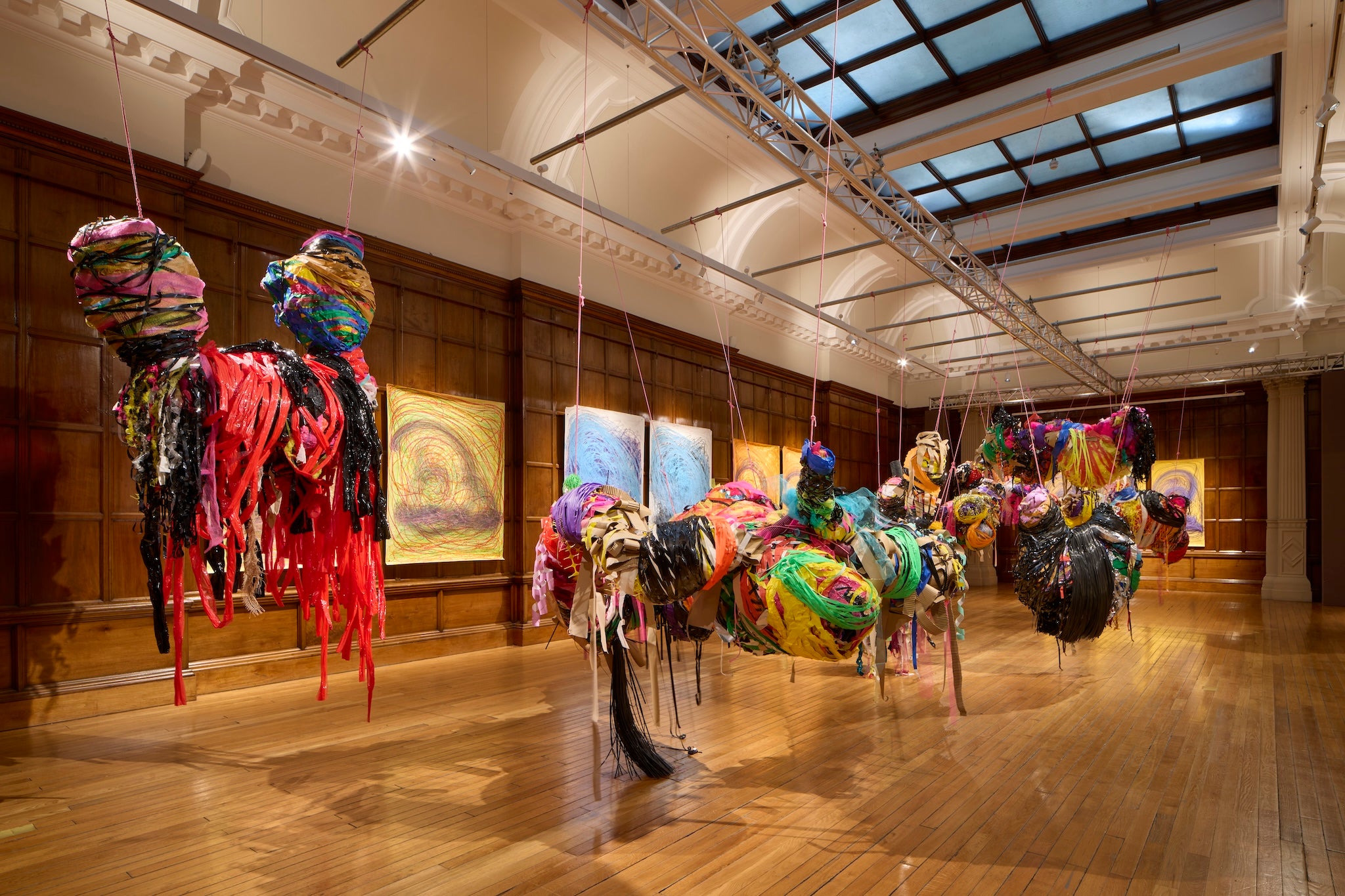
Awarding the prize, the Turner jury praised Kalu’s “lively translation of expressive gesture into captivating abstract sculpture and drawing”, noting her “finesse of scale, composition and colour” in creating her work’s “powerful presence”. Certainly, there is a sense of life-affirming uplift, on entering Kalu’s part of the Bradford exhibition, that makes Sami’s complex paintings feel a shade arid, even academic in comparison. If this year’s Turner is genuinely about a return to making, Kalu offers us that idea in its purest, most exuberant form. There may be no “capital I” ideas in her work, per se, but equally there’s no posturing or painful politicising, no pretence that the work is anything more or less than it appears.
In my original review, I argued that Sami was a more appropriate choice for the award on the grounds – based on observation of other awards – that a win for Kalu could subject a vulnerable artist to a potentially degrading media spectacle and conceivably damaging scrutiny. Whenever art involves the support of facilitators, there are inevitable questions about the degree of assistance involved, the facilitators’ motivations, and the potential for exploitation – though I am not for a moment suggesting there is anything remotely improper in Kalu’s case.
But neurodivergent people should be as free as anyone else to participate fully in Britain’s cultural life. Depriving an artist of an award that would serve as an example and an encouragement to others, on the grounds of trying to protect them, would, of course, be absurd. And if such a win raised constructive questions about the role of facilitators in the disabled arts community, so much the better. As Kalu’s longstanding facilitator Charlotte Hollinshead told The Guardian at the time of Kalu’s nomination, “It’s seismic. Someone said to me the other day, ‘It’s like someone’s just thrown a bomb into the Turner Prize’ – and it is like that. A good bomb.”
Over and above the disability issues surrounding her win, Kalu’s work reminds us that no matter how much art may illuminate our perspectives on history, politics, human relationships and the natural world, the visual and the sensual come first. And she demonstrates that lesson against all odds.
A group show of the 2025 shortlisted artists’ work is running at Cartwright Hall Art Gallery in Bradford until 22 February 2026
Join our commenting forum
Join thought-provoking conversations, follow other Independent readers and see their replies
Comments
Bookmark popover
Removed from bookmarks