Turner Prize 2025 review – A conservative shift could undermine the award’s radical legacy
Mohammed Sami is a shoo-in, but his winning it would feel like a weirdly retrogressive move for this once controversial prize
-Mohammed-Sami--Installation-view-at-Turner-Prize-2025-Cartwright-Hall-Art-Gall.jpg)
Say what you like about the artists on this year’s Turner Prize shortlist: they know how to make a physical impact. Zadie Xa hangs her visionary paintings on acid-tinged walls (and I mean acid in that sense) above a reflective gold floor that seems to double the size of the already large space. Rene Matić’s photographs of political demonstrations and queer subculture come with a soundscape of contemporary voices loud enough to make your hair stand on end, while Nnena Kalu’s suspended sculptures, formed from miles of VHS cassette tape, clingfilm and gauzy material, look fantastic against the neo-Baroque wood panelling of Bradford’s Cartwright Hall.
True to recent form, Britain’s best-known art prize seems as if it’s out to make some kind of point with the demographic of its 2025 shortlist: none of the four nominees have typically British names, one is non-binary, and another is neurodivergent. Way more important, however, is that this feels like the year in which artists have returned to the act of physically making things. After years when it was dominated by those whose work recontextualised existing objects (see 2024’s winning installation by Jasleen Kaur, which featured a car draped in a doily), the shortlist this year comprises two painters – in the oil-on-canvas sense – and a sculptor. Only one artist, the photographer Matić, works with “non-traditional materials”.
There’s a generally upbeat vibe, and a sense – barely conceivable in the light of most recent Turner Prize exhibitions – that we can approach the event through the lens of good, old-fashioned visual pleasure. Perish the thought.
That said, there’s little here that is remotely traditional. The setting for Korean-Canadian Xa’s mythological paintings feels more like some psychedelic nightclub than an art display. Glasgow-born Kalu’s weightless cocoons, meanwhile, are formed through a single hand-winding process that feels a world away from sculpture in the marble-and-chisel sense. And it hardly seems to matter whether or not Matić, from Cambridgeshire, who at 28 is the second-youngest artist ever to be shortlisted for the Turner, took their photographs of graffitied slogans and snogging gay clubbers themselves. These images feel like spontaneous emanations of the contemporary British street rather than “art photography”.
In this atmosphere of jubilant boundary-breaking, the enigmatic modern “history” paintings of the bookies’ favourite, Mohammed Sami, who was born in Baghdad, look a shade tight and careful, even academic. Sami’s finely crafted, peopleless meditations on Iraq’s troubled past and present are some of the most admired products of what is often referred to as a resurgence in British painting: certainly there has been a vast increase in the number of young artists daubing on canvas over the last few years. Given his pieces’ seductive and sophisticated merging of the figurative and the abstract, it’s hardly surprising that Sami is near universally considered a shoo-in for this year’s Turner.
-Tate--Succession-Picasso-DACS-London-2025.jpg?quality=75&width=230&crop=3%3A2%2Csmart&auto=webp) Theatre Picasso review, Tate Modern – Familiar works transformed by a bold, atmospheric setting
Theatre Picasso review, Tate Modern – Familiar works transformed by a bold, atmospheric setting David Bowie Centre: V&A East Storehouse review – Juxtaposing the culturally momentous and the quirkily trivial
 What can another Lee Miller exhibition tell us about the model-artist-photographer? A lot, it turns out
Yet for the Turner Prize to reward an artist for something as old-world as proficiency in their craft would feel like a weirdly retrogressive move for this once controversial prize. While last year’s 40th anniversary saw numerous calls for the prize to be retired – its turn-of-the-Noughties outrage highpoint having long since passed – taking a more conservative direction would undoubtedly prove destructive to an institution that has long been regarded as one of the key barometers of cutting-edge art.
But all things considered, Sami is still, in my opinion, the only credible winner for this year’s Turner Prize. Take Xa, his main competitor on the painting front, who is part of a mystical trend in contemporary art. Merging land and seascape in hallucinatory compositions rooted in the shamanic traditions of her Korean heritage, her work is technically accomplished in an overblown, occult illustration kind of way. But presented amid this eye-popping installation, with electronic soundscapes emanating from shells, festooning masses of bells – not to mention that gold floor – her paintings are reduced to pieces of decorative scene-setting. It’s as though Xa isn’t sufficiently confident of their completeness and significance to present them as works of art in their own right.
Kalu’s hanging sculptures, created by winding recycled materials – cloth, paper, card, various kinds of tape – around lengths of flexible ducting pipe, create a sense of joyous uplift as we enter her space, with their vibrant colour and feeling of twisting, turning motion. They reflect the “innate rhythms” of the neurodiverse, Nigerian-heritage artist, explains one of her “facilitators” in an accompanying video – an effect that continues into some rather beautiful spiralling drawings on the surrounding walls, though, as the facilitator concedes, “it is always the same rhythm”.
It’s refreshing, in our overwhelmingly message-driven times, to encounter art that doesn’t aim to offer anything beyond an empathic enjoyment in the handling of physical stuff. Yet while there’s no reason in principle why an artist with complex support needs, who is unable to speak for herself, shouldn’t win the Turner, exposing them to the accompanying media scrutiny could make for an uncomfortable spectacle.
Matić is the artist I most wanted to like among this year’s contenders. The artist – who has English, Irish and Saint Lucian heritage – hails from the suburbs of Peterborough, and talks powerfully in their accompanying video about being mixed-race, describing a feeling that whiteness and Blackness are “at war” in their body.
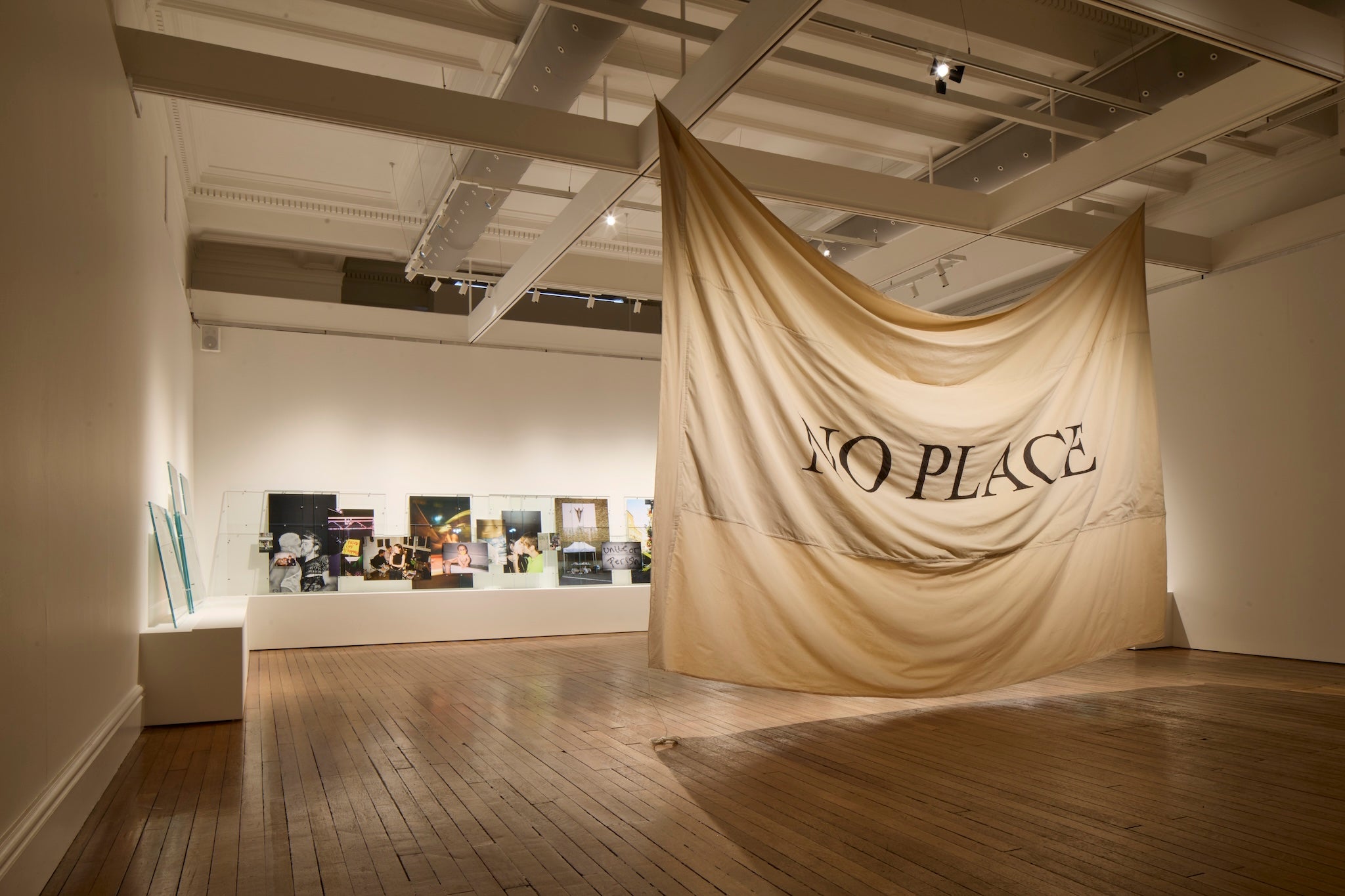
If that says something profound about the condition of contemporary Britain, far beyond the experience of one individual, it doesn’t translate sufficiently into Matić’s exhibition, which is bisected by a huge banner that reads “No Place” on one side, and “For Violence” on the other. While the slogan is drawn from American responses to the attempted assassination of Donald Trump in 2024, the work’s comment on “the contradictions between political words and actions” feels slight. Matić’s images of demos, political graffiti, and gay clubbers appear generalised, like stock images of now, and lack the sense of deeply personal involvement that is evident in the video.
Which returns us to Mohammed Sami. Wanting to deal with the traumas of his native Iraq without resorting to the clichés of news reportage – angry crowds, blasted corpses – he tries to make the intangible visible: the sound of a bullet, the presence of people who have just left the room. In The Grinder (2023), concentric circular forms, including a carpet and the ominous shadow of a large static ceiling fan, seem to pull us in, as though into a mill, towards a circular plywood table around which four chairs are loosely arranged. Whether some momentous meeting with potentially horrific consequences has just taken place, or a casual chat over coffee, we’re left to wonder. That feeling of mystery is intrinsically bound up with the mass of fragmentary brush strokes from which the image is constructed.
In the vast The Hunter’s Return (2025), a blasted palm forest emerges from a fog of orange dust, as though in the throes of some devastating battle. Any human presence, however, is hinted at only by the luminous green tracks of “military lasers” that seem to fizz across the morass of muddy paint. The feeling is of Apocalypse Now via computer games, with a touch of Monet.
I could go on. Sami’s long-term struggle to make himself understood with paint is evident in what we see on the canvas – not just in the accompanying wall texts – in a way that makes the other artists’ efforts feel a shade superficial. If the idea of the artist “wrestling” with their medium feels just a little old-school amid today’s atomised digitality, it certainly seems to be producing results.
Turner Prize 2025 is at Cartwright Hall, Bradford, from 27 September until 22 February
Join our commenting forum
Join thought-provoking conversations, follow other Independent readers and see their replies
Comments
Bookmark popover
Removed from bookmarks