David Bowie Centre: V&A East Storehouse review – Juxtaposing the culturally momentous and the quirkily trivial
Pinning down the nature of Bowie’s influence on the world isn’t easy, but with more than 90,000 items from his personal archive, the David Bowie Centre comes that much closer

That David Bowie is one of the most influential artists of the late 20th and early 21st centuries goes without saying – and that’s in the Tate Modern as much as the Billboard Hot 100 sense. Even the most mainstream music lover will concede that there’s vastly more to the boy from Beckenham than the sum of his greatest hits and even the extraordinary get-ups in which he brought fictional alter-egos such as Ziggy Stardust and the Thin White Duke before the world.
Yet pinning down the nature of Bowie‘s influence isn’t so easy. Nearly 10 years on from his death, he still feels palpably present in our culture, flitting between mediums and meanings like some amphetamined butterfly, barely contained in one conceptual frame before he appears in a subtly, or sometimes radically different form elsewhere. Now the V&A, whose hugely popular 2013 exhibition David Bowie Is was pivotal in establishing his image as a compulsive, intellectually ravenous autodidact, is providing the opportunity for an even deeper and more intimate dive into the Bowie legacy.
The opening of the David Bowie Centre, at the V&A East Storehouse in Stratford, will allow members of the public to book “one-on-one time” with their own selections from the 90,000-plus items in the artist’s personal archive, gifted to the museum by the David Bowie Estate in 2023. In other words, we all have the chance to get within smelling distance of – while preferably not touching – the costumes, stage-props, set designs, letters and handwritten lyrics that defined one of music’s most dreamed about figures.
The genesis of this extraordinary project gives a strong flavour of the man. While most of us these days think we’ve got too much “stuff”, Bowie kept his hoarded memorabilia in a museum-level, climate-controlled storage facility, with a full-time team of curators putting it in order. And appropriately for an artist who consciously projected himself into the fantasies of his fans while being, in many ways, the ultimate fan himself, he also held onto all of the thousands of pieces of “fan art” he was sent. A display in the centre’s entrance area includes a gold-haired, guitar-wielding Bowie fashioned from pipe cleaners, along with a meticulously hand-painted artist’s anatomical model showing the man himself in “Rebel Rebel”-era eye patch and bandana.
But before entering the centre’s exhibition area with its displays on diverse aspects of Bowie’s “multi-dimensional” creativity, I need to examine the items I was invited to request from the vaults of the collection. While my initial reaction was, “Surely it’s the totality that’s the point,” I homed in on “All the Young Dudes”, the song that announced the end of the great Sixties dream in 1972, and the album Low, which set the musical mood of the Eighties way ahead of the game in 1977.

_14.jpg?quality=75&width=230&crop=3%3A2%2Csmart&auto=webp)

While the archive apparently doesn’t have much on the former, three versions of the cover art for Low have been laid out on tables for me to inspect. This includes Bowie’s amateurish but rather poignant drawing of his first visual concept for the album, which was to have been called New Music: Night and Day. It shows, no doubt significantly, a young boy carefully painting a doll-like figure, as his mother watches from the shadows.
Alongside are the clapperboard from The Man Who Fell to Earth – a still from which provided the album’s final cover image – and the keys to the apartment Bowie lived in while recording the so-called Berlin Trilogy of albums – Low, Heroes and Lodger – widely regarded as the summit of his career. I’m almost in tears at what feels like my own private Bowie Christmas – and I don’t even consider myself a particular fan. This new facility will make a lot of people, from pop culture theorists to diehard Bowie aficionados, extremely happy.
Dominated by a 20ft high screen playing a rotating programme of Bowie videos in upright TikTok format, the display space comprises floor-to-ceiling vitrines, each focused on a different aspect of Bowie’s art and featuring a signature outfit. Transformational Creativity includes the tattered Union Jack frock coat, co-designed with Alexander McQueen and worn on the 1997 Earthling tour; an ancient-looking computer played on the Berlin Trilogy; a rather awkward Bowie self-portrait and the thickly encrusted palette used to paint it.

Barely noticeable alongside, but more revealing than any of these, is a letter from Bowie’s father recommending his 19-year-old son as an assistant to some swanky Mayfair firm, while he nurtures his then slowly evolving pop career. Signing himself Haywood S Jones, Dad, who was clearly no slouch himself in adopting roles and getting messages across, praises his son’s determination: “Whenever he takes on an idea of any kind, he never lets up and puts everything he has into it.”
While it’s become commonplace to describe Bowie’s propensity for self-invention as chameleon-like, or chameleonic, as the V&A have it, that feels far too passive an analogy. Where the chameleon changes its colour to blend into the background, the Bowie presented here, in displays on his interest in Black music from Little Richard to Kendrick Lamar, his obsession with science fiction, and a baffling array of unfinished projects, feels almost violently self-assertive. Bowie’s determination to manifest his creativity across the widest array of fronts, from fashion to finance to pioneering experiments with the internet, is truly mind-boggling. The self-discipline and capacity for organisation hinted at by his father was maintained even in the teeth of serious drug addiction.
The exhibition’s juxtaposition of the culturally momentous and the quirkily trivial is perhaps best summed up in a display on the social impact of Bowie’s art, dominated by a stylised Germanic eagle with expanding golden wings, used as both a prop and a costume on Bowie’s 1987 Glass Spider tour. The Berlin date took place right beside the Berlin Wall – so memorably evoked in the song “Heroes” – causing riots in East Berlin just two years before the Wall came down.
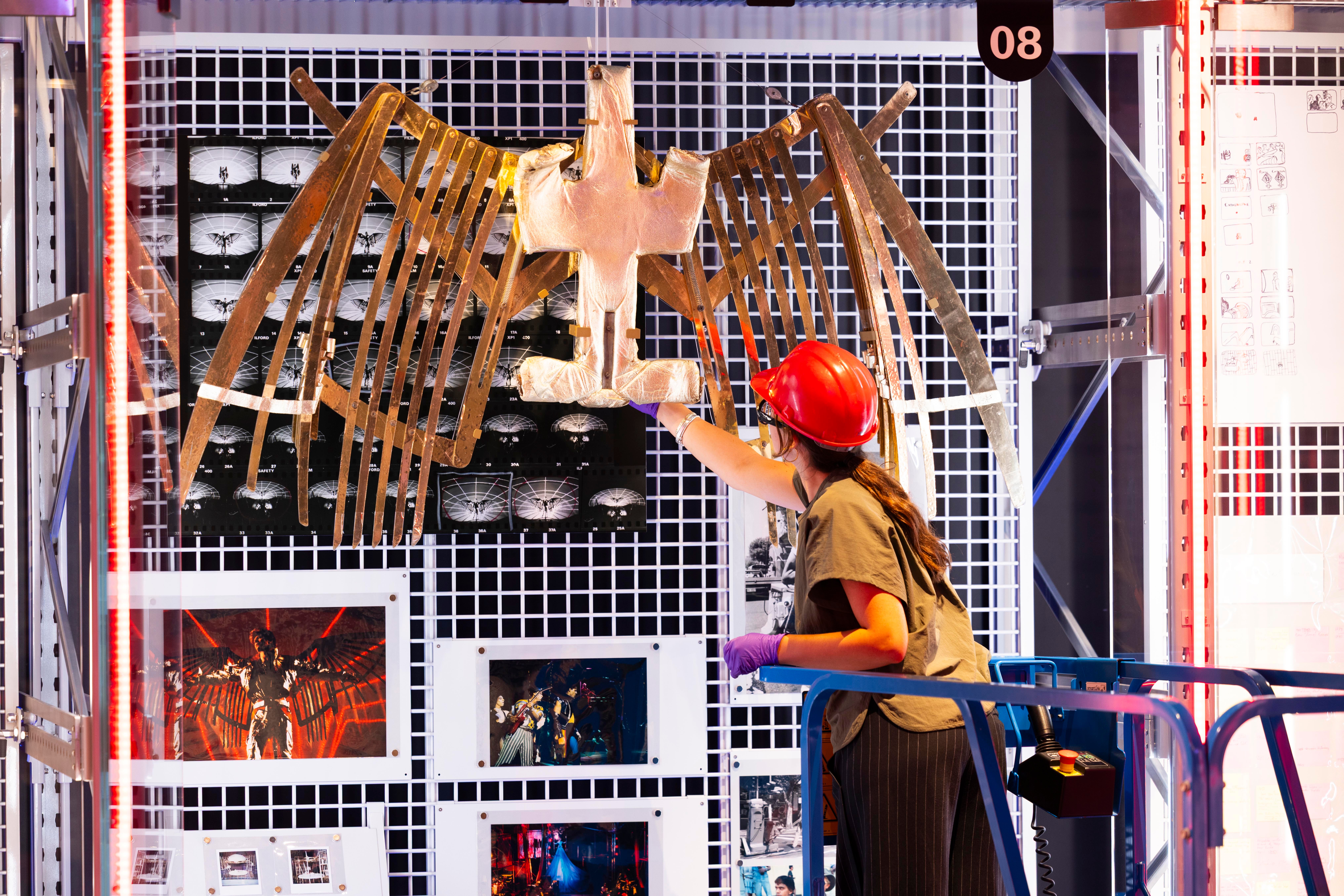
Close by is a menu card on which Bowie, singer Iggy Pop and producer Tony Visconti have each “signed” the dishes they ate in a meal in a posh Berlin restaurant during the recording of Pop’s album The Idiot. The latter item might seem a micro-curiosity of interest only to the most diehard fan. But not only is it executed far more stylishly than most of us would have managed, and it’s associated with a highly influential album, but we can sense Bowie already planning the object’s place in the gesamtkunstwerk – “total work of art” – of his archive even as the apparently childish gesture is being performed.
What “everybody” now proverbially does in terms of staging their lives on social media, putting the photos of the meal online even when it’s still being eaten, Bowie was effectively doing decades before the internet existed, and on a scale most of us could barely dream about.
From 13 September, at the V&A East Storehouse, Parkes St, London E20 3AX. Access is free and ticketed
Join our commenting forum
Join thought-provoking conversations, follow other Independent readers and see their replies
Comments
Bookmark popover
Removed from bookmarks