Anselm Kiefer takes on Van Gogh, with results both heroic and absurd
Plenty of artists have dreamed they could somehow be Van Gogh – only Kiefer has had the bottle to follow through
Anselm Kiefer doesn’t waste time on false modesty. The German artist, born 1945, found notoriety in his Occupations series of multimedia works from 1969, giving the Sieg Heil salute (still a forbidden act in Germany) on a lone mission, as he saw it, to expose German guilt. He’s as famous these days for vast installations exhibited in studios and sculpture parks that rival the size of small towns, as he is for his original discipline, painting. When he told me in an interview around his 2014 Royal Academy retrospective that he hadn’t felt the need to attend art school “because I am a genius”, there was a sense that the accompanying chuckle at his former hubris was only half-ironic.
The fact that this most visibly successful of artists (ranked among Germany’s 1,000 richest individuals in 2017) should have had a lifelong obsession with an artist who never sold a painting and shot himself at the age of 37, doesn’t come as the slightest surprise. If you’re going to identify with one artist, why not make it the one with whom we are all “obsessed” to one degree or another, whose self-sacrifice in the cause of art makes him the nearest thing we have to Christ in paint?
This fascinating exhibition, which displays 11 carefully selected Van Gogh paintings and drawings beside 14 Kiefer works, shows that Kiefer’s preoccupation with the world’s best-loved artist goes far beyond mere “influence”. His works here range from teenage drawings done on a hitchhiking trip to the south of France – “in the footsteps of Van Gogh” – to more recent and typically enormous paintings that reveal how many of Kiefer’s key tropes have been formed in response to Van Gogh.
 Not everyone will love Jenny Saville’s visceral art, but it makes most other contemporary figurative paintings look amateurish in comparison
 The hedonist and the occultist: how two queer artists responded to the mundanity of England between the wars
.jpg?quality=75&width=230&crop=3%3A2%2Csmart&auto=webp) The Liverpool Biennial 2025 is full of intriguing insights rather than big show-stopping moments
The Liverpool Biennial 2025 is full of intriguing insights rather than big show-stopping moments
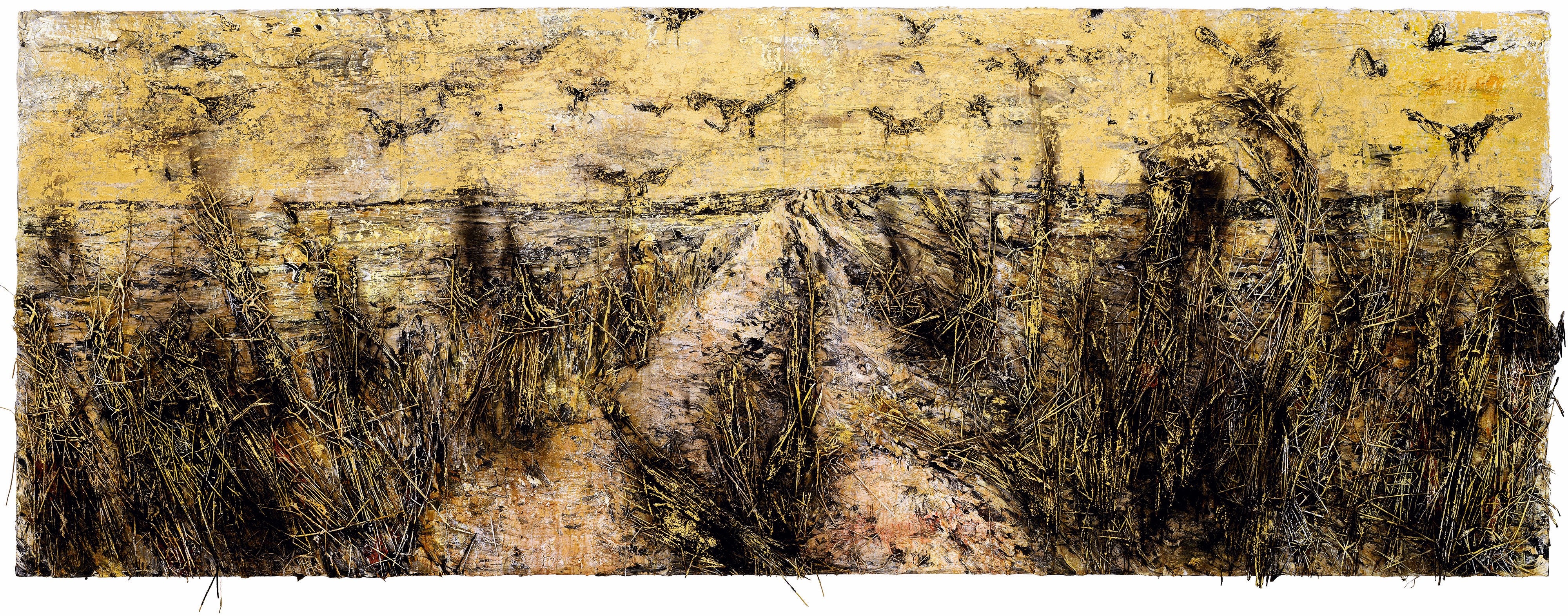
Several of these are on display in the vast painting (most things related to Kiefer tend to be “vast”) that confronts us as we enter. Like many of the works here, The Crows (2019) takes on that quintessential Van Gogh subject, the cornfield, while referencing the ominous birds hanging in the sky of Wheatfield with Crows (1890), long believed to be his last piece. Not content with simply painting the ripe corn stalks stretching towards the horizon, Kiefer grafts bundles of actual corn stalks onto the canvas, embedding them into splurges of oil paint, much of it black, creating the rather sinister sense of a landscape that is at once radiant and charred.
The use of gold leaf that encrusts much of the surface, filling the sky and covering the crows, has been a key feature of Kiefer’s painting of the past 20 years, and has evolved, the artist reveals in a fascinating catalogue essay, very much in response to the “golden” quality of Van Gogh’s paintings. Where Vincent evokes the life-giving radiance of the Mediterranean sun and the aura of his sunflowers using varied yellows and whites, Kiefer observes that his use of flat yellow backgrounds in some landscapes and portraits brings to mind the “gold grounds” created by medieval artists – which employ actual gold. That gave him license to lard his own paintings in gold leaf.
.jpg)
This use of gold, which is a metallic element, not a colour, brings a fatal decorativeness to the work. The Crows is undeniably imposing, but its impact is fundamentally theatrical, like a stage backdrop waiting for actors, rather than a painting that is complete in itself. And that sense of completeness is something that even the smallest Van Gogh, including the very modest Piles of French Novels (1887) hanging on the adjacent wall, has in its very essence.
Kiefer, according to his essay, was attracted to Van Gogh less by his quasi-messianic backstory, than by his “lack of talent” – meaning, I assume, a slick facility with paint – a quality he shares with another great artist. Yes, Kiefer himself. Where the Impressionists sought to capture the fleeting sensations of light, Van Gogh, in Kiefer’s estimation, used the elements of visual language, blocks of colour and texture and varied brush marks to reveal the “secrets of the Earth”.
Van Gogh’s conception of “the Earth”, however, feels very different from Kiefer’s. Where Van Gogh’s painting, even at its most desperate, has that sense of the life-enhancing we all love so much, Kiefer couldn’t create a straightforward “beautiful” landscape if he had a gun to his head. Instead, Kiefer’s quintessential inner landscape, seen in the show’s most impressive work – the immense, near monochrome The Last Load (2019) – recalls the flat, bleak farmland to the west of his home region of Freiburg, at a point where France, Germany and the Low Countries meet – the site of so much conflict over the centuries.

Ploughed trails seem to compete for space over a vast field, rendered in huge amounts of emulsion, acrylic and oil paint churned into furrows by Kiefer’s brush. Touches of yellow and red are thrown in as though the paint is being mixed on the canvas right before our eyes. As an exercise in sheer painterly texture-making, it’s masterly, and the charred-looking trees on the horizon bring a sense of a Europe devastated by Germany’s wars. Well, Kiefer wouldn’t be Kiefer if he weren’t somewhere revelling in guilt.
The nearest the show comes to uniting the two artists’ radically different sensibilities are two beautiful, if slightly dour Van Gogh landscape drawings, Lane with Poplars (1884) and A Country Road (1882), both of which effortlessly capture the immemorial flatness of his homeland. Landscape drawings by Kiefer, from his 18-year-old, Van Gogh-inspired journey of self-discovery, don’t quite count, as he is so clearly and self-consciously trying to be Van Gogh – and doing a pretty good job of it in at least two of the examples we’re shown. His charcoal portraits of contemporary citizens of Arles hang beside one of Van Gogh’s four iconic portraits of the woman he called L’Arlesienne. Kiefer’s hunting out of subjects who had the feel of the kind of people painted by Van Gogh, shows a very mature sense that his teenage pursuit of Van Gogh was a kind of performance.
The purpose of Kiefer’s highly personalised restaging of Van Gogh feels oddly clearer in these earnest juvenile works than it does in the show’s gigantic, wall-filling climactic piece, The Starry Night (2019), created nearly 60 years later. The title takes us instantly to Van Gogh’s painting of the same name, arguably his most famous work, showing the sky over Arles positively alive with stars. Here Kiefer has recreated the spiralling form that surges through the centre of the painting – that represents to him a dragon – in bales of gilded straw against a pale turquoise background. If I couldn’t help chuckling at Kiefer’s preposterous grandstanding – though the work is undeniably impressive simply as a physical object – equally I couldn’t work out what he was trying to achieve by it, or what he imagines the viewer will get from the work.
Yet if it’s tempting to write Kiefer off as an undeniably brilliant showman whose later work goes endlessly through a limited range of postures, while Van Gogh’s work remains stoically and transcendently itself, I wouldn’t write Kiefer or this show’s intentions off quite so lightly.
Plenty of artists have dreamed they could somehow be Van Gogh. Only Kiefer has had the bottle – and, I dare say, the resources – to carry that idea to the levels of the heroic, and sometimes the absurd, seen in this exhibition.
‘Kiefer – Van Gogh’ is at the Royal Academy of Arts from 28 June until 26 October
Join our commenting forum
Join thought-provoking conversations, follow other Independent readers and see their replies
Comments
Bookmark popover
Removed from bookmarks