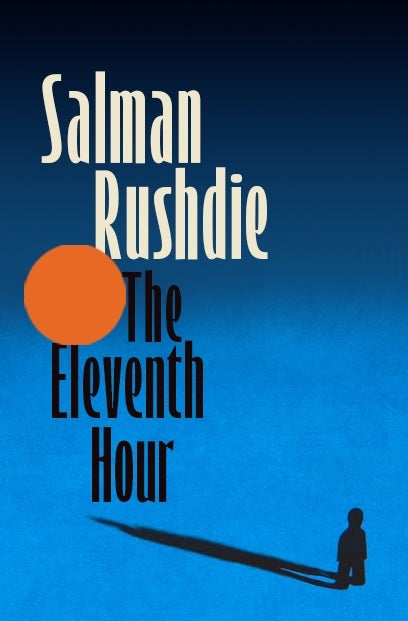
Salman Rushdie: The Eleventh Hour review – Musings on mortality loom over the author’s first fiction since the attack that nearly claimed his life
Impactful fiction from one of the most important voices in contemporary literature


In “Late”, one of the three almost novella-length stories in Salman Rushdie’s new collection, The Eleventh Hour, a ghost comes to believe that none of his former academic colleagues really care that he is kaput, remarking of death: “You doffed your hat to it and moved on.”
It is no surprise that mortality is one of the major themes of Rushdie’s first work of fiction since the horrific near-fatal assault on stage at the Chautauqua Institution in 2022, when the author was stabbed 15 times in 27 seconds, resulting in blindness in his right eye. He wrote candidly about the onslaught in 2024’s Knife: Meditations After an Attempted Murder. Although the assailant's actions shocked the world, it was not entirely out of the blue. Rushdie had lived in fear of a deadly attack since his 1998 novel The Satanic Verses prompted the Iranian leader Ayatollah Khomeini to issue a fatwa calling for the writer’s assassination.
The Eleventh Hour, whose five stories are made up of two other previously published tales, moves between the three countries he has called home: England, the US and India (where he was born in 1947). One suspects, however, that the famous writer feels rather like the young Indian university student in “Late”, of whom the narrator says, “her hometown was far away. Books were her homeland now.”



Many of the recurring subjects in Rushdie’s fiction – identity, migration, myth, freedom of speech and the search for truth – have been present since his 1975 debut, the uneven science fiction novel Grimus; they feature again in The Eleventh Hour. The opening story, “In the South”, was originally published in The New Yorker in 2009 and is one of the most satisfying of the quintet. The two protagonists, who live near Elliot’s Beach in Chennai, are octogenarians called Junior V. and Senior V. They emerge on adjacent balconies each morning to bicker – “two old men quarrelling to the death” – and accompany one another on weekly treks to the post office to cash their pension slips. They are so similar, without acknowledging it, that they are described as “two shadows”.
Rushdie presents them as deluded old “Everymen”, beset by health problems (which he neatly calls “the slow failing of the soft machine”) and a rapidly changing world. Tragedy strikes one of them hours before the tsunami of Christmas 2004 that devastated the region, including the nearby coastal town of Nochikuppam. The deadly tidal wave provides a metaphorical backdrop to anguished thoughts as to “why not me?” and whether “life is meaningless”.
Who better to weigh in on the necessary “freedom” to disagree than an author who spent a decade in hiding after that fatwa?
The second story, a new one called “The Musician of Kahani”, is the most dramatic of the five. Rushdie was born in Mumbai (then called Bombay) to a Muslim family, and his later global fame has inevitably drawn him to reflect on celebrity and success, both central themes in a yarn that features alliteration aplenty: “various vicissitudes”; “masters of music”; and “deepen his depression”. Multi-instrumentalist Chandri, a hyperintelligent, prodigiously talented musician, wants to command her own destiny in a man’s world – rather like the mythical princess Qara Köz in Rushdie’s 2008 novel The Enchantress of Florence. However, it’s a man’s world in “The Musician of Kahani” and this suits Majnoo, a celebrated playboy cricketer who loves nightclubs, fashion models and fast cars. Chandni unexpectedly falls for him – Rushdie resorts to the clichés “love lands where it lands” and “the heart wants what it wants” (a phrase popularised by Woody Allen, although actually from a letter written by Emily Dickinson in 1862).
Rushdie has fun lampooning Majnoo’s wealthy, loathsome parents (Jimmy and Dimmy), who care only about “The Family Brand” and a share of the limelight. That said, I was untickled by the flat cricket jokes the author delivers, and unconvinced by dialogue such as “wipe that glummery off of your kisser”.
Events come off the rails as Chandni is due to deliver a “billion dollar baby” and although the plot is energetic – there are sex cults, internet and media frenzies and supernatural goings-on – it never quite gels into a gratifying standalone tale. I recognise that it’s not fair to judge Rushdie by the standards of master short story writers such as Anton Chekhov, Flannery O’Connor, Raymond Carver or William Trevor, but “The Musician of Kahani” lacks the genuine boisterous inventiveness of Rushdie’s previous collection, 1994’s nine-story East, West.
As with East, West, there is striking poignancy in several stories in The Eleventh Hour, especially the 73-page “Late”, which explores legacy through the afterlife of an English academic, whose ghost communicates with a lonely Indian student. She helps him avenge a terrible wrong from his past when he suffered in an era of sexual repression. Expiry is again a central topic, with the spirit reflecting on the fact that we all end up like “a lump of sugar dissolving slowly in water”.
Rushdie is a huge admirer of Franz Kafka (he called Metamorphosis “unbeatable”), and Kafka’s incomplete novel Amerika comes into “Oklahoma”, his meditation on what it is to disappear. The story, like some of Rushdie’s best work, is intricately structured and concerned with identity and deceit. In this cryptic tale, a young writer investigates whether his mentor faked his own death. The prospect of being alienated from the current world – as well as the terror of change – features in “Oklahoma”, which is about the quest of writing itself. Does an author “steal” real people? Parts of the tale come across as Rushdie in dialogue with himself.
The Eleventh Hour is the latest addition to Rushdie’s oeuvre, a body of work that encompasses 13 novels and intertwines history, myth, politics and identity. The best of it speaks across cultures, which is especially true of 1981’s Midnight’s Children, a masterpiece that was later named “Best of the Booker”. I would also recommend 1983’s Shame and 1999’s The Ground Beneath Her Feet ahead of the chewy historical epics Quichotte or Victory City.
‘The Old Man in the Piazza’ reveals how even the least dynamic of us can be easily seduced by the prospect of a little power
The concluding story, “The Old Man in the Piazza”, was first published in 2020. It revolves around a man who, every day, sits at a café on the opposite side of a piazza from “our language,” who is female. The parable story, set in a locale that is deliberately nonspecific, is in part Rushdie tipping his hat to the admired writer Italo Calvino. Rushdie explores what it means for the old man, who has been an observer for decades, to suddenly become the judge of everyone’s disputes.
“The Old Man in the Piazza” not only satirises ideological laziness – Rushdie remarks that the world has turned from devotees of doubt to a place of “bar-room moralists” – it also reveals how even the least dynamic of us can be easily seduced by the prospect of a little power. Amusingly, Rushdie admitted that the story was sparked by watching the wild car chase at the climax of the original Pink Panther movie, when a gentleman impassively watches as cars zoom past in every direction, with one driver in a gorilla outfit. The serious focus of his story is the change in language and debates over what constitutes acceptable discourse. Who better to weigh in on the necessary “freedom” to disagree than an author who spent a decade in hiding after that fatwa?
One of the most touching moments of The Eleventh Hour arrives when the narrator of “The Musician of Kahani” is walking around Rushdie’s former home city of Mumbai and recalling long lost memories: “I am visiting my yesterdays one last time and they are visiting me. I will not come this way again.” At 78, Rushdie is still publishing impactful work; we can all doff our hats to one of the most important voices in contemporary literature.
‘The Eleventh Hour’ by Salman Rushdie is published by Jonathan Cape on 4 November, £18.99
Join our commenting forum
Join thought-provoking conversations, follow other Independent readers and see their replies
Comments
Bookmark popover
Removed from bookmarks