Timothée Supreme: How Chalamet finally escaped boy-next-door purgatory
The actor’s new role as ping-pong prodigy Marty Mauser has seen him emerge as the Best Actor frontrunner this awards season, bagging his latest win at the Golden Globes. It’s a watershed moment for a star whose ascendant career has not been without its teething issues, writes Xan Brooks
Marty Supreme begins with a bang: with a snap of suspenders, a hurried climax and a montage of sperm attempting to break into an egg. Those tiny swimming tadpoles come with a message and set the film’s direction of travel, reminding us that some scrawny hopefuls are tougher and more persistent than others. That’s certainly the case with Marty Mauser, the hustling anti-hero of Josh Safdie’s underdog fable, just as it’s true of Timothée Chalamet, the film’s headline star. Earlier this month, Chalamet won the Critics Choice award for his performance and last night picked up the Golden Globe. He’s now the odds-on bookies’ favourite for the Best Actor Oscar.
While bookies, like hustlers, aren’t always to be trusted, there’s something undeniably thrilling about Chalamet’s turn as Marty, a runtish shoe salesman in early 1950s Manhattan who fancies himself as a ping-pong superstar. Marty paddles through the action like Augie March’s east coast cousin; a wheedling freestyle opportunist with a listing whip of Brylcreemed hair and a moustache that resembles a malnourished caterpillar. He’s incorrigible, reprehensible, a thief and a liar fuelled by self-entitlement and self-pity.
The fact that we’re able to stomach him – let alone cheer for him – is chiefly down to Chalamet, who makes the man nuanced and convincing without once softening his edges. This has already been a fine, varied year for Best Actor Oscar candidates and so Academy voters may yet be swayed by Ethan Hawke’s high-style emoting in Blue Moon or Joel Edgerton’s tight-lipped restraint in the tragic Train Dreams. It’s Marty Supreme, though, that provides the season’s biggest firework display.
As for Chalamet, the film feels like a significant step change, a coming-of-age breakthrough for a performer who has always looked younger than his years and was therefore stuck playing children for longer than was strictly healthy. Hollywood stars are defined as much by their genes as they are by their acting genius and it was Chalamet’s fate to embody Elio Perlman, the doe-eyed teenage hero of Call Me By Your Name (2017), almost too perfectly. The role secured his first Oscar nomination and made him an international sensation, but it also led to his being typecast as an emblem of limpid, sensitive youth, just as other performers get typecast as dopey dads or by-the-book police commissioners.
None of Chalamet’s subsequent pictures were outright duds, exactly. He was fine as the handsome prince in Lady Bird (2018), functional as the anguished addict in Beautiful Boy (2018) and just about tolerable as a student firebrand in Wes Anderson’s The French Dispatch (2021), a film that wouldn’t know a firebrand if one came and set its pastel-coloured stage-flats alight. It was only his portrayal of callow Henry V in The King (2019) that properly strained credibility, in the way it had him squaring up to actors twice his size, hacking and slashing a path through the armoured French forces like a kid playing dress-up in his suburban back bedroom. Most films demand a certain leap of faith from the viewer. The King, though, required a standing jump across the English Channel.
Naturally the 29-year-old star will never be cut out for a Schwarzenegger-style action career. Physically and aesthetically, the role doesn’t suit him. He represents a different brand of 21st-century masculinity. The New York Times last year hailed Chalamet as the unofficial frontman of a group it dubbed “the Noodle Boys”, a gang of “twiggy”, androgynous-looking performers that included Stranger Things’ Finn Wolfhard, Dominic Sessa of The Holdovers (2023) and Russian-born Mark Eydelshteyn, who played the Brighton Beach brat in the Oscar-winning Anora (2024).
That’s a neat cover-all label so far as it goes. Except that every noodle boy is just the latest iteration of the boy-next-door, a Hollywood archetype that’s as old as the malt shop and the white picket fence. And if past evidence tells us anything, it’s that boys-next-door peak early and then have to adapt and regroup. Mickey Rooney aged like milk and the magnificent Montgomery Clift self-destructed. Anthony Perkins turned inward, went dark and reframed the clean-cut all-American as a knife-wielding psycho killer.



Alternatively, consider the case of Leonardo DiCaprio, the fresh-faced poster boy of Nineties Hollywood, who has recently installed himself as Chalamet’s wise old mentor. “No superhero movies and no hard drugs,” DiCaprio told his pupil, which is sensible advice on both counts.
And yet it’s DiCaprio’s own career that provides the most reliable roadmap for Chalamet, because it shows how he was able to weather that first blast of fame and transition to rewarding grown-up roles – tentatively at first with The Aviator (2004) and Blood Diamond (2006), then bullishly, victoriously, with the likes of The Revenant (2015) and Once Upon a Time in Hollywood (2019). Probably every young actor undergoes the career equivalent of an adolescent phase, an awkward few years where they can’t quite convince as a fully-formed adult. But the good ones – the tough swimmers – finally emerge all the stronger.
“This is probably my best performance,” Chalamet has bragged about his role in Marty Supreme. “This is really some top-level s***.” That’s the sort of thing that Marty himself might say, a bit of postmodern promotional circus barking, liable to annoy at least as many people as it amuses. And yet annoyingly, he’s right: there’s no doubt about it. As he closes in on his 30th birthday, the actor has grown into the frame and moved up through the gears, from Dune (2021), Wonka (2023) and A Complete Unknown (2024) to what is far and away his most compelling grown-up role to date.
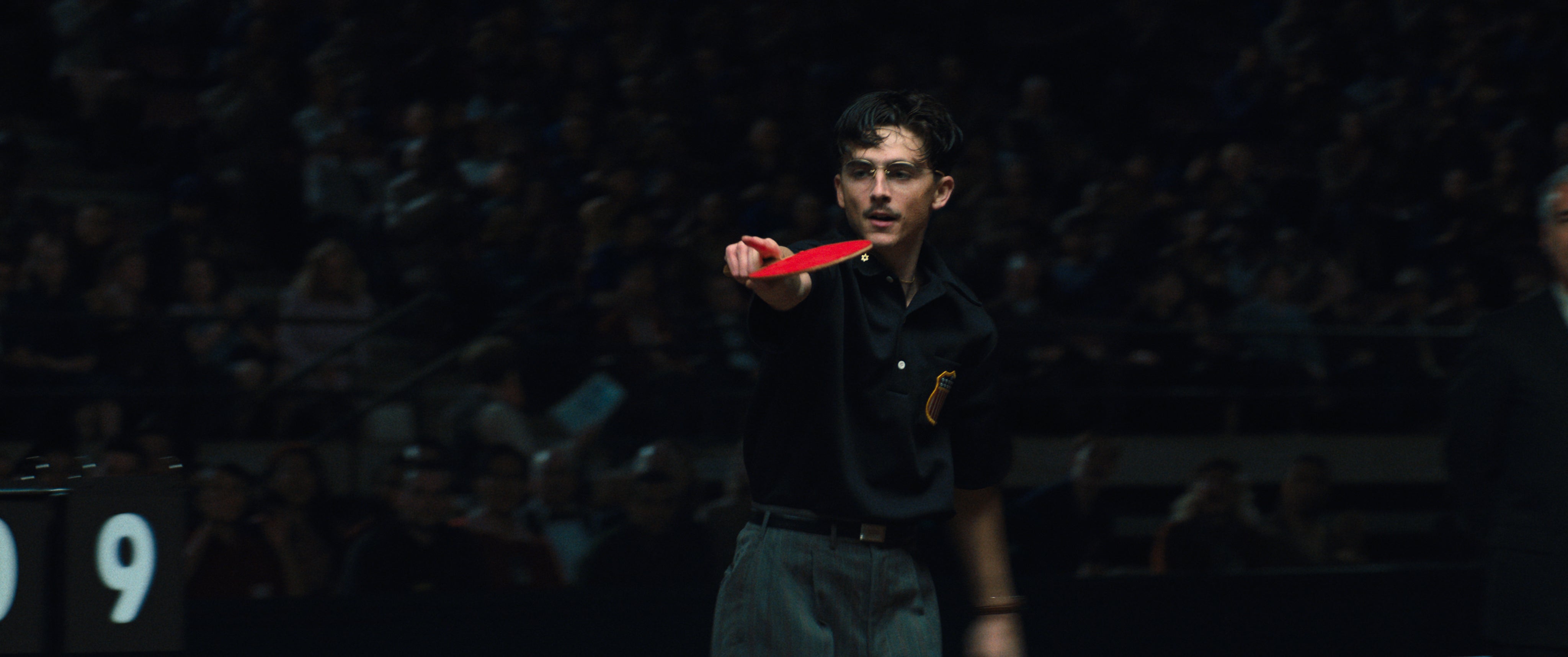
On screen, volatile Marty Mauser is eventually pitted against Koto Endo (Koto Kawaguchi), an ice-cool table tennis champion from Japan. Off screen, if the bookies are to be believed, Chalamet’s main Oscar rival is none other than his mentor, DiCaprio, who plays the rackety dad in One Battle After Another (2025). The brash young gun versus the serene aged samurai. The battle of the former boys-next-door. That’s the kind of cheesy Hollywood ending that would make a cineaste blush, but it plays to the gallery and its showbiz panache can’t be faulted. It’s a late-breaking twist that would bring the picture’s story full circle; a real-world climax at the Academy Awards ceremony, ensuring that Marty Supreme both comes in with a bang and goes out with one too.
‘Marty Supreme’ is out in UK cinemas from Boxing Day
Join our commenting forum
Join thought-provoking conversations, follow other Independent readers and see their replies
Comments
Bookmark popover
Removed from bookmarks