Preserving the Hezhe voices
THE ARTICLES ON THESE PAGES ARE PRODUCED BY CHINA DAILY, WHICH TAKES SOLE RESPONSIBILITY FOR THE CONTENTS

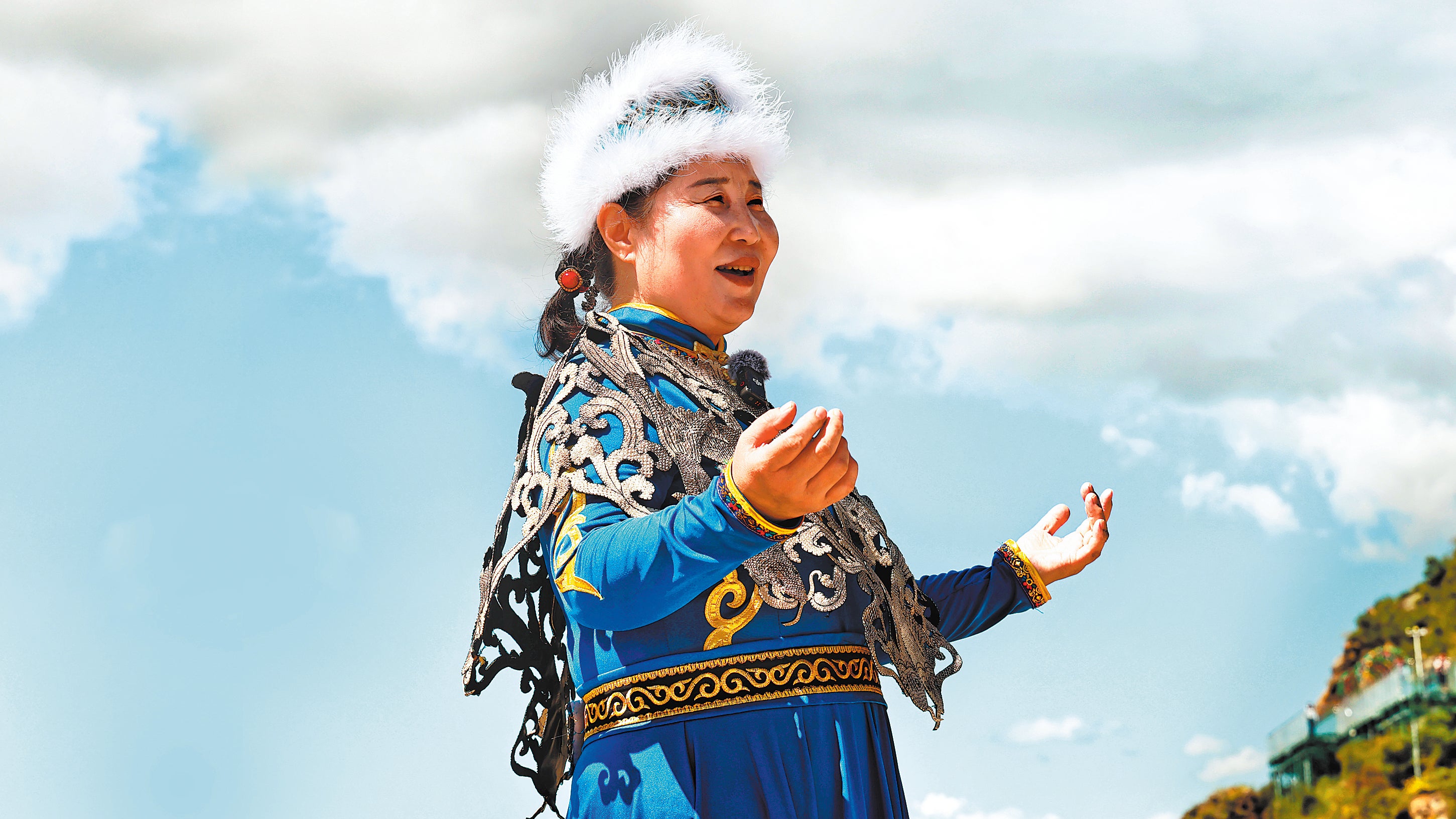
In northeastern China, where the Heilong and Songhua rivers converge, lies Tongjiang, the birthplace and cultural heartland of the Hezhe, one of the smallest ethnic groups in the country with a population of just over 5,000.
Tongjiang, a small yet historically significant city, is home to nearly one-third of the Hezhe population, with 1,643 Hezhe people residing there, according to the Tongjiang government website.
For centuries, this region has been a sanctuary for the preservation, accumulation and transmission of Hezhe culture.
The Hezhe are a proud ethnic group with a rich heritage rooted in fishing and hunting. Their unique culture includes mystical shamanistic dances, the haunting sounds of the jaw harp, and perhaps most notably, the traditional oral performance art of Yimakan storytelling.
Inscribed in 2011 on the List of Intangible Cultural Heritage in Need of Urgent Safeguarding by UNESCO, Yimakan storytelling is an oral art in the form of singing and speaking that has been transmitted from generation to generation by the Hezhe people, who speak a language without a written form. It serves not only as a historical record of the Hezhe’s past but also as a living testament to their spirit and values.
In recent years, Hezhe inheritors have taken up the mission of preserving Yimakan, breathing new life into this ancient art form. One such person is You Mingfang, a 60-year-old woman who is part of the ongoing effort to safeguard and pass on the tradition of Yimakan.
Born and raised in Tongjiang, You was immersed in Hezhe culture from a young age. Her childhood was filled with the sounds of her elders speaking Hezhe, a language that, despite the challenges of modern times, has always been a cornerstone of her family life.
“I grew up learning the Hezhe language with my father. When I was little, my father would lie in bed with us, and we practiced speaking it together,” she recalls.
The art of Yimakan was passed down to her through oral tradition, deeply ingrained in the everyday life of the community.
“I never formally learned Yimakan until much later, but I remember hearing it during family gatherings, especially when we sat together during long winter nights,” she says, reflecting on how these experiences shaped her understanding of this art form.

Yimakan is known for its ability to weave together storytelling and song, creating a rhythm that feels both intimate and powerful. At first, You didn’t understand what the art form truly was, but over time she learned that it encapsulates everything from myths and legends to the stories of love, war and daily life.
“I grew particularly fond of the myths, which have such a magical quality to them,” she says.
The importance of Yimakan has not gone unnoticed by scholars. Hou Ru, an associate researcher at the Heilongjiang Provincial Academy of Social Sciences, began her academic journey with a focus on the Hezhe people in 2012.
“When I first started my research, I was drawn to Yimakan because of its unique value and the pressing need for its protection,” she says.
Over the years, Hou has worked tirelessly to document and safeguard the stories, songs and performances that constitute Yimakan.
“Yimakan is not just an art form; it’s a living history of the Hezhe people,” she says.
“It reflects their society, religion, historical struggles and way of life. Through Yimakan, we can see their connection to nature, to their ancestors and to each other.”
Hou’s work also involves documenting and protecting the Hezhe language, which plays a central role in the performance of Yimakan.
Without a standardized written script, preserving the language is as vital as safeguarding the art form it supports.
“Yimakan and the Hezhe language are inseparable,” Hou says.
“Without the language, the songs and stories lose their meaning.”
The local community in Tongjiang, particularly through You and others, has worked to engage younger generations with the art. Schools and community centers now offer classes in the Hezhe language and the performance of Yimakan, fostering a new generation of performers.
“The younger generation is no longer just passive listeners. They want to learn and perform it themselves, which is incredibly encouraging,” You says.
New forms of media, including online platforms and digital archives, have also helped Yimakan become more accessible to a broader audience.
Moreover, the integration of Yimakan into local tourism and cultural events has brought it to the attention of both locals and tourists.
“I want it to be something that feels alive, something that people can experience and relate to.”
Bookmark popover
Removed from bookmarks