Hundreds protest outside Bangladesh embassy in Delhi as tensions soar over Hindu man’s death
Some protesters burnt pictures of Bangladesh’s interim leader Muhammad Yunus, while others demanded a boycott

Hundreds of people protested outside the Bangladesh High Commission in Delhi on Tuesday over the lynching and burning of a Hindu man in Bangladesh, as tensions between the two neighbours intensified.
The demonstration in Delhi followed the killing of Dipu Chandra Das, a 25-year-old factory worker who was beaten and set on fire last week in Bangladesh’s Mymensingh district after a crowd accused him of blasphemy, according to Reuters. Bangladeshi police said at least 10 people have been arrested in connection with his death.
The protest in Delhi was led largely by the Vishva Hindu Parishad and other right-wing Hindu groups. Demonstrators shouted slogans accusing Bangladeshi authorities of failing to protect minorities and carried placards reading “India will not tolerate torture of Hindus in Bangladesh” and “Our silence should not be mistaken as weakness, we are lions”.
Police erected multiple layers of barricades around the diplomatic enclave and deployed armoured vehicles and a heavy security presence. Television footage showed protesters clashing with police as they attempted to push through barriers set up roughly 800 metres from the mission.
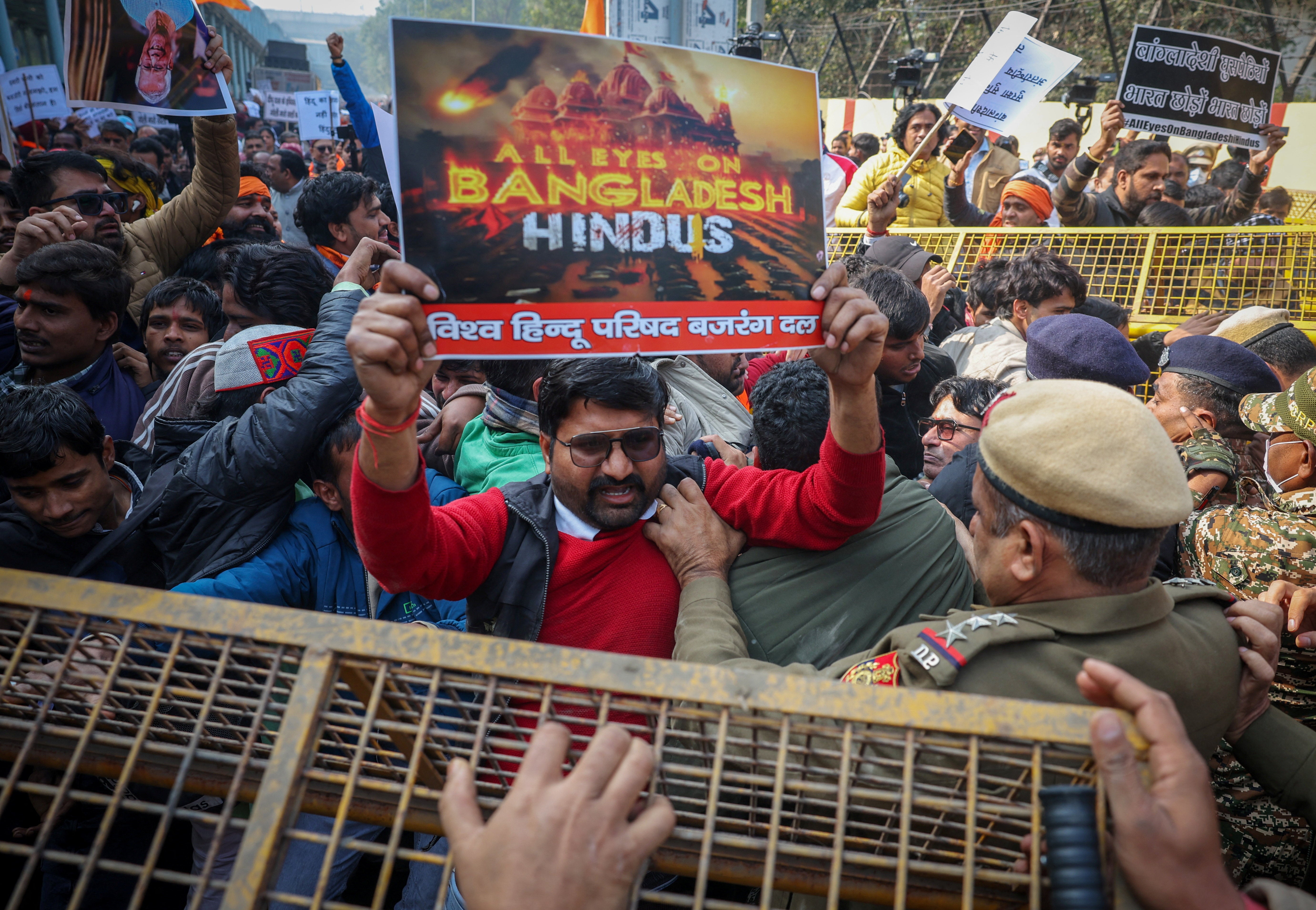
Some protesters burnt pictures of Bangladesh’s interim leader Muhammad Yunus, while others demanded a general boycott of Bangladesh.
One protester, Rajkumar Jindal, told the Associated Press that there would be “dire consequences” if violence against Hindus in Bangladesh did not stop. “People who are committing atrocities should stop doing that. We are here to awaken the people who are asleep,” he said.
The killing of Das has intensified tensions between India and Bangladesh, which have risen steadily since the ouster of former prime minister and India ally Sheikh Hasina last year. Hasina, who has been convicted of crimes against humanity in her absence by a Bangladesh tribunal, is living in exile in India.
Critics of the interim government that replaced Hasina have accused the Yunus administration of failing to protect minority groups, including Hindus and Christians, as well as members of Hasina’s ousted ruling party. The government has rejected the allegations.
The latest unrest has unfolded against a volatile political backdrop in Bangladesh. Earlier this month, student activist Sharif Osman Hadi was shot in Dhaka and later died in hospital in Singapore. Bangladeshi police said they had identified suspects and believed the gunman may have fled to India.
Hadi’s death triggered widespread violence in Dhaka, with offices of national newspapers torched and protests that targeted Indian diplomatic missions.
In response to protests in Delhi on Tuesday, Bangladesh’s foreign ministry said it summoned India’s high commissioner to Dhaka, Pranay Verma, to express “grave concern” over protests and acts of vandalism near diplomatic premises in India, including its high commission and a visa centre in Siliguri.
Bangladesh condemned what it described as “premeditated violence or intimidation” against its diplomatic establishments and urged India to ensure their protection in line with its international obligations.
India’s foreign ministry said earlier that a smaller protest near the Bangladesh High Commission over the weekend had been dispersed quickly and that Delhi remained committed to ensuring the safety of foreign missions.
Analysts said the latest flare-up risks undermining cooperation between India and Bangladesh on trade, border management and regional connectivity at a time of economic uncertainty. Sreeram Sundar Chaulia, an international affairs expert at Jindal School of International Affairs in New Delhi, told the Associated Press that the rupture could also push Bangladesh closer to China if relations with India deteriorate further.
"Opposing India and alleging Indian conspiracies of interference in Bangladesh are being done in order to harden a blatantly Islamist and non-inclusive path for the country," Mr Chaulia said.
India and Bangladesh had enjoyed close ties since 2009, when Ms Hasina came to power, with cooperation spanning security, infrastructure and trade. Her opponents accused her government of being overly aligned with Indian interests, an accusation that has resurfaced sharply since her removal and the violence that has followed.
Join our commenting forum
Join thought-provoking conversations, follow other Independent readers and see their replies
Comments
Bookmark popover
Removed from bookmarks