Physicists prove long-held theory light can be made from nothingness of vacuum
Researchers say simulation experiment may pave way to look for dark matter particles
Scientists have demonstrated after decades of theorising how light interacts with vacuum, recreating a bizarre phenomenon predicted by quantum physics.
Oxford University physicists ran simulations to test how intense laser beams alter vacuum, a state once thought to be empty but predicted by quantum physics to be full of fleeting, temporary particle pairs.
Classical physics predicts that light beams pass through each other undisturbed. But quantum mechanics holds that even what we know as vacuum is always brimming with fleeting particles, which pop in and out of existence, causing light to be scattered.
The latest simulations, detailed in a study published in Communications Physics, recreated a strange phenomenon predicted by quantum physics.
The theory predicts that the combined effect of three focused laser pulses can alter virtual particles in vacuum, generating a fourth laser beam in a “light from darkness” process. “This is not just an academic curiosity,” study co-author Peter Norreys said. “It is a major step towards experimental confirmation of quantum effects that until now have been mostly theoretical.”
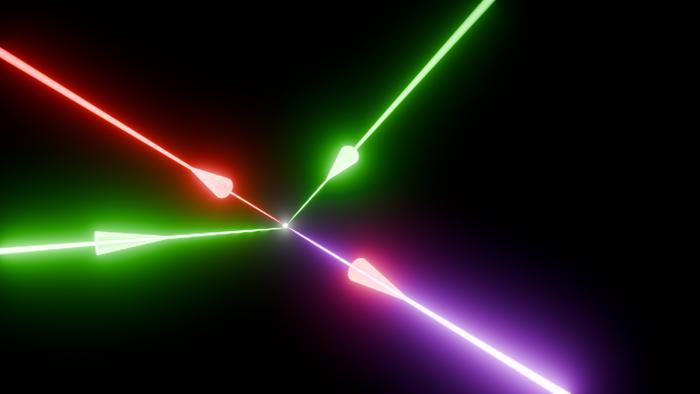
Physicists used a simulation software package called OSIRIS to model interactions between laser beams and matter, giving them a peek into vacuum-light interactions that were previously out of reach.
The simulations revealed that intense laser beams could agitate virtual particles and cause light particles to scatter off one another like billiard balls.
They also showed how real-world factors such as imperfect beam alignment could influence the result. “By applying our model to a three-beam scattering experiment, we were able to capture the full range of quantum signatures, along with detailed insights into the interaction region and key time scales,” said Zixin Zhang, another author of the new study.
Physicists now hope to conduct real-world laser experiments to confirm the bizarre quantum phenomenon.
The simulation experiment could also pave the way for more in-depth study of a range of theorised quantum effects in vacuum in other laser setups.
They believe the latest simulation experiment can act as a basic framework to search for hypothetical particles such as axions and millicharged particles, which are potential candidates for dark matter.
Join our commenting forum
Join thought-provoking conversations, follow other Independent readers and see their replies
Comments
Bookmark popover
Removed from bookmarks