Scientists in US awarded the Nobel Prize in Physics for quantum mechanics discovery
The scientists’ discovery could transform how we use mobile phones, cameras and even fibre optic cables

The Nobel Prize in Physics has been awarded to a team of scientists based in the U.S. for their landmark discovery in quantum mechanics.
John Clarke, Michel H. Devoret and John M. Martinis were handed 11 million Swedish Kronor ($1.17 million) for their work.
The trio’s experiments demonstrated that the strange laws and properties of the quantum world can have measurable effects in everyday science.
Quantum mechanics is the study of how light and matter behave on an atomic and subatomic scale.
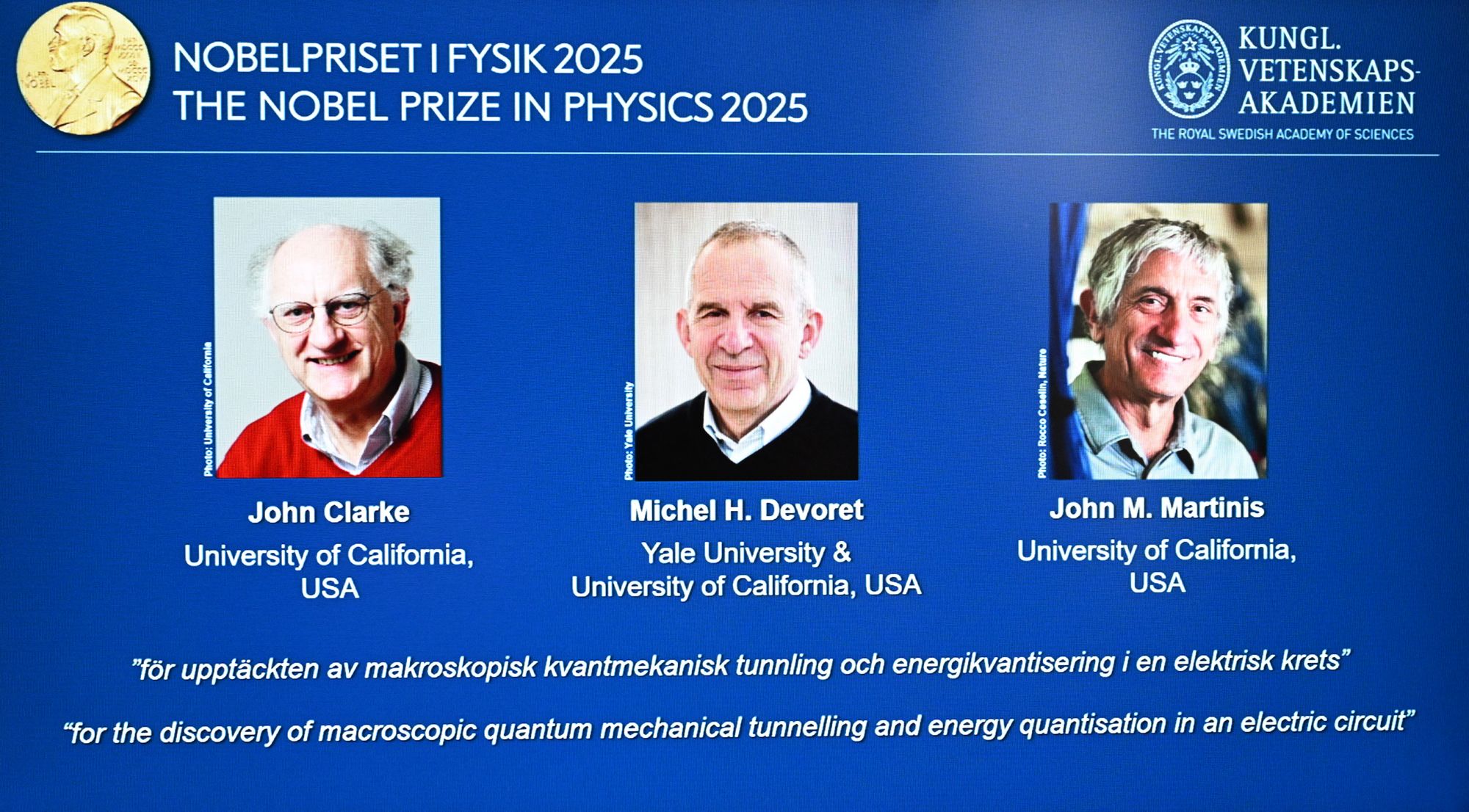
The team’s discoveries included developing a superconducting electrical system that could “tunnel” from one physical state to another. “Tunnelling” is a process which mimics a ball passing through a wall instead of bouncing back after impact.
Martinis, based at University of California Santa Barbara, and his colleagues originally conducted the experiments in the 1980s, with their work still being used in research today.
Both he and Devoret, a French physicist at Yale University, have previously worked for Google Quantum AI to develop supercomputers for the company.
During Martinis’ time at Google Quantam AI, the company reported that it achieved quantum supremacy in 2019. Quantum supremacy means that a supercomputer has solved a problem that no classical computer could solve in a realistic period of time.

Clarke, their colleague on their Nobel Prize winning discovery, is a British scientist based at the University of California at Berkeley. He described the win as “the surprise of my life.”
According to him, the three men found out about their win via a phone call. “I am completely stunned. It had never occurred to me that this might be the basis of a Nobel prize,” he said.
"I'm speaking on my cellphone, and I suspect that you are too, and one of the underlying reasons that the cell phone works is because of all this work," Clarke added. “Our discovery, in some ways, is the basis of quantum computing.”
The winners of this year’s Nobel Prize in Physics were revealed at the Royal Swedish Academy of Sciences. Each of the men will be handed a medal by the king of Sweden.
"There is no advanced technology used today that does not rely on quantum mechanics, including mobile phones, cameras...and fibre optic cables," the Nobel committee said when revealing the winners.
“It is wonderful to be able to celebrate the way that century-old quantum mechanics continually offers new surprises,” added Olle Eriksson, Chair of the Nobel Committee for Physics.
“It is also enormously useful, as quantum mechanics is the foundation of all digital technology.”
Join our commenting forum
Join thought-provoking conversations, follow other Independent readers and see their replies
Comments
Bookmark popover
Removed from bookmarks