‘Each terrorist had a favourite hostage – if we asked right, we might get extra food’
Eli Sharabi was taken from his home on October 7 and held prisoner in Gaza for 491 days. Ahead of his book being published, he tells Nicole Lampert how he’d cajole and bargain with his captors to survive – even playing cards with one family of Hamas. It was only after his release he would realise the true horror of what had happened that day


Eli Sharabi sees a therapist every week. The other day, he asked her what was wrong with him. ‘I asked if I was f*cked up or something,’ he admits quietly. He knows that no one would blame him if he were in bed crying all day, but, in truth, he doesn’t want to.
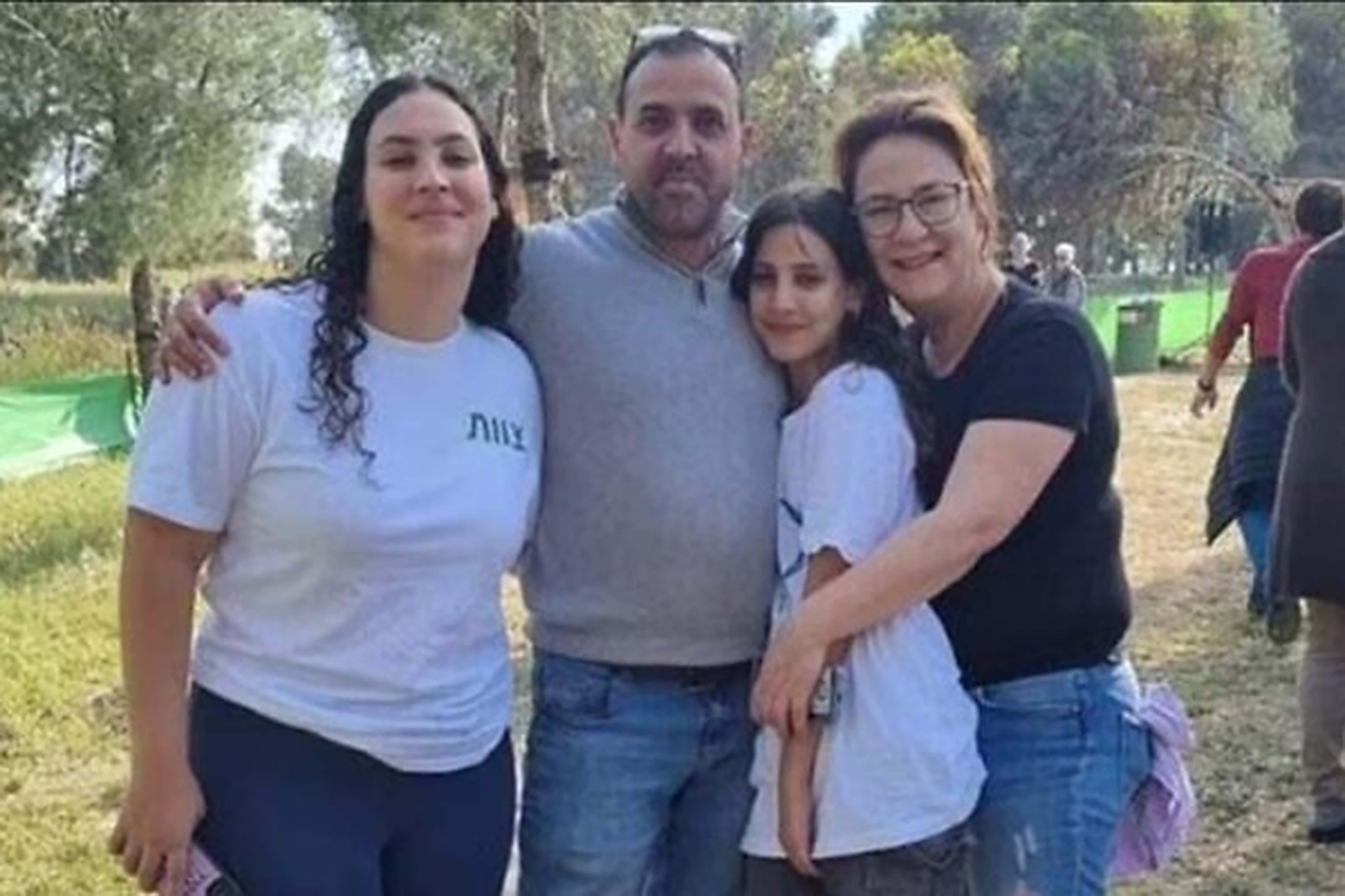
For the past two years, Eli, 53, has been one of the faces of the Hamas horror. Terrorists stormed into his home in the Kibbutz Be’eri when he was taken hostage and held underground for most of his 491 days in captivity; starved, beaten up, and kept in shackles. The one thing that had kept him going was the idea of being reunited with his British wife, Lianne, and their teenage daughters, Noiya and Yahel.
It was only when he was finally released as part of the hostage deal in February that he discovered they had all been murdered on the day he was taken into Gaza. He only found this out after Hamas had encouraged him, both during the “rehearsal” for his release and on the day of his release, to express how much he was looking forward to seeing them.
Eli had hoped that perhaps their British passports (the girls were also British citizens) might have saved them. “I was sure the terrorists wouldn’t dare mess around with His Majesty’s subjects,” he says sardonically. But no one had been spared: Jew, Muslim, Israeli, Thai, Bedouin, British, American, young and old – it didn’t matter – they were all killed that day.

Among the dead was also his beloved oldest brother, Yossi, who was also taken hostage into Gaza from the Kibbutz just over a mile from the Gaza border. Eli was told by Hamas that Yossi had been killed while in Gaza. His body remains there.
Why, after so much horror, he wanted to know from his therapist, was he still able to feel happiness? To actually be happy. He was told he had multi-trauma, but his therapist wasn’t able to diagnose PTSD, which she said was amazing. Nor was Eli suffering from nightmares or flashbacks.
We had to learn to manage the terrorists. They could be very cruel. They humiliated us on a daily basis. But you cannot hate them, because you cannot survive by that
“Some of the other hostages can’t eat pita bread or hummus because that’s all they ate for more than a year. I understand, but I don’t feel like that. While they damaged my body and starved me, they couldn’t get through to my soul.”
Eli’s incredible mental stamina is why he was able to write about his experiences with such clarity in his new book Hostage, which has made him a national hero in Israel. It is a story of a man who had everything taken from him, but refuses to be defeated. Eli’s book is a guide to life. A guide to positivity.

In Hostage, Eli describes how, from the moment he realised he was being taken hostage into Gaza, a different Eli emerged – “Survivor Eli”.
Hostage is the first book released by one of the Israeli captives, and it gives a fascinating insight into the strange dynamics of captive and captor in Gaza. When he was first dragged into the Palestinian territory, he was saved from being lynched by Hamas, who wanted to keep him as a bargaining tool.
“I was first dropped outside of a mosque,” he says. “Civilians pulled me from my captors, and even kids were hitting me with shoes and dragged me to the ground. Fortunately, the Hamas terrorists succeeded in taking me away from them. Hamas said they were worried that civilians would spot me in the first house where I was kept and come in and kill me. I believed them.”
In the first stage of the war, he was held above ground by a Hamas family and even played cards at night with them. At one point, this former economics lecturer even explained basic economics to them as they marvelled at the wealth of Israel in comparison to Gaza.
“They don’t understand much about Israelis, they’ve been brainwashed,” he says. “After they’d known me for a few months, they’d say, ‘if only all Israelis were like you, the situation would be different.’ I told them, “Most Israelis are like me and just want to live in peace.”
In return, he learned about Hamas and their ideology: “They told me they will not stop until they succeed in defeating Israel. They don’t care if it will take 100 years or 200 years. They want the whole world to be Islam. Crazy.”
Eli has an impish humour and a smile almost as wide as his face. After the first ceasefire deal, Eli was taken underground into the tunnels, where he was eventually kept with fellow Israelis Alon Ohel, Or Levy and Eliya Cohen, all taken from the Nova festival. He initiated a nightly ritual where they would discuss something positive that had happened. “I didn’t get beaten up… I got an extra half a piece of pitta… the worst terrorist wasn’t on duty.” He encouraged his fellow hostages to share, teaching them there was power in teamwork.

The book is unflinching about the fact that this wasn’t always easy, but by working together, they realised that each captor had a favourite hostage. And, if they asked at the right time, they might get a precious extra piece of pitta bread to share.
The book brings out the humanity of those who kept him in shackles, despite their cruel nature. Some were kinder – if not kind - towards the hostages. The hostages realised too that if they got them on their own, they were more likely to give an extra piece of food. But when together, they would try to outdo each other in trying to hurt them. Once, one attacked Eli so severely that his ribs were broken. When he was eventually released, he was the weight of his youngest daughter, around 97 pounds.
‘We had to learn to manage the terrorists,’ Eli says. ‘They could be very cruel. They humiliated us on a daily basis. But you cannot hate them, because you cannot survive by that. So you have to learn to speak to them normally and respectfully just to survive, to be able to eat, go to the toilet. They weren’t all evil, but we were their hostage; if I’d had the opportunity to escape by killing them, I would have shot them. If they were told to, they would have shot me. It is not black and white.’
Within days of the book being released, he was flown to Washington to meet – and thank – President Trump, who took responsibility for the hostage deal that got him home. He attended a meeting at the UN where he pleaded with organisations to do more for the 48 hostages still being held; he has been advocating for them ever since meeting with Sir Keir Starmer and dozens of other worldwide leaders.

When we meet at a hotel just outside Tel Aviv, a seaside resort where Eli is now living and sharing an apartment with friends, he is mobbed by fans. He says that he has just returned from Australia and met with Charles Marles, Australia’s deputy prime minister, and berated him for rising antisemitism in the country.
He also recently spoke at the Heaton Park Synagogue in Manchester, where last week two men were killed and three others injured in a terrorist attack. He messages me after the attack to say: “This is the same terrorism that kidnapped me and murdered my family, it is shocking to think that something like this can happen in the United Kingdom.”
Eli loves the British: one of the first things he asked for on being released was crumpets, as he used to enjoy them on annual family trips back to Bristol, where Lianne grew up. The family was drinking tea – a morning tradition initiated by Lianne – when Hamas broke into their house.
While inside Gaza, Eli dreamed of leaving Israel and moving to the UK with his family. There are hopes to rebuild Be’eri – some have even returned. But he won’t be among them. He wants to start life afresh, away from the horrific memories of what went before.
‘I don’t need to be somewhere to remember my family. They’re with me almost every minute of my day until the last day of my life. But it will be alongside my life, not instead of it,” he reflects.
“I’ve been given a second chance. I realise now what it is to be a free man; to not have to ask permission to use the toilet, or to talk, or to open a fridge and choose what you want to eat and what to drink. To shower, to have toothpaste. I appreciate everything. And that is why I am happy. Yes, really happy. Because I am lucky to be alive. Lucky to be free.”
It is why he has been so desperately advocating for the release of the hostages – with Alon, who is alive, and his brother Yossi, who is dead, among the 48 still being held. “It feels we are close. I hope that this new peace agreement will see them back very, very soon so the living can be reunited with their families and those no longer alive, like my brother Yossi, can be returned for burial in Israel.”
Eli Sharabi’s ‘Hostage’ (Swift Press) is released on 9 October
Join our commenting forum
Join thought-provoking conversations, follow other Independent readers and see their replies
Comments
Bookmark popover
Removed from bookmarks