Strange interstellar object hurtling towards Earth has now grown a tail, astronomers say
Comet travelling on an orbit that would carry it back into interstellar space
A striking new image of the strange interstellar object 3I/ATLAS has revealed it is growing a tail, offering more proof that it is a comet visiting our Solar System.
The suspected comet, discovered on 1 July, is only the third known interstellar object to pass through the Solar System – after Comet 1I/ʻOumuamua in 2017, and Comet 2I/Borisov in 2019.
Previous estimates suggest that the comet is no more than 3.5 miles (5.6 km) wide and could veer close to Mars without posing any threat to Earth.
Now, researchers assessing images captured by the Gemini South telescope located on a mountain in the Chilean Andes have found that the object has a growing tail of gas.
They also observed a glowing coma, which is the dust and gas cloud that forms around a comet’s icy nucleus as it gets closer to the Sun.
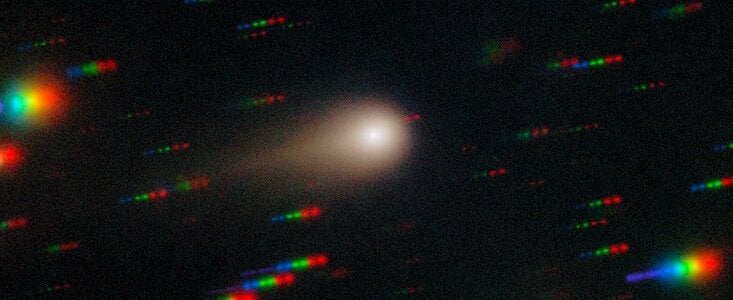
Using the telescope’s Multi-Object Spectrograph instrument, scientists gathered information on the wavelengths of light emitted by the comet.
This data offered insights into the comet's composition and chemistry, allowing researchers to understand how it changes as it passes through the Solar System.
“The primary objectives of the observations were to look at the colours of the comet, which provide clues to the composition and sizes of the dust particles in the coma, and to take spectra for a direct measure of the chemistry,” said astronomer Karen Meech from the University of Hawai‘i Institute for Astronomy.
“We were excited to see the growth of the tail, suggesting a change in the particles from the previous Gemini images, and we got our first glimpse of the chemistry from the spectrum,” Dr Meech said.
Observations have so far revealed that, unlike comets bound to the Sun, 3I/ATLAS is travelling on an orbit that will eventually carry it back into interstellar space.
During its current brief passage through the Solar System, astronomers have a once-in-a-lifetime opportunity to study its material and understand how similar objects form around distant stars.
The latest observations suggest it is made of dust and ice similar to those of comets native to our Solar System, hinting at shared processes in the formation of solar systems around other stars as well.
“These observations provide both a breathtaking view and critical scientific data,” Dr Meech said.
“It reminds us that our Solar System is just one part of a vast and dynamic galaxy – and that even the most fleeting visitors can leave a lasting impact,” she added.
Join our commenting forum
Join thought-provoking conversations, follow other Independent readers and see their replies
Comments
Bookmark popover
Removed from bookmarks