
Why skipping is a key part of boxing training... and how it helped Crawford beat Canelo
In the Venn diagram comprising boxers’ go-to conditioning moves and school playground pastimes, skipping occupies the fairly slender middleground. Harry Bullmore investigates why.

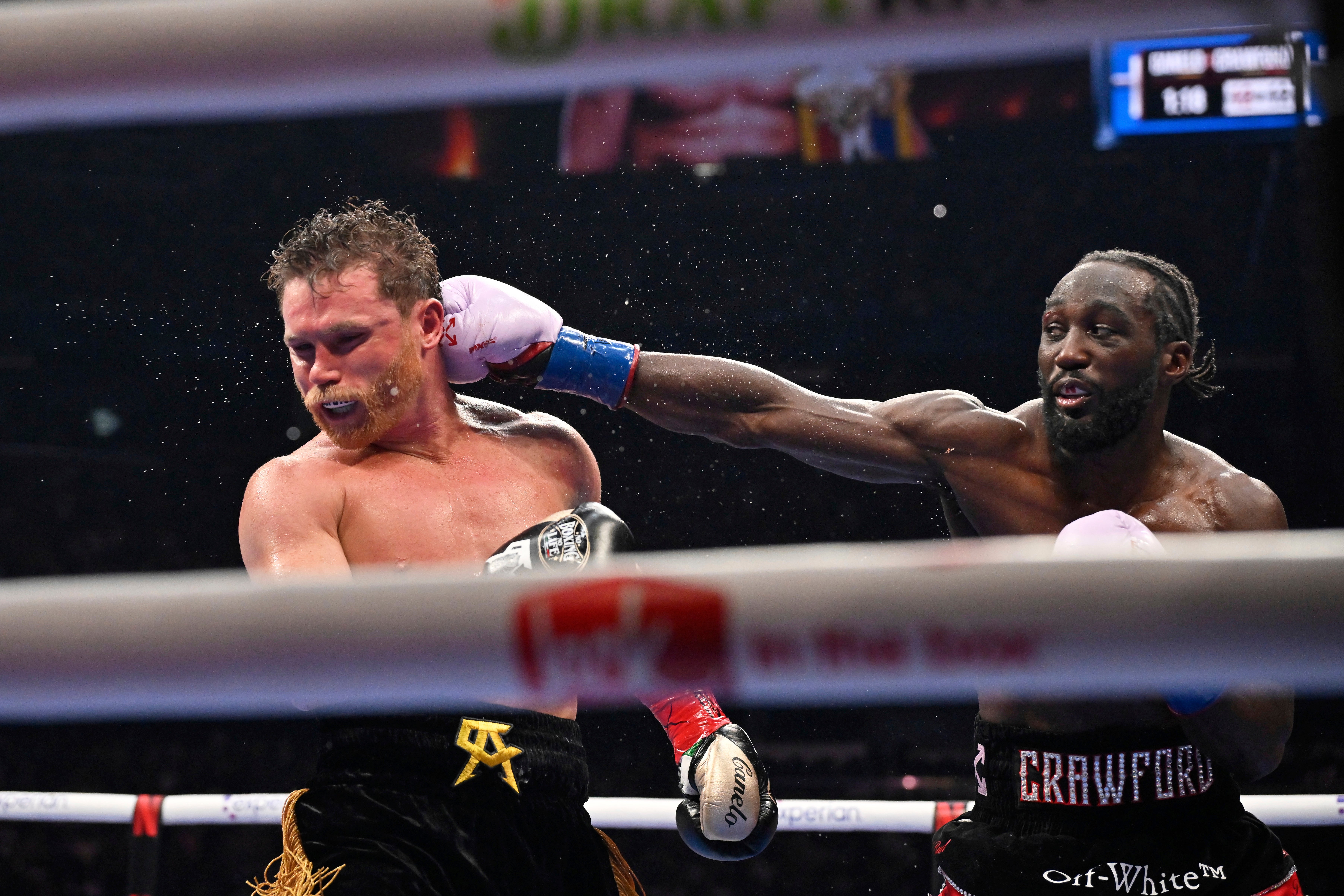
You would be hard-pressed to argue against boxing’s status as a hardcore sport. It involves two people placed in a compact arena, surrounded by a baying crowd, whose aim is to establish physical dominance by putting the other one on the ground – or at least dealing some damage on their way to victory.
Skipping does not have the same hardcore reputation. Chances are you first encountered this activity on the school playground; search for the phrase “skipping rope” on Google and several pictures of smiling children crop up. Yet it is synonymous with boxing.
Every boxing strength and conditioning coach I have spoken to as a fitness writer includes skipping in their athlete’s pre-fight preparations; Rocky montages would be incomplete without a healthy dose of jumping rope; black and white footage shows legends such as Joe Louis and Rocky Marciano using this affordable training tool. But why is it such a staple?
The simple answer is that the humble jump rope is an accessible, affordable and effective way of helping someone become incredibly fit. The longer answer, which you can find below, dives into the more detailed reasons why a rope can be a boxer’s best friend.
 I tried the Royal Navy’s new fitness test – and it wasn’t what I expected
 Terence Crawford’s brutal workout to build power and strength for Canelo clash
 Terence Crawford’s coach reveals intense training regime for Canelo as he predicts ‘Spence Part Two’
 The two exercises that give Moses Itauma ‘the edge’ over most opponents
Specificity
Unlike most other forms of conditioning, skipping does a decent job of mimicking the movements required throughout a fight – for the lower body, at least.
“When they’re skipping, a boxer is using pretty much all the same muscles as they are when moving in the ring,” Chet Fortune, Terence Crawford’s strength and conditioning coach, tells me. “The legs are always going, hopefully – you get some fighters who will just stand in front of you, and they don’t have great leg movement.
“One of the things that sets Bud apart is, if he goes 12 rounds, I want him to still feel like it’s the first round. The legs have got to be primed, the calf muscles have got to be primed, the hips need to be in tune – skipping does all of that.”
It requires perpetual motion – you are constantly bouncing on the balls of your feet, ready to generate force.
“That translates to a pretty similar movement to what boxers are going to see in the ring,” Fortune says. “You’re really driving those legs to work without stopping, and still incorporating an upper body movement.”

Tissue tolerance
The body adheres to the SAID principle. This stands for specific adaptation to imposed demand, and simply means the body adapts to get better at the things you consistently ask it to do.
Skipping repeatedly places a significant load through your lower body, particularly the calf muscles, ankle joint and the surrounding tendons, ligaments and bones.
Doing this on a regular basis signals to the body that these tissues need to be stronger, and so it sets about bolstering your tendons and boosting the density of the partaking bones.
Better yet, unlike running, it does so in a controlled environment. This means there is a low chance of injury while skipping, and the activity also builds robustness in your lower body to reduce your risk of injury in other activities going forward.
For a fighter, an injury can eat into valuable training time or, in some cases, cause a fight to be cancelled, so injury prevention is an attractive perk of jumping rope.

Cardiovascular endurance
Skipping is jumping; if the rope is to go underneath your feet with each revolution, your feet need to leave the floor.
Even for the fittest people, jumping repeatedly for a sustained period of time requires a significant amount of effort. Your heart rate rises and your breathing quickens as your body works to provide extra oxygen to the working muscles – and that, quite simply, is aerobic exercise.
Raising your heart rate in any way can lead to myriad benefits, with the main perk for performance being improved cardiovascular health and efficiency. If a boxer is to go the full 12 rounds, they need their heart and lungs to keep up with their fists.
Fitter people require more intense activities to see continued progress in this area, and skipping can deliver this through longer sessions, faster speeds, incorporation into conditioning circuits and the introduction of more demanding techniques such as double-unders.
You might look elsewhere to develop certain attributes. Courtesy of Matchroom Boxing’s head of performance Dan Lawrence, Conor Benn completed 10 rounds of a fast 300m run, followed by a 100m walk, when preparing for his first meeting with Chris Eubank Jr, developing his VO2 max among other things. Johnny Fisher’s strength and conditioning coach Sonny Cannon favours short, sharp fan bike intervals for developing maximum power output and power repeatability.
But skipping provides a fairly boxing-specific, no-frills and versatile way to tax the cardiorespiratory system.
Read more: The surprising change in Terence Crawford during Canelo camp that has shocked his own team

Coordination
A punch is a full-body movement, requiring cohesion between the legs, torso and arms to deliver a powerful, accurate shot. Force is first generated through the ground, travelling up the legs and through the extended hips to the core. These mid-body muscles then act as a transfer centre, redirecting the force across the torso before expressing it through the arm. This system of interconnected tissues within the body is known as the kinetic chain.
While the movements in skipping are not the same as throwing a punch, it does require the body to work as one. If any single body part is out of place, or you lose your timing, you will trip.
Introducing more advanced techniques such as double-unders, crossovers and even the eponymous boxer skip provides more of a neurological challenge – your body and brain have to work together to learn the skill and piece the movement together. The ability to problem-solve and learn new skills – otherwise known as neuroplasticity – is invaluable for an athlete.
This is supported by science. A 2015 study published in the Journal of Sports Science Medicine investigated the impact of a training protocol incorporating jump rope with young football players, and found it was “effective to improve motor coordination and balance”.
Read more: The best exercises for developing knockout punching power, according to leading boxing coach

Improved athletic performance
A 2019 study published in the International Journal of Sports Physiology and Performance looked to determine the effectiveness of skipping at improving power and lower-limb stiffness when used as part of a warm-up by amateur endurance runners.
It assigned a group of athletes to one of two groups, an experimental group and a control group, with the former asked to jump rope two to four times per week for a combined total of 10-20 minutes.
It concluded: “[Completing] 10 weeks of jump rope training, in place of five minutes of regular warm-up activities, was effective in improving 3km time trial performance, jumping ability, reactive strength index [tested through drop jump performance] and arch stiffness in amateur endurance runners. Improvements in reactive strength index and arch stiffness were associated with improvements in 3km time-trial performance.”
A second study, published in the International Journal of Environmental Research and Public Health, found that eight weeks of skipping helped athletes generate more velocity when taking off for a standing long jump.
The sum of these parts is that athletes became better at generating power through their feet when taking off, largely as a result of increased reactive strength and arch stiffness in the feet. And while a boxer may not need to run 3km or perform a standing long jump come fight night, the ability to create force from the ground up is always going to be useful.
DAZN is the home of combat sports, broadcasting over 185 fights a year from the world's best promoters, including Matchroom, Queensberry, Golden Boy, Misfits, PFL, BKFC, GLORY and more. An Annual Saver subscription is a one-off cost of £119.99 / $224.99 (for 12 months access), that's just 64p / $1.21 per fight.
There is also a Monthly Flex Pass option (cancel any time) at £24.99 / $29.99 per month. A subscription includes weekly magazine shows, comprehensive fight library, exclusive interviews, behind-the-scenes documentaries, and podcasts and vodcasts.
For pricing in your country, more information and to sign up, click here.
Join our commenting forum
Join thought-provoking conversations, follow other Independent readers and see their replies
Comments
Bookmark popover
Removed from bookmarks