Could this be the year that changes Apple forever?
Apple will soon launch its first big products of 2026 and it could set the stage for a decade that could see the company change in unknown and unexpected ways, writes Andrew Griffin

At the beginning of March, Apple’s year will really begin. In the first week of the month, it will show off a whole host of new products. But it might represent something far more significant than that: the beginning of a year that could decide the future of the company forever.
There will be a host of products. Apple is rumoured to be working on a new, cheaper iPhone; a couple of new iPads; a whole range of new Macs and new displays. It’s not clear which of them will be part of that launch week, though they all could be.
It will be a strange week. Apple is known for launching its big products during live events: before the pandemic, they were done live on stage, but now they are pre-recorded videos, though the company also hosts in-person screenings at its Apple Park campus. This time around, Apple is hosting press events in New York City, London and Shanghai, though rumours suggest that the company could actually launch the products through announcements on its website before them.
It will be a strange week that, in a way, kicks off what could be a strange year, at the midpoint of a strange decade. On the one hand, Apple has spent the 2020s so far cementing its status: it has made record-setting amounts of money, and could be the most powerful force in US history. On the other, the last couple of years have led to new kinds of complaints about the company. Those two facts might not be as contradictory as they seem.
Last year, Apple commentator John Siracusa wrote a piece called ‘Apple Turnover’, in which he said that it now seemed necessary for the company to make significant changes because it seemed to be losing its way. “Too many times, in too many ways, over too many years, Apple has made decisions that do not make its products better, all in service of control, leverage, protection, profits – all in service of money,” he wrote.


He pointed to some of the more technical problems that have led to frustration with the company. They include the way that it keeps its control over the App Store, where developers are limited in the ways that they can sell things within apps, and must pay a substantial part of any sales to Apple itself. But the criticism is not just focused on technical issues or the company’s products, but a much deeper question about what kind of company Apple actually wants to be.
That might be about to change. Over recent months, Apple has begun what appears to be a move to change: late last year, for instance, it announced that it would bring in a new general counsel: Jennifer Newstead, who had previously worked at Meta and before that for the government. At the same time, it said that its environmental head, Lisa Jackson, would retire in January, and she would not be replaced.
One of the most telling of those recent changes was the loss of John Giannandrea, Apple’s head of artificial intelligence and machine learning.
Apple has, in recent times, been prickly about these accusations. Chief executive Tim Cook’s statement about Giannandrea’s departure included one such statement, when he said that machine learning has “long been central” to the company. It had been integrating the technologies that are now called artificial intelligence for years before the current hype cycle, and executives feel that the accusation that it has fallen behind unfairly misses the fact that it has instead often chosen to be intentional about how it integrates that technology, favouring genuinely useful experiences over showy features for the technology’s own sake.
But in recent years – amid the success and excitement over other technology such as Google’s Gemini and OpenAI’s ChatGPT – it clearly began to feel the heat, and in summer 2024 it announced a suite of features known as “Apple Intelligence”, which was an attempt to both catch up technologically as well as to make clear to the market that it really was working on AI. Many of the announced products did not arrive on time, however, and it only served to underscore that narrative.
It was those troubles that led Apple commentator John Gruber – long among the company’s more vocal supporters – to write a lengthy blog post last year headlined “Something is rotten in the state of Cupertino”, which Apple calls home. He suggested that the company was in “disarray if not crisis” and that it could “collapse upon itself” if it continued to accept “mediocrity, excuses, and bullshit”.
In the wake of that frustration, speculation has turned to whether Cook would continue as its chief executive, and the question is becoming more insistent. The departure of those executives in recent months has only led to more speculation that this year could be the one that would see him appoint a successor, leaving the company he has led since 2011, after the death of Steve Jobs, and where he has worked since 1998.
Cook was long seen as a safe pair of hands, and his tenure at the top of Apple has seen it become the most valuable public company in history. Originally derided as having too much of a focus on operations, and leading to concerns that Apple might stop innovating, he has overseen the launch of whole new categories of products, including the Apple Watch and AirPods.
But recent times have brought that concern back. For years, Apple was working on its own car, but it failed to materialise. The launch of the Vision Pro headset appears to have disappointed. And it has failed to spend as much as its competitors on artificial intelligence, which might have led to it missing out on what seems to have been the real great technological innovation of the 2020s.
Cook has been careful not to be clear about his political positions, with rare exceptions for his concern for environmentalism and privacy. But he has done enough to give a sense that he was vaguely liberal, throwing his support behind company strategies to encourage diversity, for instance. However, throughout Donald Trump’s second presidency, he has become cosy with the government, recently notably attending a screening of the Melania film hours after Alex Pretti was killed by federal immigration agents. (Shortly after, he wrote to employees saying he was “heartbroken” by the situation in Minneapolis and calling for people to “treat everyone with dignity and respect no matter who they are or where they’re from”.)
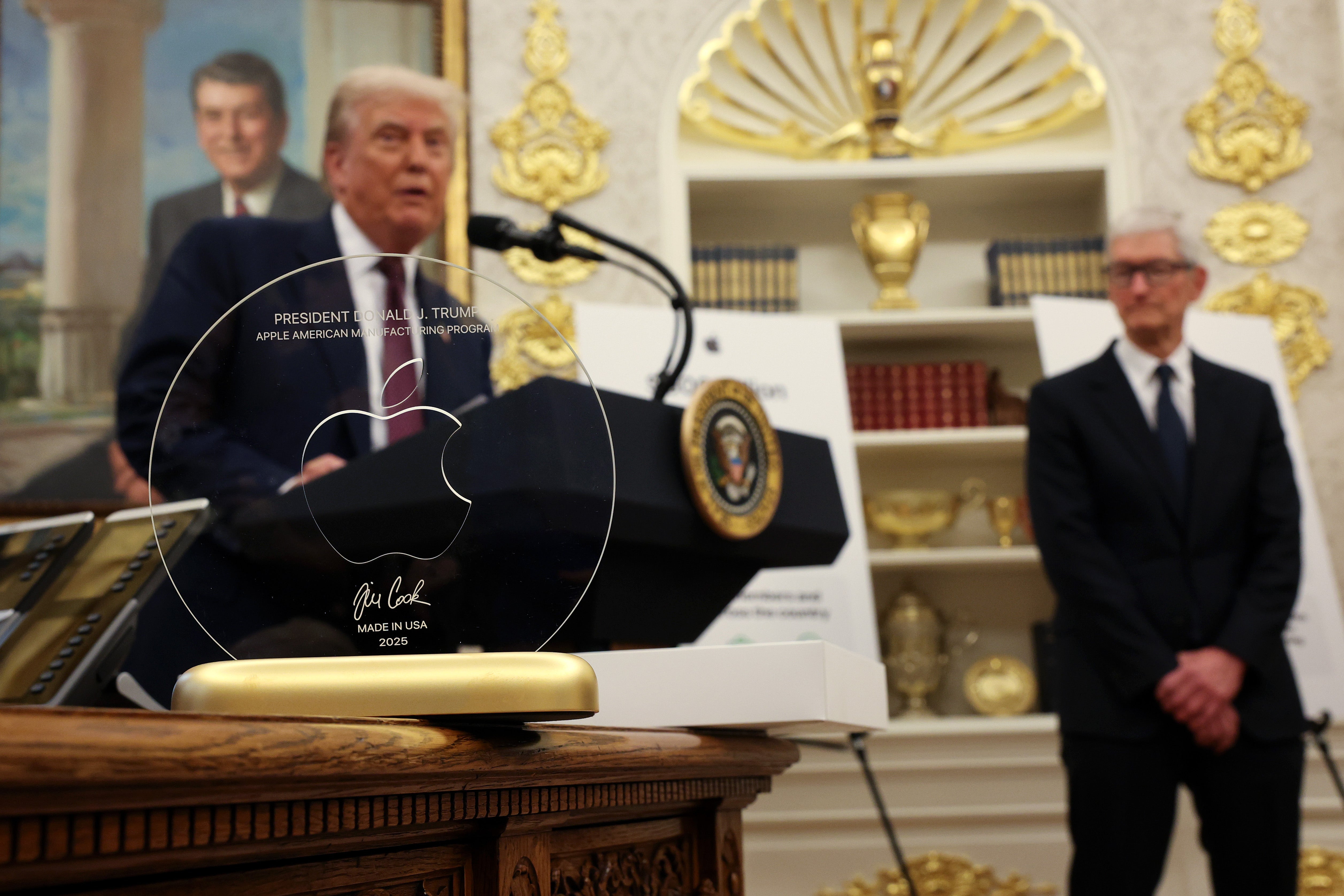
The policy was made most clear last summer, when Tim Cook presented Donald Trump with a trophy made of glass with a gold base, on which was written “President Donald Trump, Apple American Manufacturing Program”, and a signature from Cook. It wasn’t even entirely clear what it was for – it was presented to celebrate Apple’s plans to manufacture more products in the US, but the trophy didn’t actually say anything. But it was clear what it meant: that Cook’s Apple was prepared to flatter the president.


It has been a profitable strategy. Apple was given significant exemptions from Trump’s tariffs, for instance, which could otherwise have been incredibly damaging given how many of its products are made in China. But it has led to an uncomfortable situation for a company that has been proud of its work on human rights.
His most likely replacement has been rumoured to be John Ternus, Apple’s current head of hardware. He has overseen the launch of a whole host of new products – which, despite the scepticism about the current direction of Apple, have been widely welcomed – as well as new strategies, including the vastly successful move to start designing its own chips, which have improved its Macs profoundly. He is a relative unknown among the public, in part because his rise came as Apple moved towards pre-recording its public events and featuring a wider variety of staff members, but he is well regarded both internally and by analysts.
It remains unclear whether he will get the job, what it might look like when he does, or when Cook might leave. But the process to replace him is clearly beginning.
Given its current status, it is easy to forget that Apple was not always a sure success, and has in fact been close to extinction. The company came close to bankruptcy in 1997, before Steve Jobs – who had been forced out more than a decade earlier – returned, and turned the company around. Four years later, Apple released the iPod, which was both a result of and confirmation of that turnaround, and much of the rest is history.
That history still lives on in Apple, however. Even as its fortunes massed, it has stayed lean: the company is famous, for instance, for not offering its employees free lunches, like many of its competitors in Silicon Valley. Even as time and success have took it so far from collapsing again, the memory of how close that fate once was remains.
Join our commenting forum
Join thought-provoking conversations, follow other Independent readers and see their replies
Comments
Bookmark popover
Removed from bookmarks