Any Ukraine peace deal without Belarus risks Russian annexation
Belarus is a corridor through Europe that Russia could take over and use to invade Poland, Lithuania and Latvia, as well as Ukraine, write Valery Tsepkalo and Dmitry Bolkunets. President Lukashenko’s friendship with Putin is a loophole that needs to be closed


As diplomatic efforts to chart a path to peace in Ukraine intensify, one critical element remains overlooked. Lasting peace in Europe is impossible if Belarus is left outside any agreement.
On the eve of the invasion, Alexander Lukashenko – Belarus’s first and only president since 1994 – assured Ukraine and the international community that no attack would come from Belarusian territory. Yet, just days later, Russian columns entered from Belarus in a direct betrayal of Ukraine and the Belarusian people, who oppose participation in this war. Missiles were launched, aircraft flew from Belarusian airfields, and Russian forces received logistical and rear support. Several countries have recognised Belarus as a co-aggressor in Russia’s invasion of Ukraine.
Belarus stretches approximately 1,080km along Ukraine’s northern border. It is the shortest route to Kyiv and a direct missile corridor toward Nato countries. As long as Belarus remains an unregulated military space, Europe’s security architecture contains a fundamental breach.
Excluding Belarus from any future agreement would therefore leave a gaping hole in the peace of the continent. What was exploited once can be exploited again – not only against Ukraine, but Poland, Lithuania or Latvia. As long as Russian forces can freely use the territory, any “peace” is nothing more than a temporary ceasefire wrapped in diplomatic language.
If Belarus were to be fully or partially absorbed by Russia, the Kremlin would gain a direct corridor to exert pressure across central and northern Europe. The Russian army could deploy large forces along Nato borders and threaten Ukraine from the north, significantly complicating its security even after the current war ends. This would create a permanent source of tension and render any peace agreement incomplete and unstable.
The Belarusian people do not support this war. In 2020, around 200,000 people took to the streets for months to protest against the stolen election and to demand Lukashenko’s resignation. Only through the Kremlin’s support and massive repression was he able to cling to power.
The Belarus Democratic Forum, a coalition of independent Belarusian civil society leaders, experts and activists operating in exile, has submitted five proposals to President Trump and to the leaders of Ukraine, the UK and the EU that must be included in any peace agreement if we are to achieve that end.
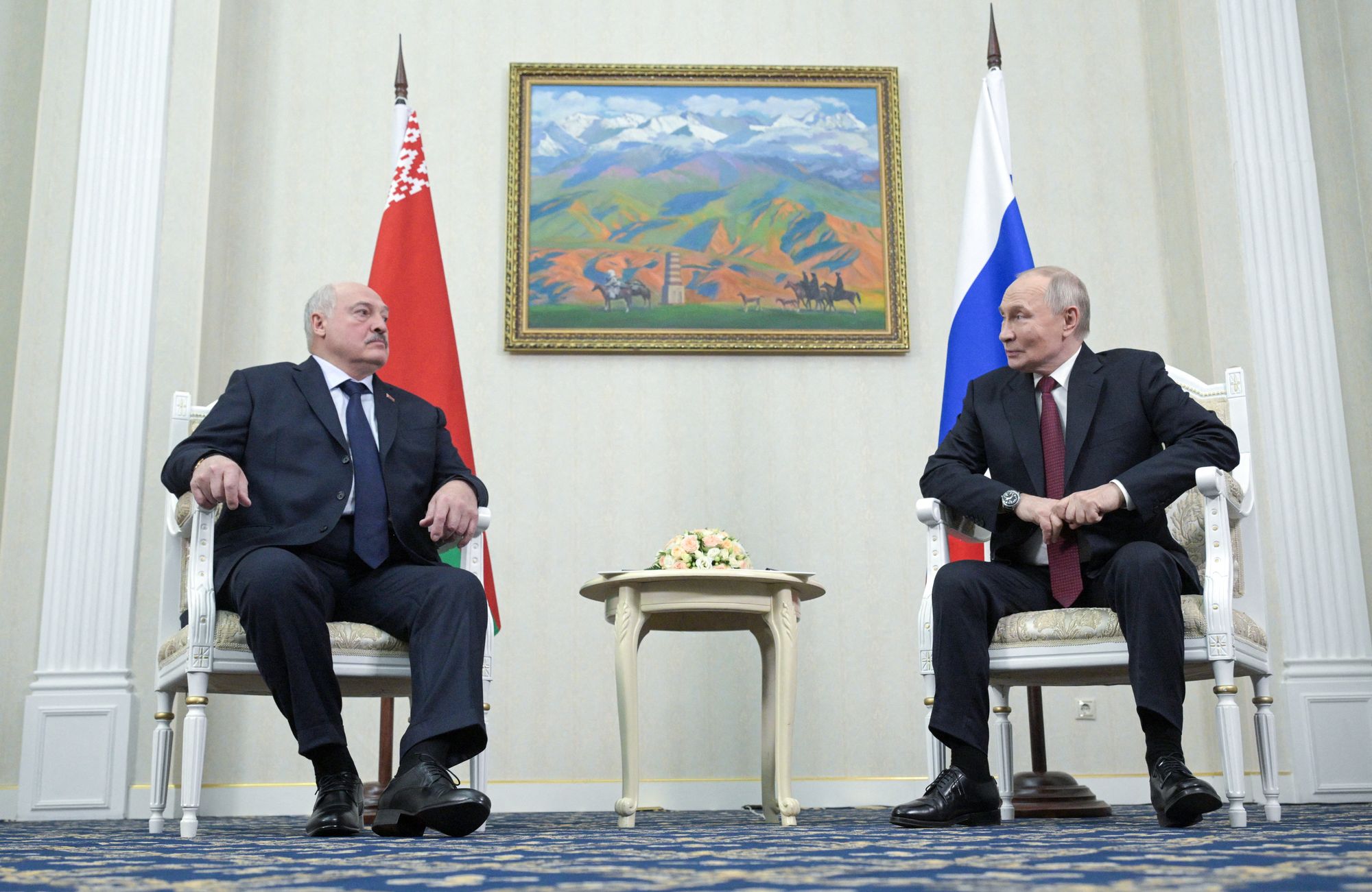
Firstly, there must be binding guarantees of Belarus’s sovereignty and territorial integrity, equivalent to those offered to Ukraine. Without such guarantees, Belarus remains vulnerable not only as a military platform but also as a state. After Ukraine, the Kremlin will likely seek opportunities to compensate for its failures. Russia is fully capable of pursuing a scenario involving the complete annexation of Belarus. This would instantly shift Russia’s military infrastructure hundreds of kilometres westward, directly to the borders of Poland, Lithuania and Latvia, radically destabilising Nato’s eastern flank and making a large-scale war in Europe far more likely.
That brings us to the second of our demands: a complete ban on using Belarus as a Russian platform for foreign aggression, and the restoration of Belarus’s permanent non-nuclear status. At the end of the Soviet era, the Belarusian Military District was a strategic launchpad for the Soviet Union in case of a major conflict. It can never become so again.
Thirdly, within 30 days of signing the agreement, all politically motivated cases in Russia, Ukraine and Belarus must be closed, political prisoners released, and citizens guaranteed safe and free return. Today, Belarus alone holds more than 1,300 officially recognised political prisoners, and more than 500,000 people have fled the country. Nobel laureates have also called for this in an open letter to the presidents of the US, Russia and Ukraine, and to EU leaders, urging the inclusion of a provision for the pardon or exchange of civilians recognised as political prisoners. Thanks to the personal intervention of President Trump, more than 100 people were released for the first time in many months, and we expect this process to continue.
Fourthly, there must be free and fair elections in Belarus within 250 days, monitored by the Organisation for Security and Cooperation in Europe, the only internationally recognised structure capable of providing legitimate electoral monitoring in post-authoritarian transitions.
Lastly, sanctions relief for Belarus should be gradual and strictly conditioned on the release of all political prisoners, the cessation of political repression, and the holding of free and fair elections.
These proposals are designed to prevent a repeat of the 2022 invasion of Ukraine and avoid a wider war in Europe. The 1994 Budapest Memorandum, which guaranteed the security of Ukraine, Belarus and Kazakhstan in exchange for giving up nuclear weapons, did not require ratification by the parliaments of the guarantor states. The result was a document that looked reassuring but proved legally weak – unable to protect Ukraine when it mattered most.
Any modern peace agreement must therefore undergo full parliamentary ratification in accordance with the internal procedures of the signatory states. Without these foundations, peace will once again rest on the same fragile ground that previously failed Ukraine. Without Belarus, lasting peace is impossible. Belarus must be part of the agreement, bound by obligations and protected by strong security guarantees.
Europe cannot claim to be secure while leaving on its map a territory that the Kremlin could use for annexation and future attacks on neighbouring states. A stable future is only possible when this loophole is decisively closed.
Valery Tsepkalo is a former ambassador to Washington and ran as a presidential candidate in Belarus in 2020. Dmitry Bolkunets is a political commentator and secretary general of the Belarus Democratic Forum
Join our commenting forum
Join thought-provoking conversations, follow other Independent readers and see their replies
Comments
Bookmark popover
Removed from bookmarks