Aung San Suu Kyi has spent 20 years imprisoned – she must be freed
Editorial: The Nobel Peace Prize winner’s continued incarceration is a burning injustice that must be righted – she is the only democratic hope for Myanmar
Given the personal history of Aung San Suu Kyi and that of the country she has worked for so long to make free, it is no surprise that she has reached a grim milestone in her detention at the hands of the military junta that runs Myanmar, with little news about her, let alone signs of her release.
She has now, on and off, spent a total of 20 of her 80 years in some sort of captivity or confinement, and sometimes in the most appalling of conditions.
That is for two reasons. First, she has long represented the most potent democratic threat to the military rule that has been the normal state of affairs for most of the last six decades. Second, she is, as far as we know, still alive and has not been disposed of by the generals because she is simply too powerful and popular to be dealt with as they might – and do – treat any other prominent campaigner. Her survival in such circumstances is as much a testament to the latent power she yields as it is her own resilience.
By rights, if she wished it, she should still be the leader of her nation’s government now, and standing for another term of office in the current rounds of elections. But she was deposed as “state counsellor” (effectively president) in 2021, and it is widely known that the polls are being rigged.
Her party, the popular National League for Democracy, is banned from putting up candidates; the political wing of the government, the Union Solidarity and Development Party, is bound to win, greatly helped by the constitutional guarantee of one-quarter of the seats in parliament being reserved for the generals’ cronies. It is a sham election, as they so often are.
This is a story of multiple tragedies. It is Ms Suu Kyi who has won the few free and fair elections held in the country since the first military coup in 1958, some years after her father, Aung San, was assassinated just months before seeing independence from the British in 1948. Instead of democratic parties trying to balance ethnic and economic interests constructively, the country has been riven with tensions and even genocides for decades.
Ms Suu Kyi herself has not escaped accusations for her comments about the fate of the Rohingya Muslims in Rakhine state, many fleeing to neighbouring Bangladesh for their lives and giving first-hand accounts of mass killings. For a Nobel Peace Prize laureate, her defence of the Myanmar military before the International Court of Justice in The Hague in 2019 was a misstep, even though UK ambassadors have given the view that this was a potential trap set by the military junta to discredit her.
It is a moment that deserves scrutiny. The naive assumption her critics make is that if she, as head of the civilian government, had somehow defied the generals, resigned or led a campaign against them, then it would have stopped their murderous rampage, and full human rights for all would have been secured. She herself ordered an inquiry into what happened.
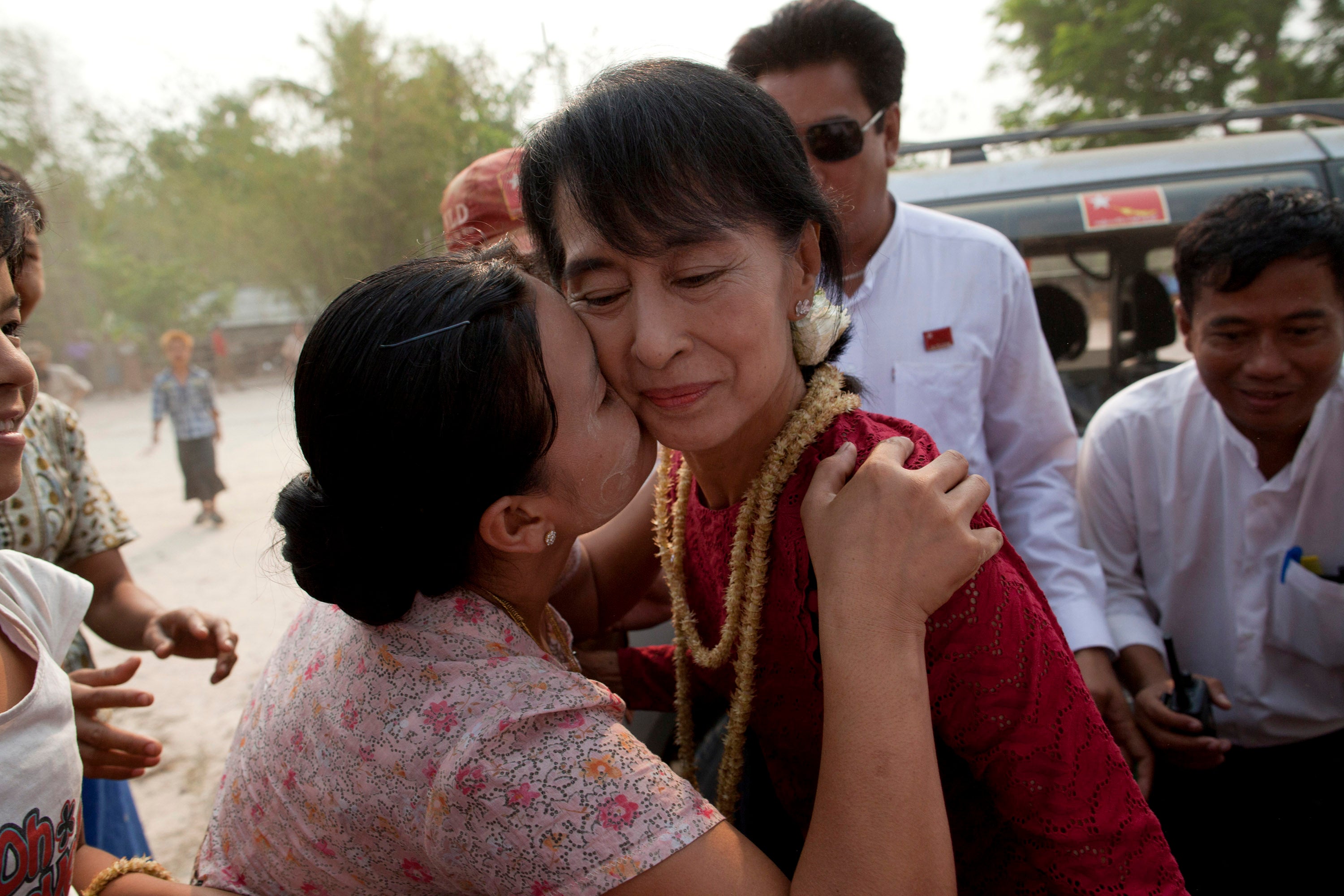
That was clearly not an option. Outright opposition might have triggered yet more suffering. Her choice, she could argue, was to try to restrain the army as much as she could, or to collapse whatever passed for democracy at that time.
Such a debate should be had. Certainly, Ms Suu Kyi should be accountable for her time in government, even if the generals who perpetrated the killings are not. She cannot do any of that from her rumoured confinement in a military prison in the capital, Naypyidaw. At her age, she must be frail and may be unwell, but no one has any real idea about her welfare.
Not even her own son, Kim Aris, is told what is going on. “For all I know, she could be dead,” he says.
Key is the uncomfortable fact that the military regime is being supported by China and has given no indication of any intention to allow free democratic votes and rights. Nothing symbolises this repression more than Ms Suu Kyi’s illegal, rigged internment.
The tragedy of Myanmar is inextricably tied up with that of its most promising and politically gifted leader, whose family have suffered enormous sacrifice – her father was assassinated, and her own husband was forced to stay away from seeing her when he was dying. In a parallel history of what was known as Burma, the country could be much more like its neighbours – imperfect but functioning democracies, their emerging economies gradually lifting people out of abject poverty.
The foreign secretary, Yvette Cooper, should therefore follow the example of previous foreign secretaries like William Hague and David Lammy to mobilise allies to pressure the Myanmar regime with sanctions and other diplomatic pressure to release Ms Suu Kyi and order free elections – and with urgency. As a “pen holder” for Myanmar in the UN Security Council, Britain does have some leverage in this matter. There is not that much time left for Ms Suu Kyi to complete the mission of her life to bring freedom to the country she loves.
Join our commenting forum
Join thought-provoking conversations, follow other Independent readers and see their replies
Comments
Bookmark popover
Removed from bookmarks