Starmer must juggle China’s ‘red emperor’ with America’s orange one
As Keir Starmer joins the line of European leaders making the journey to see Xi Jinping, Michael Sheridan says that this policy of ‘not choosing sides’ is a delicate balancing act


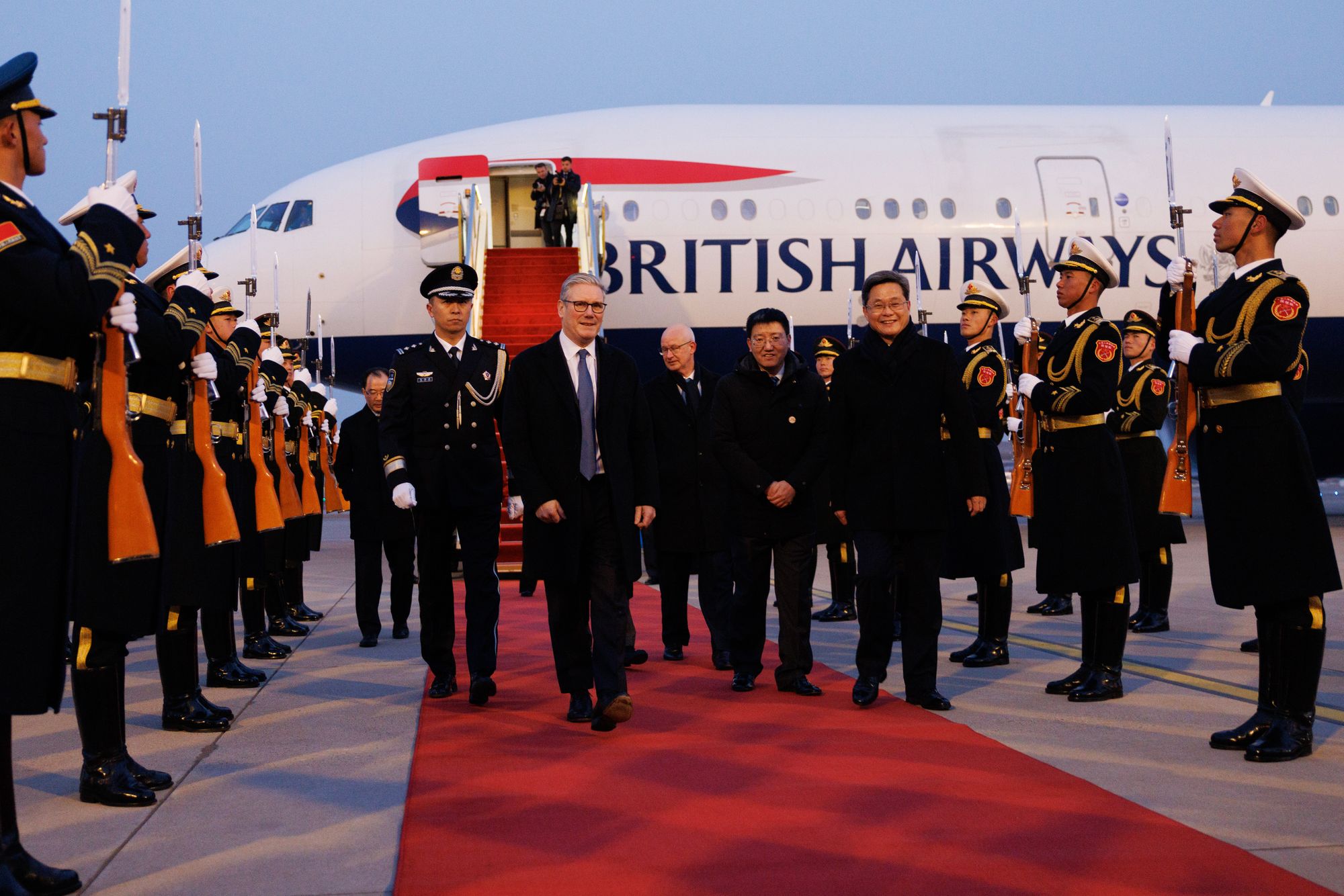
“Britain has finally come to its senses,” declared an official Chinese commentary as the prime minister landed in Beijing – praise from his hosts that Sir Keir Starmer may not have found entirely welcome.
This is the first visit by a British premier for eight years and, although Starmer rejects opposition claims of a “kowtow”, it is portrayed by China as a sign that the world is changing in its favour.
More trade and less trouble might be the unstated ambition of the trip. I watched three of his predecessors, Tony Blair, Gordon Brown and David Cameron, perform the same surface business-as-usual routine with varying degrees of unease. But nothing is usual about it this time.
In staying friendly – or at least engaging – with Washington DC, Brussels and Beijing, Starmer is trying to do three things at once. “It is his 3 Body Problem,” a senior Westminster figure, who has long worked on British-China relations, as told to Politico.
Like that Chinese-inspired science fiction series, the politics play out in several dimensions because the British approach resembles a challenging physics conundrum, namely, how to keep the Chinese happy, the Europeans calm, and the Americans on side.
When Starmer meets President Xi Jinping, he will encounter a “red emperor” at his most imperious. Xi has just purged the country’s top general and taken almost sole command of the world’s biggest standing army. He has seen off the American trade war, forged an axis of autocracies with Russia and North Korea, watched the West divide and dispelled rumours of coups, ageing or illness.
The spectre of President Donald Trump – who critics say is a “orange emperor” in America – will hover in the grand reception room. But talk that the British visit annoys him is wrong. The Trump administration has quietly sidelined its China hawks, the latest Pentagon plan no longer paints China as enemy number one, and the president himself is due to tread the flagstones of the Forbidden City in April.
If anything, serious Americans will value face-to-face contact between their closest ally and the enigmatic Xi. One of the multiple policy worries is that as Xi becomes more powerful, he also becomes more remote and does not receive advice he might not like to hear on subjects as crucial as the fate of Taiwan and rising military tensions across East Asia.
That was why the Biden administration sent envoy after envoy to communicate difficult messages in person at a time when the CIA and the Pentagon feared that China’s own hawks – of whom there are plenty in the ranks – might be tempted to make a rash move, Putin-style.
Effective diplomacy is not guaranteed: when the Canadian premier Mark Carney came away from Beijing recently with a trade pact, talking of a new world order in which medium powers would have to act for themselves, it was more or less exactly what Xi did want to hear. Xi aims to break up the alliance system between the Western powers and Asian countries like South Korea, Japan, Thailand, the Philippines and Singapore.
As for the Europeans, Starmer can hardly be criticised for following the king of Spain, the president of France and the prime minister of Finland on the path of homage to Beijing. The German chancellor Friedrich Merz will not be far behind.
So why, then, does China think Britain of all countries has “finally come to its senses”? The phrase was used in a publication controlled by the People’s Daily and faithfully reproduced across the official media on Wednesday.
It appeared in a commentary notionally written for the Global Times, an outlet which serves to ventilate things in that “semi-official” media space beloved of totalitarian states. Nonetheless, it’s worth examining for the Chinese perspective.
The writer picked up Starmer’s comment, made in an interview with Bloomberg News, that he did not have to choose between countries like the US and China.
This, the paper said approvingly, was “widely seen as reflecting a more rational British diplomatic approach” and showed that “even within the West, ‘small circles’ and bloc-based confrontations are increasingly losing traction”.
Decoded, this means that Chinese diplomacy seeks to weaken democratic alliances which the autocracies see ranged against their economic and strategic ambitions.
Xi himself has talked of the big theme that the East is rising and the West is in decline, so the commentary reads as if he might as well have written it himself.
“The Western world is undergoing a brainstorm,” it declared. “Starmer’s stance of ‘not choosing sides’ reflects, to some extent, a Western rethinking of outdated concepts of security, civilisation and international relations.”
An increasing number of perceptive figures in the West – the Global Times continued piously – “have come to realise that blindly following a single hegemon and severing global connections ultimately undermines their own countries”.
Relations between China and Britain have “endured a prolonged downturn lasting several years” in which the “hot and cold” policy of 10 Downing Street was a major factor, it said. We shall now see if the “ice age” begins to thaw – even if the “golden era” is, thankfully, a distant memory.
Michael Sheridan, longtime foreign correspondent and diplomatic editor of The Independent, is the author of ‘The Red Emperor: Xi Jinping and His New China’ and ‘The Gate to China’’
Join our commenting forum
Join thought-provoking conversations, follow other Independent readers and see their replies
Comments
Bookmark popover
Removed from bookmarks