Lee Miller review, Tate Britain – Seeks to rescue the artist from her role of iconic beauty and muse
Her unflappably cool eye and nose for the telling detail seem never to desert her, even in the most harrowing circumstances

Two American soldiers peer into a truck at an emaciated corpse. The photographer, Lee Miller, has climbed into the vehicle, at the newly liberated Dachau concentration camp in 1945, to fully take in their expressions, which register not so much horror as a kind of bombed-out resignation. It’s an emotion that is frequently felt in this revelatory, and sometimes challenging, exhibition.
Miller, the Vogue model who photographed the liberation of Buchenwald and Dachau, seems to become an ever more emblematic figure. Her extraordinary life brings together some of the most creatively uplifting moments of the 20th century with some of the most hellish. And if the idea of this all-American siren of Surrealist Paris snapping heaps of skeletal corpses might feel in questionable taste, Miller wasn’t present as a model, but as an accredited war photographer. She fought tooth and nail against sexist bureaucracy to be allowed to follow in the path of the American advance across Europe.
Yet her achievements as a photographer still tend to take second place to her story as the outwardly serene, but inwardly troubled “golden girl”, who chose to chronicle the degradation and squalor of war and its aftermath, having served as muse to the likes of Man Ray and Picasso. Despite numerous major exhibitions devoted to Miller’s photography since her death in 1977, she is still better known for other people’s photographs of her – like, say, the famous photograph of her in Hitler’s bathtub – than she is for her own images.
Tate’s major exhibition is out to foreground Miller the artist, rescuing her from the role of iconic beauty and muse. If it isn’t the first exhibition with that aim, it won’t be the last to be derailed from it, at least in its first rooms, by the sheer strength of the material available to illustrate her early career.
Spotted by Vogue founder Condé Nast crossing New York’s Fifth Avenue, aged 19, Miller was photographed by great snappers of the order of the likes of Cecil Beaton, Edward Steichen and Arnold Genthe, all represented in the Tate’s opening display on her work as a model. If her own brilliantly composed Self Portrait modelling Mado-Dobbs sports hat (1930) is perhaps the strongest picture, images of Miller with her unchanging, soulfully serene expression seem to negate the idea of Miller the artist, even when she took them herself.
-Mohammed-Sami--Installation-view-at-Turner-Prize-2025-Cartwright-Hall-Art-Gall.jpg?quality=75&width=230&crop=3%3A2%2Csmart&auto=webp)
-Tate--Succession-Picasso-DACS-London-2025.jpg?quality=75&width=230&crop=3%3A2%2Csmart&auto=webp)

Having enrolled in a wide range of art courses in her time off from modelling, Miller decamped to Paris, signing herself on as a “student” of the great Surrealist photographer, Man Ray, initially against his wishes. He soon succumbed to her formidable will, falling in love and using her as the focus for some of his most iconic images, into which Miller, the show argues, had a far greater creative input than is generally credited. A series of photographs of the pair with their heads in bell jars, under the title Hommage a D.A.F. de Sade (1929), is assigned to them both, while two untitled images of the swelling, alabaster-smooth contours of a naked female back, long believed to be by Ray, are attributed solely to Miller. While there’s no reason to doubt this or Miller’s claim that they “were like one person when [they] were working”, the presiding spirit here is Ray’s. By this point in the show, the viewer will be itching to get past images of Miller herself, however brilliant, and be on the other side of the lens to see what the world looked like through her eyes.
When we do finally see images that are definitively Miller’s, she seems to leap straight in at the high end of classic modernist photography. The feel is less surreal than you’d expect from the creator of one of the most disturbing of all Surrealist images: Severed breast from radical surgery (1929) is shown in a tiny format in the previous room, serving the breast of its title up on a plate.
Miller’s use of awkward angles and tight cropping to reveal disconcerting juxtapositions in everyday life recalls the abstract experiments of Bauhaus pioneer László Moholy-Nagy rather than Surrealism’s probing of the unconscious. In the disorientating Impasse Aux Deux Anges (1930), a severely geometric view of shadows in a Parisian alley turns out to have been tilted onto its side.
Portraits of Miller’s famous friends – she apparently “knew everyone” – include some of the key personalities of a period that appears in retrospect frighteningly like our own, with global tensions building towards an apparently inevitable conflagration. They include Picasso, Charlie Chaplin, and Jean Cocteau. But some of the most arresting are of lesser-known figures, such as the then obscure Surrealist painters Leonora Carrington and Leonor Fini, whose portraits have such freshness and immediacy, they could have been taken yesterday.
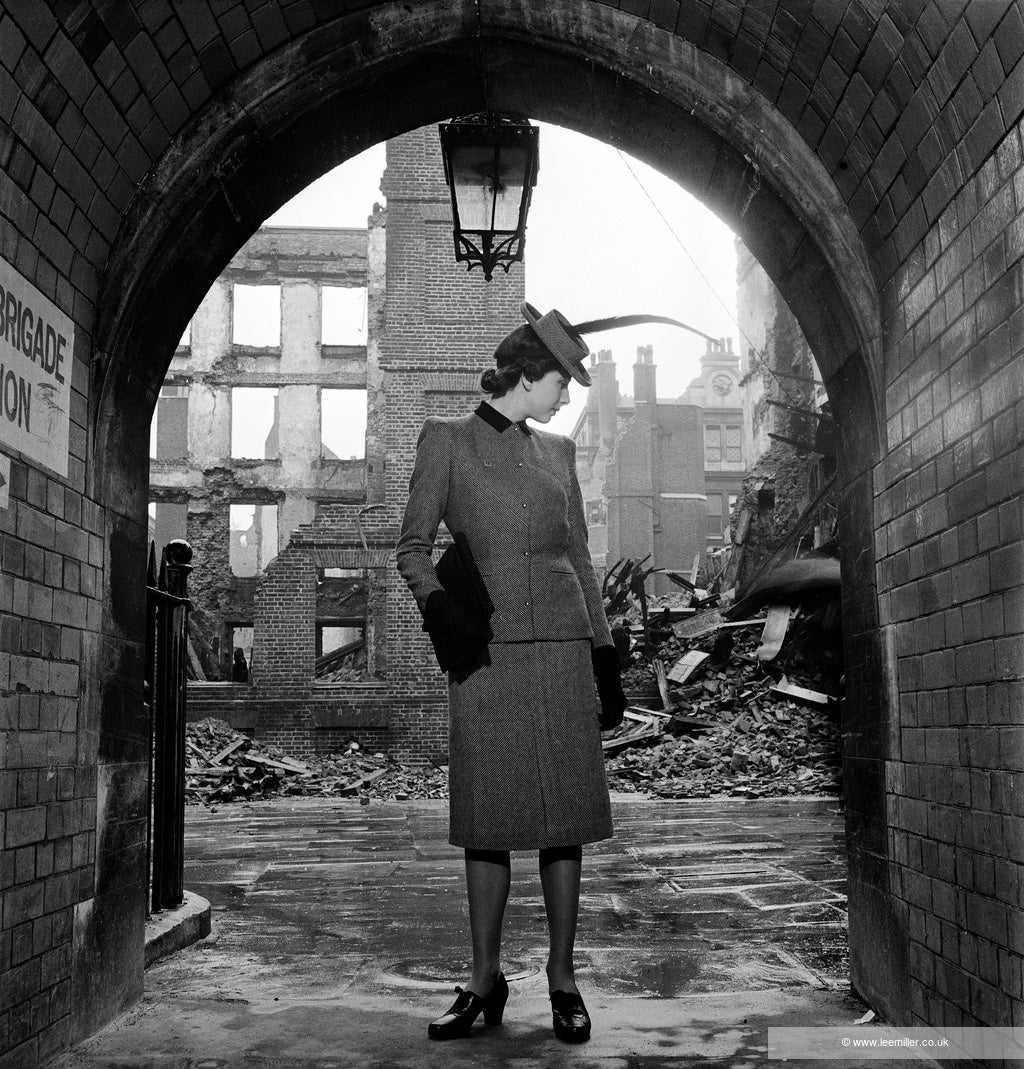
Miller moved to London in 1939, to be with her second husband, Surrealist painter Roland Penrose, just as that “inevitable conflagration” was kicking off. In Model wearing Digby Morton suit (1941), one of several London-based fashion photographs, the model in her jaunty feather-topped hat maintains superb composure against a background of bomb-blasted rubble.
But it’s when Miller sees action in the wake of the 1944 Normandy landings, when conditions were deemed safe enough to allow the presence of a woman photographer, that the exhibition, and indeed Miller’s art, really get into their stride. Her unflappably cool eye and her nose for the telling detail seem never to desert her, even in the most harrowing circumstances. We read the bent figure in the foreground of the snowbound Infantry Advancing as a soldier praying, though he is perhaps just hunched against the cold. The angelic female figure apparently asleep in The deputy Burgermeister’s daughter (both 1945) has taken cyanide along with the rest of her family in advance of the Americans’ arrival. Only when snapping a soldier with thickly bandaged face and hands, at his own request, does Miller allow the camera to shake. “It was pretty grim,” she wrote, “and I didn’t focus well.”
While we flatter ourselves about the way we “pulled together” during the recent pandemic, an experience that was likened to war, Miller’s photographs of the aftermath of the Second World War show that we didn’t even come close. There’s a penetrating humanity to these images that makes them vastly more than just great reportage, a quality that’s as evident in the queasily dreamlike Dead SS prison guard floating in a canal (1945) as in Give us this day our daily bread (1946), the latter showing two cheeky, barefoot girls in the back streets of Budapest.
Miller takes us to a moment when all of Europe seems to have been on the move, trying to get back to where they were before – on every level. The general understanding is that Miller never did regain her equanimity, to the degree that she’d ever had it, after her wartime experiences. A final room of postwar portraits of artists, including Penrose, Isamu Noguchi and a very young Eduardo Paolozzi, has a slight sense of going through the motions. Miller threw her energies instead into cooking in her final years, while succumbing to alcoholism and depression. The idea of the artist martyring themselves to the obligation to contemplate the unthinkable on behalf of the rest of us may feel more than a shade romantic, but it’s hard to escape in the closing moments of an exhibition that feels unnervingly timely given the world’s current parlous state.
‘Lee Miller’ is at Tate Britain from 2 October 2025 to 15 February 2026
Join our commenting forum
Join thought-provoking conversations, follow other Independent readers and see their replies
Comments
Bookmark popover
Removed from bookmarks