South Korean president grins in selfies with China’s Xi as part of four-day charm offensive
Xi frames South Korea and China as historic allies against Japanese militarism
South Korean president Lee Jae Myung laughed and posed for selfies with his Chinese counterpart Xi Jinping on Monday as the pair began what he described as a “new phase” in relations during his four-day visit to Beijing.
It marked their second meeting in two months, signalling efforts by both sides to foster closer ties as regional tensions mount with Japan and Taiwan.
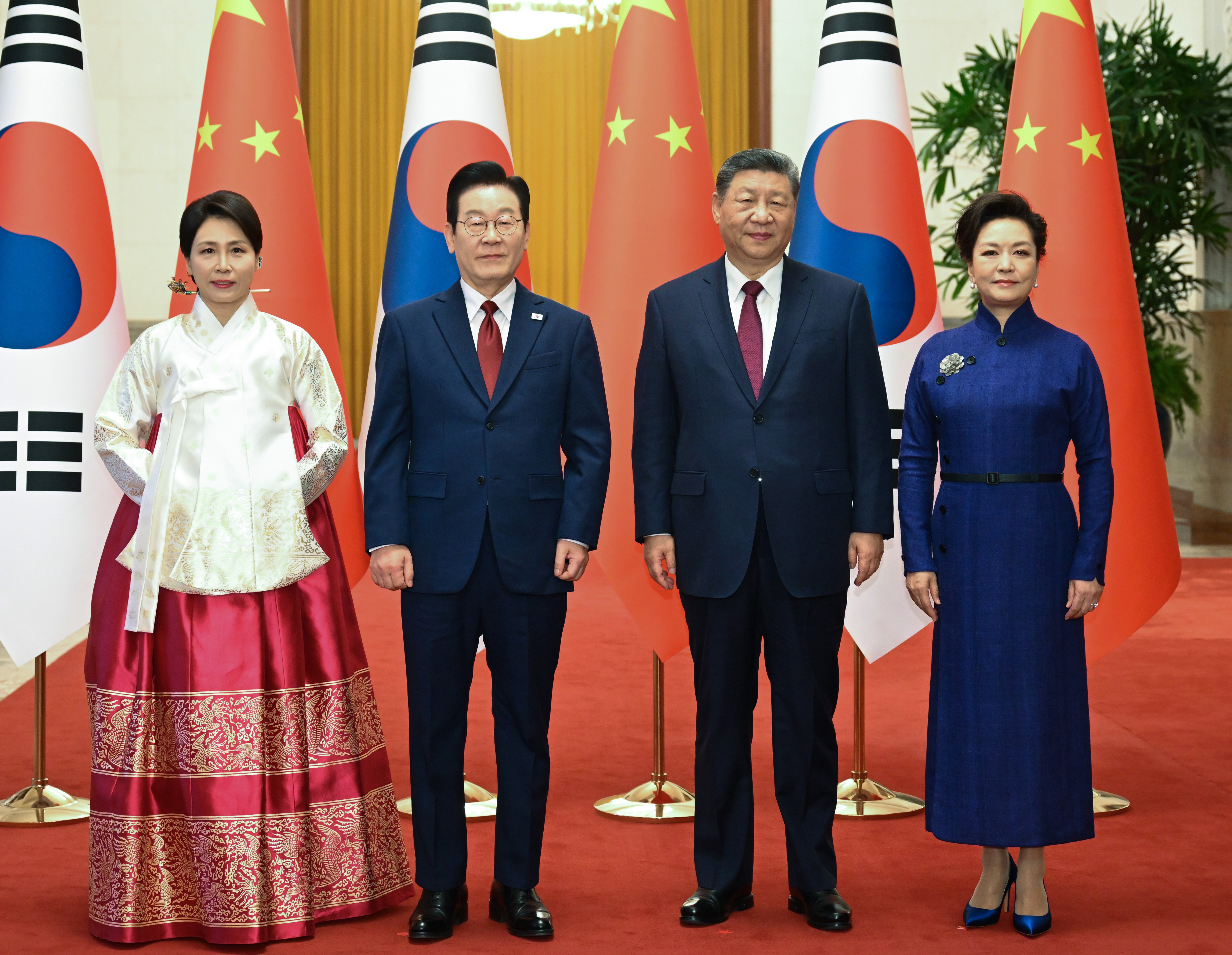
After their summit in Beijing on Monday, Mr Lee took to social media to post his selfies with Mr Xi and their wives on X – noting that he took the images with a phone he was given by the Chinese president.
"A selfie with President Xi Jinping and his wife, taken with the Xiaomi I received as a gift in Gyeongju," Mr Lee wrote, referring to the earlier APEC summit in South Korea.
"Thanks to them, I got the shot of a lifetime," he added.
Mr Lee’s office also shared a short video of the moment they took the picture, with Mr Xi heard complimenting Mr Lee on his selfie-taking skills.
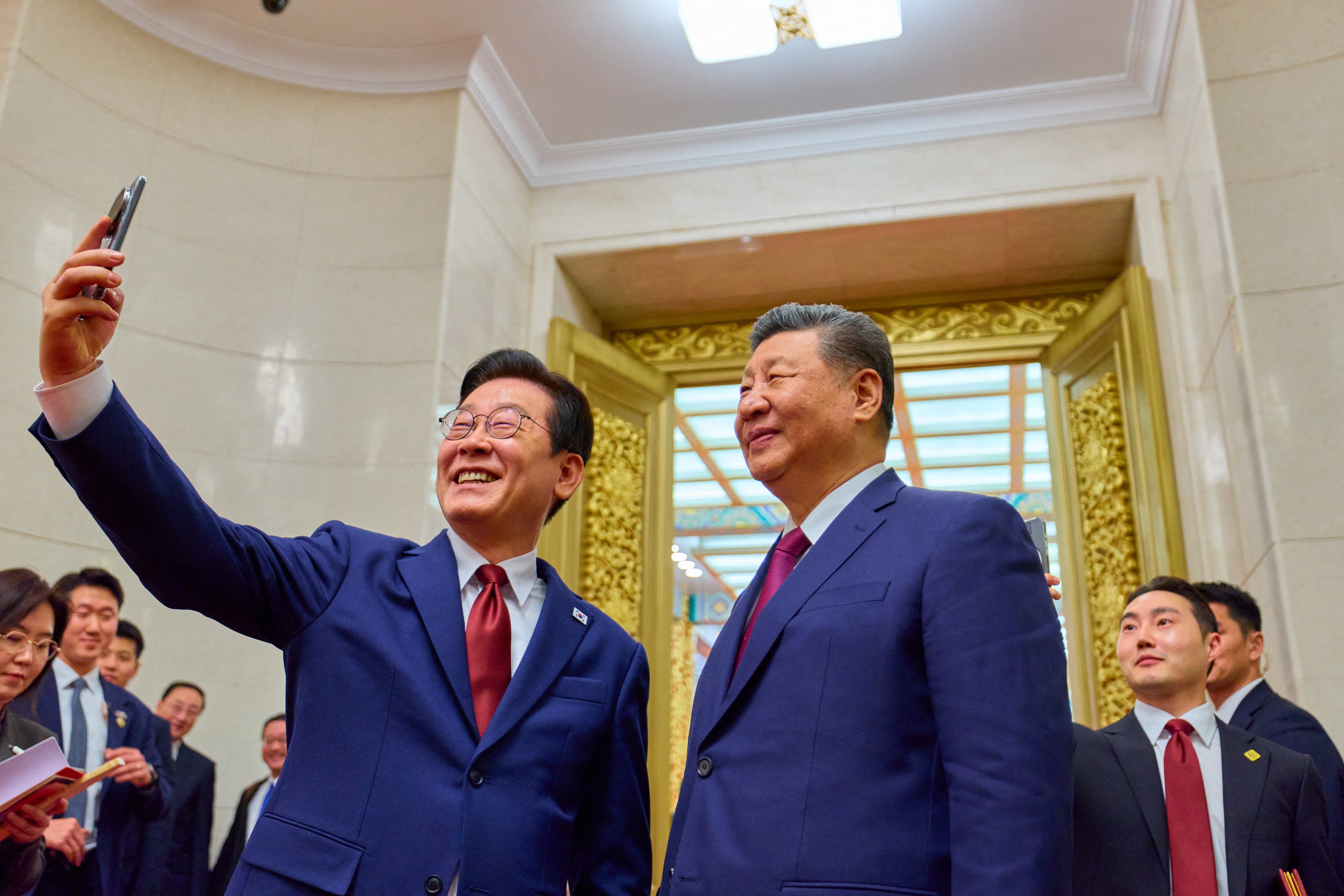
"The image quality is certainly good, right?" Mr Lee posted on X.
Mr Xi’s charm offensive towards Seoul comes at a time of otherwise antagonistic behaviour from Beijing towards other regional powers. Mr Xi used the occasion to make an unusually direct reference to his tensions with Japan, and highlighted Seoul and Beijing’s shared history in resisting Tokyo’s militarism during the Second World War.
“More than 80 years ago, China and South Korea made tremendous national sacrifices and won the victory against Japanese militarism," Mr Xi told Mr Lee.
The two countries should "safeguard peace and stability in Northeast Asia," Mr Xi said, urging his counterpart to stand on the right side of history.
Mr Lee became the first sitting South Korean president to visit China since 2019, arriving in Beijing on Sunday for a four-day trip that also includes a stop in Shanghai.
He is leading a delegation of more than 200 South Korean business leaders including Samsung Electronics chairman Jay Y Lee, SK Group chairman Chey Tae-won, and Hyundai Motor Group executive chair Euisun Chung.
The visit follows Xi Jinping’s trip to South Korea in late October – his first in 11 years – during which he stressed the importance of regional peace and stability and pledged deeper cooperation with Seoul.
The meeting is seen as crucial in restoring ties after bilateral relations soured under Mr Lee's predecessor, impeached ex-president Yoon Suk Yeol, who was very critical of China and remained focused on improving ties with the US.
"This summit will be an important opportunity to make 2026 the first year of full-scale restoration of Korea-China relations," Mr Lee said.
"I believe that efforts to develop the strategic cooperation and partnership between the two countries into an irreversible trend of the times will continue,” Mr Lee added.

"We want to usher in a new phase in the development of South Korea-China relations."
Beijing, for its part, is keen on stronger ties with Seoul since a rupture with Japan, whose prime minister Sanae Takaichi suggested in November that Tokyo could take military action if Beijing attacked Taiwan.
The two countries signed 15 agreements at the summit, according to South Korean and Chinese broadcasters, including documents on technology, intellectual property and transportation cooperation.
Chinese and South Korean companies also signed nine cooperation agreements, South Korea's Trade Ministry said, naming Alibaba International, Lenovo and South Korean retailer Shinsegae.
South Korea and China need to expand economic cooperation in artificial intelligence, Mr Lee said, and could also collaborate in consumer goods such as household goods, beauty, food products and cultural content such as movies, music, games and sports.
Leif-Eric Easley, a professor at Ewha University in Seoul, said South Korea’s push to restore high-level diplomacy with China is strategically necessary, but the Beijing summit delivered mostly symbolic gains.
“This summit in Beijing, following soon after APEC in Gyeongju, accomplished that. Yet despite Seoul’s diplomatic efforts, China has not adopted more internationally responsible policies on maritime disputes or Pyongyang’s nuclear threats,” he said.
He said China still hasn’t rolled back all of the coercive economic measures it applied after South Korea decided to host a US missile defence system almost a decade ago.
“It is meaningful for President Lee to commemorate Korean independence anniversaries in Shanghai, but unfortunate that Chinese media will likely spin an anti-Japan historical narrative while relations between Beijing and Tokyo are especially strained over Taiwan,” he added.
Join our commenting forum
Join thought-provoking conversations, follow other Independent readers and see their replies
Comments
Bookmark popover
Removed from bookmarks