Five days in the furnace: What it’s really like to run the Marathon des Sables
In Morocco’s 120km Marathon des Sables, Rod Ardehali learns that the desert strips everything back to the essentials, from the weight on your back to the thoughts in your head

It’s 6.15 p.m. in Ouarzazate, Morocco, and I’m cutting the excess foil from a packet of paracetamol in a bid to save weight. Beside me lies a small mound of rejected kit – spare batteries, a tiny stove, a handful of fire bricks, even the amputated bottom third of a foldable foam mattress. To the uninitiated it looks like the aftermath of a minor breakdown; to those of us about to run the Marathon des Sables, it’s the logical prelude to five days of voluntary suffering. Every gram counts when your backpack will carry everything you need to survive in the Sahara Desert.
The Marathon des Sables, often called the toughest footrace on earth, is best known for its full 250km edition – a seven-day slog across some of the most unforgiving terrain imaginable. I’m taking part in the shorter Morocco 120km version: a mere four days, temperatures up to 47 C, and enough sand to test every ounce of self-belief. It’s still very much out of the frying pan and into the furnace.
We begin in Ouarzazate, a small town whose name comes from the Berber for “without noise”. It’s a curious staging post – famous for Hollywood film crews and ultrarunners, yet with all the energy of a waiting room. The real ordeal lies five hours deeper into the dunes, reached by a convoy of coaches that bump through scrubland and dust until the horizon begins to ripple. By the time we reach the smattering of large black bivouacs and fluorescent yellow tents arranged in circles of six, with just enough space for a small fire in the middle, the absurdity of what’s ahead has settled in.
Stage 1
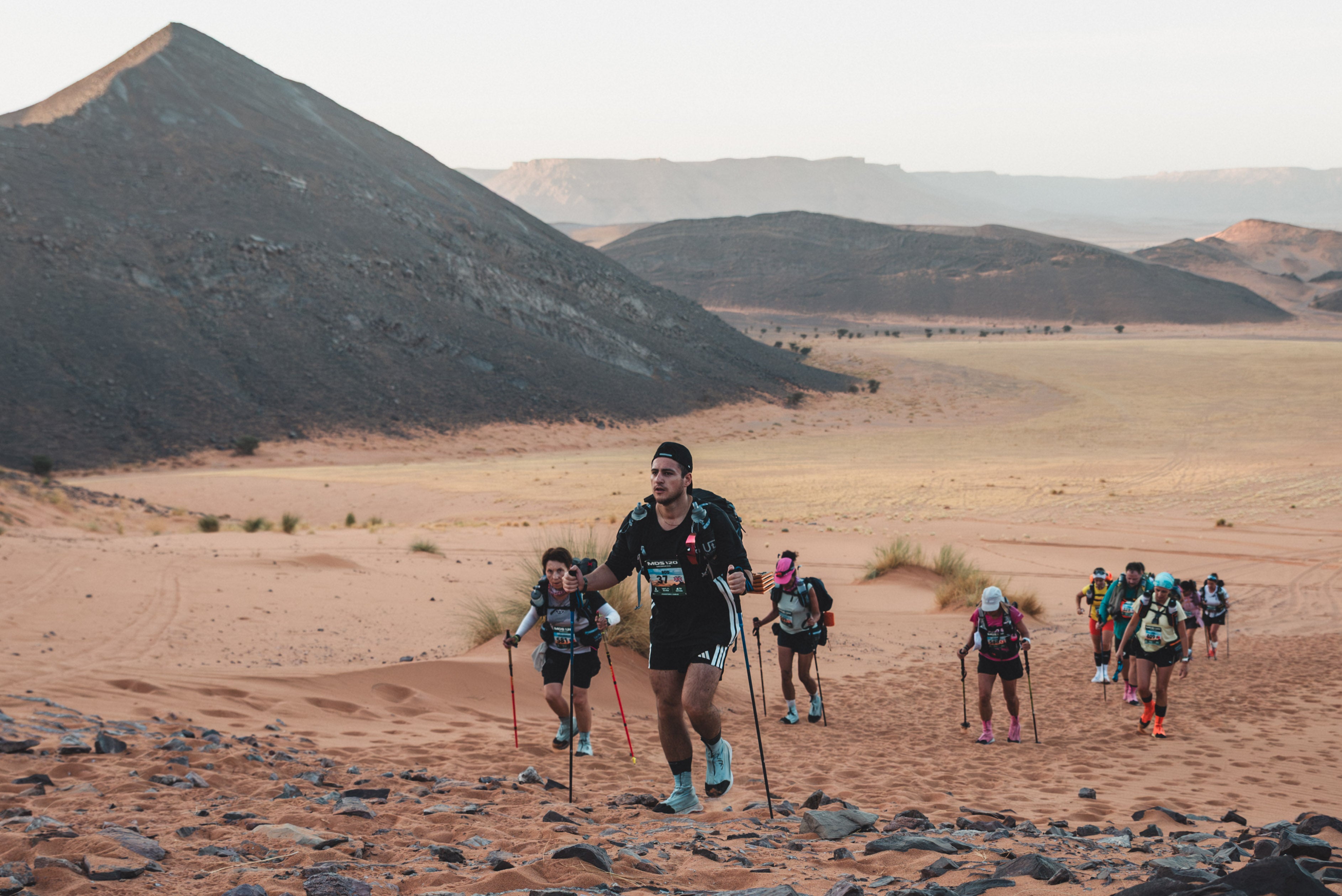
The first morning begins with a certain amount of bravado. We enjoy our last moments of ignorance before a safety briefing, first in French, then in English – the majority of runners being Francophone. After that, at long last, and soundtracked by some truly awful Eurotrash, we set off into the unknown: a trail of limbs and hiking poles vying for space in soft-packed sand. The fittest – led by ten-time MDS winner and local legend Rachid El Morabity – vanish almost immediately into the shimmering distance. I’m somewhere in the middle wave: part running, part trudging, trying not to get caught up in the excitement and overheat too early.
Within hours, bravado turns to bargaining. The temperature hits a mind-boggling 45 C, the climb ahead rises 250 metres, while the sand behaves like a conveyor belt pulling us backwards. Despite all my careful prep, it’s obvious I’ve overpacked. Aside from five days of meals, I’m carrying two litres of water, a change of clothes, a heavy battery pack, trekking poles, sandals, socks and other flotsam I’d held onto out of misplaced caution. By the 18 km mark, marching into the sun’s full blaze, I’m down to 250ml of warm water with four kilometres to the next checkpoint. People stop. Others collapse. Some use their bodies to shade those who’ve fainted. I realise the Sahara is indifferent to our struggle so I keep moving forward slowly.
When I finally crest the hill and see the checkpoint below, I’ve learned my first lesson the hard way: never leave one without both canteens full to the brim. Two savage climbs and one never-ending march later, the camp finally comes into view. To experienced trail runners, 25 km is a manageable distance. This stage feels like something else entirely. That evening, a hush settles. You hear the low murmur of conversation, the hiss of stoves, the shuffle of people discovering that even sitting hurts. The smell is dust, sweat and rehydrated curry.
Equally there’s excitement around the camp. Runners share stories of where they suffered the most, or surprised themselves by running farther than expected. Which checkpoint felt the longest, what trekking poles they’re using and how their backpacks stood up to the test. I realise everyone is in this together, the culmination of their own long journeys to get to the starting line.
Stage 2
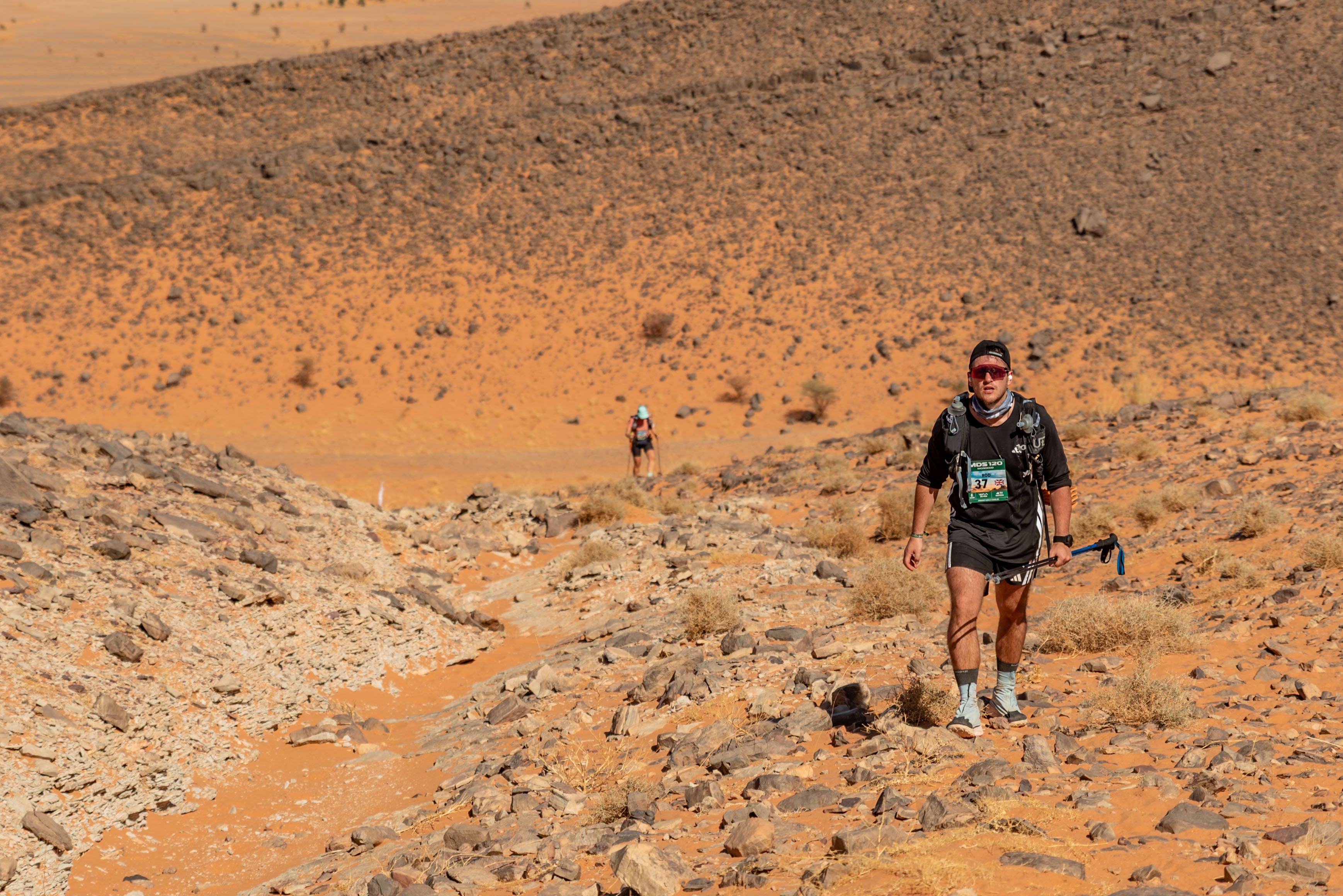
By the morning of the second stage the organisers have already conceded to the heat. The route is shortened from 46.5 km to friendlier 40km, a tacit admission that a predicted 47 C by midday is punishing even for them. The morning feels briefly kind: hard-baked earth instead of soft sand, a chance to find rhythm. We half-run, half-march, the miles ticking by until the sun begins its assault. The route dips and rises. Flags mark the path past a herd of camels in the distance and through fields of jagged rock. Lesson learned from the day before, I’m monk-like in my discipline with my water and electrolyte mix. Despite this, there are tell tale signs of dehydration. I’d packed an electrolyte sachet for every other checkpoint across the whole event. In any other race that would have been more than enough, but here, under this heat, I should have had one per stop. You simply can’t absorb water without salts; at a certain point you just become a human canteen, liquid sloshing inside you and weighing you down.
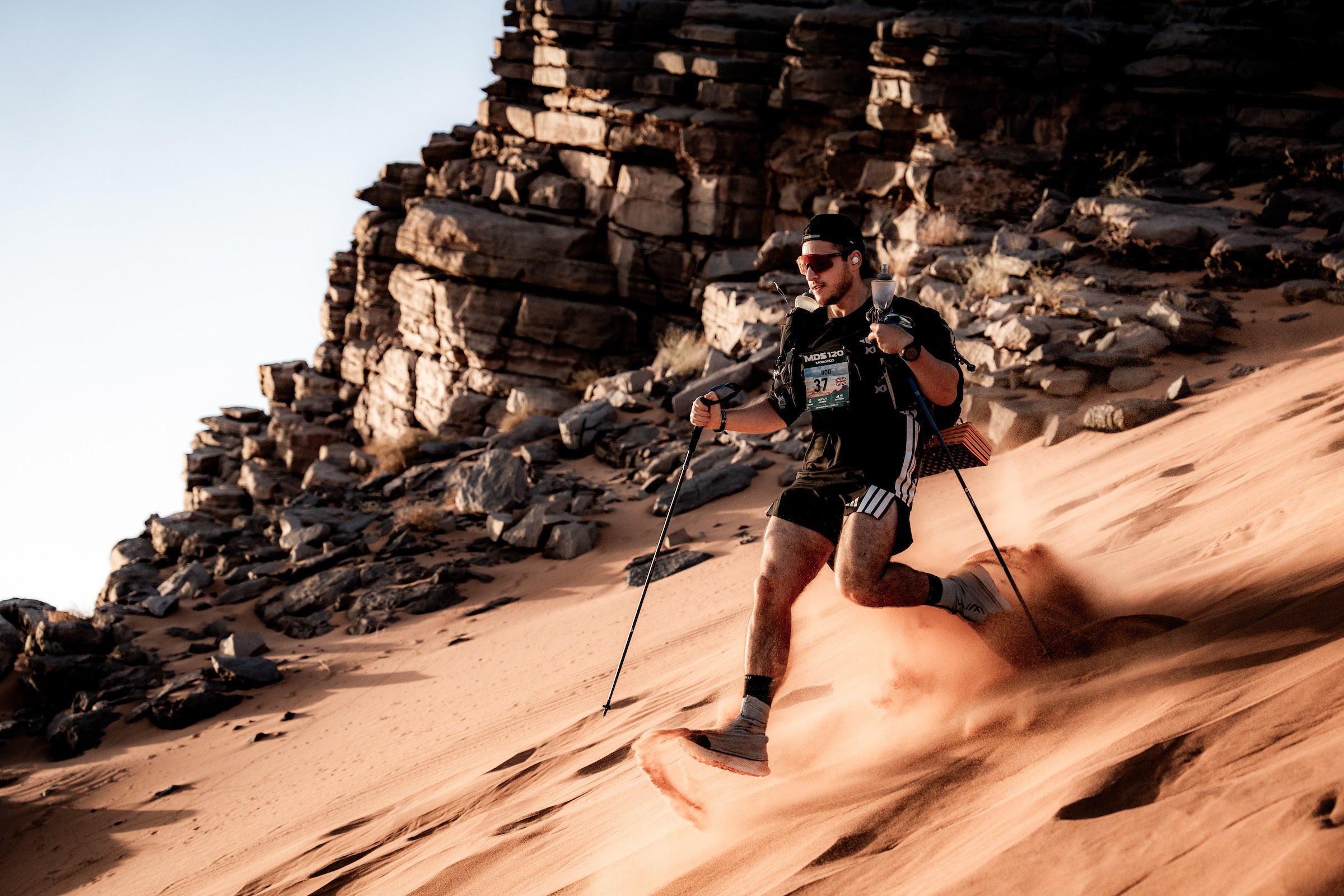
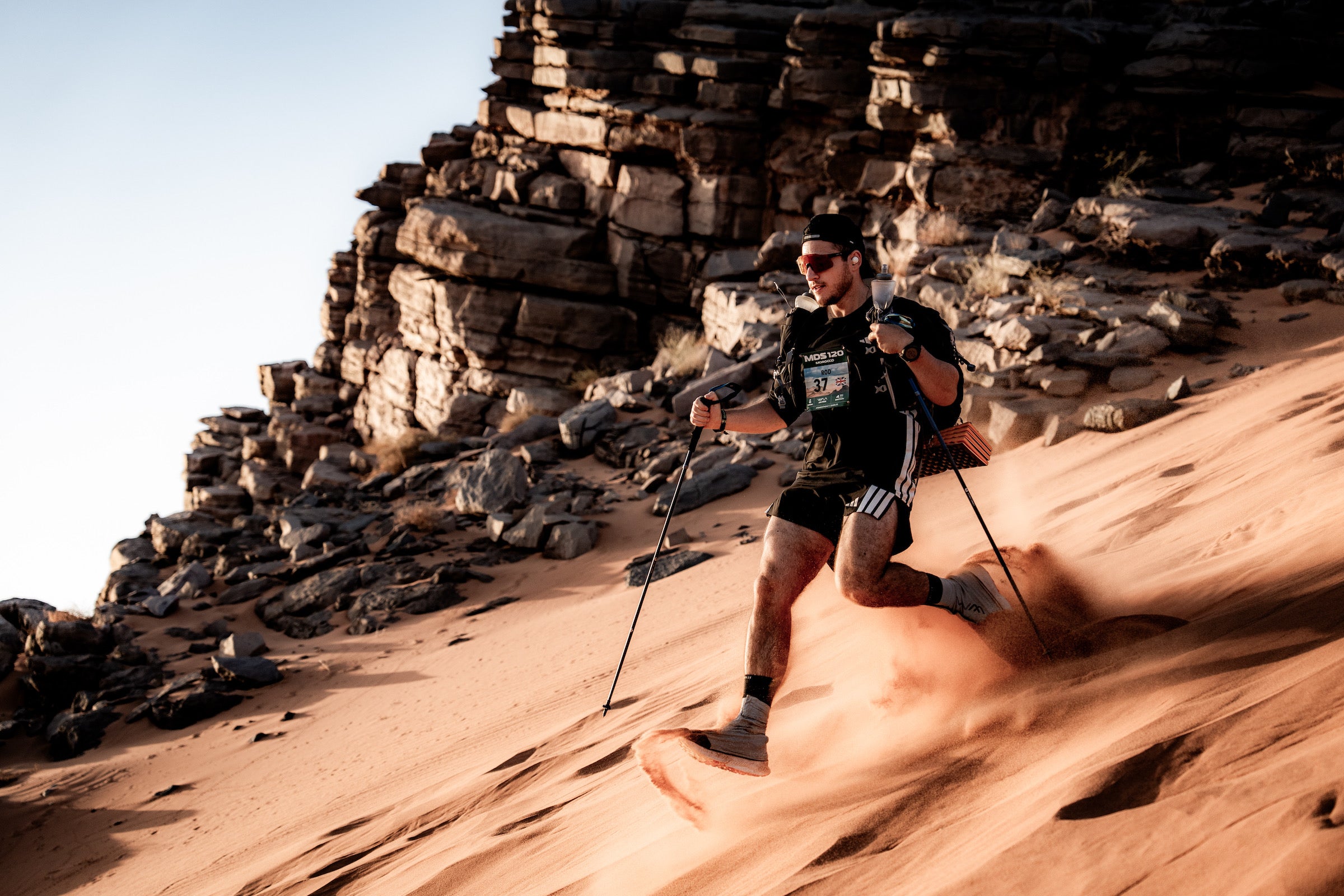
At the final checkpoint, around 32km in, the staff warn us to rest and refuel before tackling the nine kilometres ahead. With good reason: it’s the hardest stretch of my life. First up, endlessly up: soft orange sand dotted with jagged rocks that you scan for the promise of solid footing. When that fails, you follow the footprints of those ahead, their paths slightly firmer than the rest. At this stage, survival is the only strategy. In the furnace, a 211-metre ascent feels biblical. False peaks appear and vanish. The air hums with heat. A single, withered tree marks the end of the ascent, and from there a descent through soft sand that swallows every step. You round jagged cliff face and the camp appears ahead. It’s a little more than a dot but not much more, a mirage that refuses to grow closer no matter how long you move. Uphill, downhill, flat, uphill, downhill, flat. Rolling flats, more soft sand. There is no respite, just one extended sting in the tail.
Despite this, there are small mercies. British volunteers, scattered along the course, make a beeline for their compatriots. The race may be dominated by French and Belgian runners, but the Brits, competitors and volunteers alike, form the tightest group. Encouragement and little conversations with fellow runners remind you that this is an adventure, not a chore. It’s an astonishing setting and the hardship brings out the best in humans. As the heat takes its toll, close friendships are forged in the furnace and you can’t help but look out for your camp mates on the route. A few of the group find themselves in ice baths to cool down, fifteen minutes each time to drag the core temperature back to human range. You become just as invested in them finishing as in yourself.
Rest day
By the rest day we’ve learned the rhythm: ration, boil, repack, repeat. The best bivouac, the one with airflow, is claimed by a cheerful band of Brits: doctors, lawyers, finance types, a farmer, the customary military types, and an entrepreneur or two. The Marathon des Sables attracts exactly the kind of happy-go-lucky adventurers that our island specialises in. We sit cross-legged, dealing cards, discussing the merits of different dehydrated meals as if haute cuisine. Then a sandstorm arrives, tearing up the idyll. Some tents are blown away; the pop-up toilets disappear into the distance. We hunker down, faces covered, eyes closed, and wait it out with the quiet patience of delayed commuters.
Stage 3
The final stage begins before dawn. At 5.30am the air is cool enough to run freely, and for the first time my body feels tuned to the desert. The rhythm has arrived: run the flats, march the dunes, poles out, poles tucked away. Confidence replaces dread. Fifteen kilometres pass before the sun rises. Somewhere between exhaustion and acceptance, I stop fighting the place. The desert doesn’t change, but I do. This isn’t a race; it’s a sequence of small survivals stitched together. As the sun climbs, the plain turns a deep red and for a moment it feels like Mars: arid, silent, surreal. The landscape turns copper, then gold. The finish line appears almost by accident: a modest archway that feels both anticlimactic and immense. Volunteers cheer. A medal is placed around my neck. Several hugs are given and the organisers appear genuinely delighted for me the hundreds who cross the line in various states of emotion.
Aftermath
There’s no time to linger. We’re bundled onto buses and driven back to Ouarzazate, demob-happy, sunburned, half-delirious. We’ve been reduced to our simplest selves and now, suddenly, we’re returning to civilisation, laughing too loudly, debating what we’ll eat and drink first, dreaming of that first shower.
Back at the hotel, there’s a party. Runners from all different continents raise glasses to their blisters, their bandages, their survival, a mixture of triumph and relief.
A few hours later, as I lie awake in a comfortable bed with the air conditioner humming, I realise I already miss it: the sand, the silence, the simplicity, the furnace. The desert doesn’t care if you finish. But if you do, it never quite lets you go.
Join our commenting forum
Join thought-provoking conversations, follow other Independent readers and see their replies
Comments
Bookmark popover
Removed from bookmarks