The Independent's journalism is supported by our readers. When you purchase through links on our site, we may earn commission.
How to start weight training – with this simple formula for strength and longevity
The many benefits of strength training are making headlines worldwide, from improved physical capacity to better longevity. Dr Andy Galpin tells Harry Bullmore the 3x5 workout plan is a simple yet effective way to get started

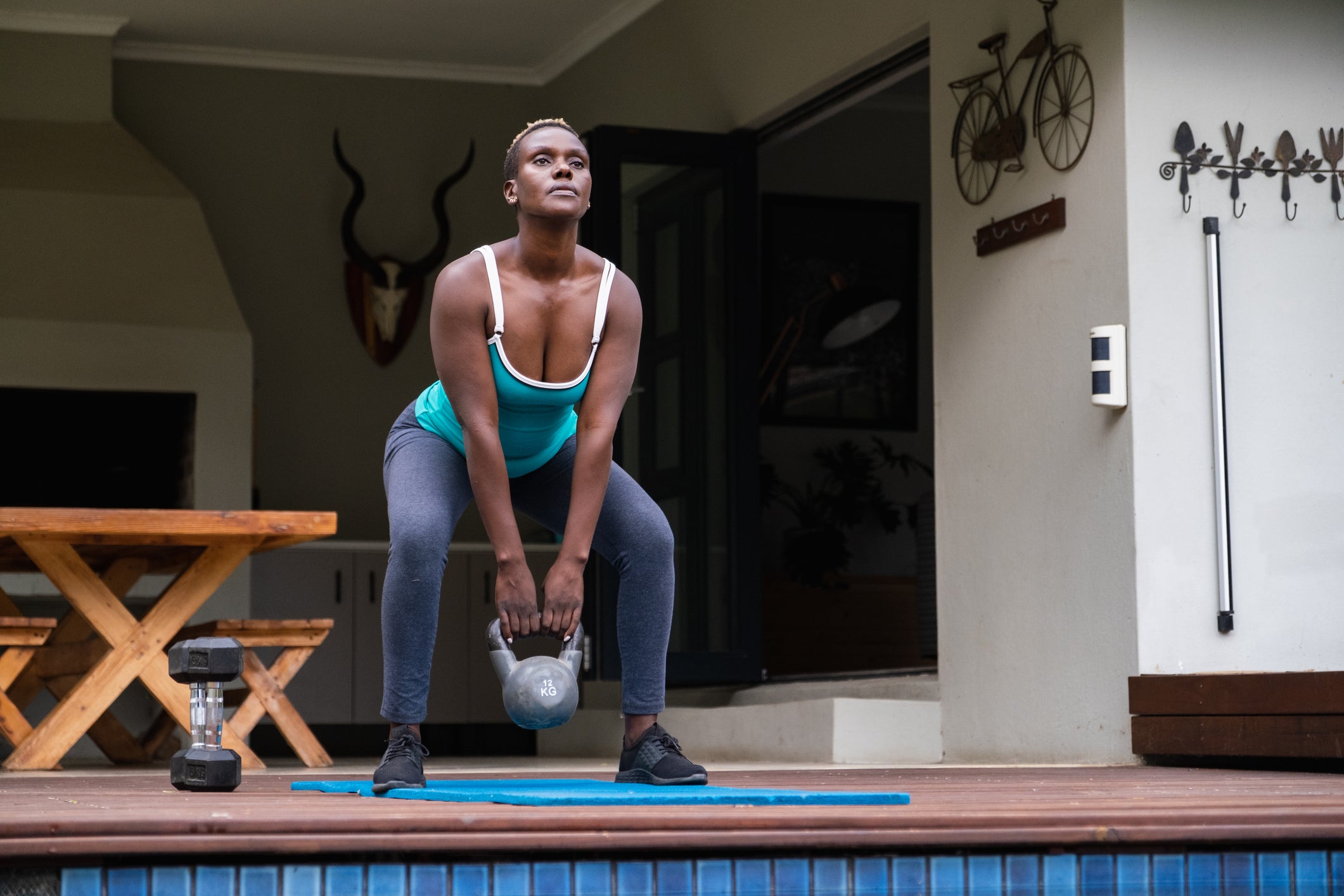
Lifting weights is incredibly good for you and a potent anti-ageing agent – recent headlines have made that mainstream information. Starting to lift weights is less straightforward.
Stepping into a gym, or even grabbing a set of dumbbells at home, can be an intimidating experience at first. Worse, there are a lot of companies competing for your attention (and money) with health hacks and quick fixes, making it hard to know where to begin. But competence breeds confidence, and you can bypass these issues by learning the basics well – for beginners in particular, this is where most benefits of strength training lie.
To do this, world-leading human performance coach Dr Andy Galpin says the refreshingly simple 3x5 workout plan can be a good framework to follow.
“I wish I could say I invented it,” he tells me on the eve of his keynote speech at Healf’s HX25 event. “It is a simple approach to strength training where you say, ‘I’m going to train between three and five days per week, doing three to five exercises per day, completing three to five reps and sets per exercise, and resting three to five minutes between each one of those sets’.”
The 3x5 plan can be modified to look very different for different people, with workouts taking anywhere from 30 minutes right up to two hours. This malleability means it can cater to everyone from beginners to advanced exercisers and span a wide range of fitness goals.
However, you adjust it, the common denominator is the 3x5 plan’s ability to help you build a stronger, healthier body, both inside and out. Here is how to use it.
 Is the rise of endurance sports a harmless health kick – or dangerous addiction to adventure?
 If you have tight hips, a flexibility expert recommends these three stretches
 From back pain to heart health – Experts reveal how to counter the negative effects of too much sitting down
 The science-backed exercise method that can help fight the effects of ageing
How to follow the 3x5 workout plan
Strength training is safer than most sports as it’s performed in a controlled environment with few dynamic elements. But nailing the basics is still important for maximising benefits and minimising injury risk.
When you start, focus on the quality of your movements. Practice foundational exercises like the squat, deadlift, chest press and bent-over row using lighter weights until you can perform them competently – ideally, find a trainer to help you learn how to do them correctly.
“People often forget that strength training is a skill,” Dr Galpin explains. “There are very specific techniques that we want to use, and we want you to be in good positions – that means you need to learn them. One of the mistakes we often see is people think squatting is a simple human movement, but the reality is most people don’t do it well. If you add load on top of dysfunctional movement, or volume on top of bad movement, it’s a recipe for short or long-term injury.”
In the beginning, Dr Galpin suggests hiring a qualified coach for a month or two. Rather than looking to lose weight or gain strength immediately, ask them to teach you a handful of foundational compound (or multi-joint) movements such as squat, lunge, deadlift, press and row variations.

“That’s going to be better than doing it on your own – then film them so you have coaching cues you can look back on,” he advises. “You want to be moving well for the next 65 years, so if you invest a few months now, it’s really worth it in the long run.”
Learning how to perform a few exercises that cover all the body’s major movement patterns – squatting/lunging, hip hinging, pushing and pulling – will give you the tools you need to follow most plans effectively later down the line.
“We’re getting your system ready to handle different movements,” says Dr Galpin. “I want your joints, soft tissue and muscles to get past that initial round of soreness and fatigue [experienced by newcomers to strength training]. Then they can develop strength and stability – they’re going to do that best through practice.”
Galpin shares a few examples of how to use the 3x5 plan below.

The 3x5 plan for beginners
Exercise | Sets | Repetitions | Rest between sets |
Squat variation (eg barbell squat, barbell front squat, box squat, goblet squat, Bulgarian split squat, leg press machine or leg extension machine) | 3 | 5 | 2-3 minutes |
Chest press variation (eg barbell bench press, dumbbell chest press, single-arm dumbbell bench press, dumbbell floor press, machine chest press, press-up or hands-elevated press-up) | 3 | 5 | 2-3 minutes |
Deadlift or hinge variation (eg barbell deadlift, Romanian deadlift, rack pull, hip thrust, hip thrust machine, dumbbell Romanian deadlift, single-leg Romanian deadlift or good morning) | 3 | 5 | 2-3 minutes |
Workout frequency – Three days per week
The biggest barrier standing between people and a regular exercise routine is a shortage of time. While a higher training frequency presents more opportunities for beginners to practice the movements, performing three workouts per week provides a more accessible and sustainable entry point for beginners.
Number of exercises, sets and reps – Exercises: 3 Sets: 3 Reps: 5 Rest: 2-3 minutes
Doing just three sets of three exercises allows you to keep the workout duration short – roughly 30 minutes – while also preventing beginners from overtraining.
“If you’re keeping your number of repetitions per set low – in the three to five range – it allows you to ensure each one is very high quality,” Dr Galpin explains. “You’re maintaining good technique because you’re not experiencing a tonne of intra-set fatigue.
“When you’re doing 20 reps, it’s pretty hard to be really focused for every single rep. But for three, four or five reps, it’s much easier for people to pay attention in addition to putting in effort.”
Dr Galpin also says the intention behind each rep is important for optimising your results. Research suggests that simply watching or thinking about the working body part can lead to greater muscle activation in this area – “That mind-muscle connection drives more intent and can drive more results”.
Approach every rep with purpose and intention, focusing on moving well and recruiting the working muscles effectively.

Exercise selection – Mostly compound, multi-joint exercises
Prioritise multi-joint compound exercises like variations of squats, deadlifts, presses, pull-ups and rows, as these recruit more muscles simultaneously. By doing this, it is possible to enjoy a whole-body workout with just three movements, allowing you to train each muscle group more frequently over the course of the week for increased results.
A simple framework to start with is the stalwart exercises: the squat, bench press and deadlift. These movements can be performed with barbells, dumbbells or kettlebells, and they cover all of the body’s major muscle groups – but they won’t be an ideal choice for everybody.
“You want to select exercises that take you through the largest range of motion possible that is safe for you,” Dr Galpin explains.
If you struggle to perform the squat, bench press and deadlift, swap them out for exercises that target similar muscles and movement patterns over a shorter range of motion, or in a more controlled environment. This could mean regressing from a barbell squat to a box squat to counter for mobility limitations, or using a leg extension machine while you develop the stability needed for a full squat – all exercises require extension at the knee, and as long as you are challenging your quadriceps muscles on the front of the thigh, all of them can increase strength and muscle in this area.
“You might go from a squat, bench press and deadlift to a machine chest press, a leg press and maybe a Romanian deadlift or machine hamstring curl for a less complicated version,” Dr Galpin says.
“Or if you wanted a little bit more of a functional version – including balance and unilateral, or single-sided, elements – that could include a single-leg Romanian deadlift, then a split squat or lunge and a single-arm row or single-arm press.”
Read more: The science-backed exercise method that can help fight the effects of ageing

What weights to use
If you want to build strength, you need to move heavy weights, with the term “heavy” being relative to your existing strength levels.
However, for this programme, you should not be grinding through reps or pushing to the point of muscular failure, where your muscles have grown too tired to complete another rep. Instead, Dr Galpin says you can “leave a little in the tank” on each set while still enjoying most of the benefits of lifting weights. Try stopping at the point where you could perform roughly two more repetitions with good form.
“If you’re getting towards the end of a set and you feel yourself starting to move poorly, shut it down,” says Dr Galpin. “We’re not trying to maximise strength, we’re simply trying to get moving.”
You can use trial and error to find the right weight, starting conservatively and building from there. Or, as a rough rule of thumb, when following the 3x5 plan, Dr Galpin suggests using 90 per cent of the maximum weight you could lift for five repetitions.
The important thing to remember is that, for continued progress, you will need to apply the progressive overload principle to this plan.
This simply means incrementally increasing the difficulty of your workouts in line with your improving strength and fitness levels.
The easiest way to do this is by increasing the weight you are lifting every week or two. Or, if you have limited equipment, you could add an extra set or an extra rep to each set, each week.

Benefits of the 3x5 plan
Doing just nine repetitions of an exercise per workout might not seem like enough to have an effect, but Dr Galpin says this is not the case.
“There is excellent research that suggests a small number of sets – up to five sets, or even lower, per week total – is sufficient to maintain strength in many people, if not most,” he explains.
In people who have not lifted weights before, the stimulus is new to them, so less intense efforts are required to trigger positive adaptations in the body. As a result, an incredibly low weekly training volume can still deliver strength training’s many associated perks; improved strength, joint health, muscle mass, mobility, bone density, joint health, mental health and more.
“[Working a joint through a full range of motion under load] will create more muscle growth, especially at the end range,” Dr Galpin says. “The more of a stretch there is, the greater the results, and the more likely you are to see improvements in connective tissues, joint health and strength.
“Then the one people always forget is that it is actually the most evidence-based way of improving range of motion, flexibility and mobility, by a large standard.”
The cumulative impact of these adaptations is a body that feels and functions better, allowing you to enjoy a reduced risk of injury and improved physical capacity for years to come – think exploring a new place on holiday, playing with your grandchildren, or simply going about your day-to-day life unencumbered.
Read more: Why going sober was one of the best things I’ve ever done

Drawbacks of the 3x5 plan
“The 3x5 plan is not great for muscle growth,” says Dr Galpin. “It’ll work, but it’s not the optimal thing you could do if that’s your goal.
“It’s also not always great for skill development – there just aren’t enough repetitions.”
This is why it is recommended to practice the movements using higher-rep sets at lighter weights, ideally with the guidance of a qualified trainer, before starting the plan.
For beginners, the 3x5 plan also contains limited movement variety. With the body operating on a rough “use it or lose it” basis, the more you grease the groove of different movement patterns, the more likely you are to maintain safe access to them.
For this reason, as you become more competent in your strength training, Dr Galpin recommends weaving a greater variety of exercises into the 3x5 format. These might include two-sided exercises, one-sided or unilateral exercises, and exercises that move you through multiple planes of motion, such as those involving side-to-side and twisting movements.

How the 3x5 plan can be modified for different fitness levels and goals
The true beauty of the 3x5 plan lies in its flexibility, accessibility and simplicity. It can easily be adapted to suit different fitness levels and goals with a couple of tweaks. Here’s how:
Working on weakness
If there is a certain area of the body you want to grow, strengthen or focus on, you can add an extra exercise or two to the end of your session.
“The 3x5 plan doesn’t have to be the only thing you ever do,” says Galpin. “If you wanted to add one or two sets of isolation [single-joint] exercises for 10 to 15 reps at the end of your session, great.”
You could also add more movement options in this way to improve mobility, such as rotational exercises, side-to-side movements and direct core work.
Balancing with other sports
If you have a sport you are passionate about, such as running or walking, but you’re looking to build a more robust body through strength training, the 3x5 plan can support this goal.
Dr Galpin recommends keeping the volume low enough that your primary activity isn’t compromised by tired muscles – you might want to stick to the beginner framework of three days per week, performing three exercises for three to four sets of three to four reps. You can also increase or reduce this volume depending on how you feel on the day of each workout.
Advanced lifters
“This is someone who doesn’t have time restrictions or limitations; they recover well and they’re ready to get as strong as they possibly can,” says Dr Galpin.
While he says there are better programmes out there for building absolute strength, the practical framework can still make the 3x5 plan an attractive option for simplicity’s sake.
“You might want to do four days per week,” Dr Galpin says. “I’m not going to recommend five days per week because I don’t know that you’re going to have the recovery capacity to handle it.
“If you really want to maximise peak strength, we’re probably going to go a little bit lower on the repetition spectrum and higher on the set prescription – four exercises for five sets of three reps.”
He suggests alternating between upper and lower body workouts, doing lower body sessions on Monday and Thursday, and upper body sessions on Tuesday and Friday.
All sets should be completed with high intensity, quality and intention, using weights that are 90 per cent of your three-rep max or above.
Training for speed and power
“If you’re really going for speed and power, you want to use lighter weights and move them fast,” says Dr Galpin. These can be useful attributes to develop if you are looking to improve your performance in a certain sport, such as football or volleyball.
However, it is always worth laying firm foundations of strength before progressing to this more specific training goal.
Read more: Is the rise of endurance sports a harmless health kick – or dangerous addiction to adventure?
Join our commenting forum
Join thought-provoking conversations, follow other Independent readers and see their replies
Comments
Bookmark popover
Removed from bookmarks