Brooklyn Beckham, and the new war on ‘toxic boy mums’
When the Beckhams’ eldest son took to Instagram to share his side of the feud with his parents, much of his anger was directed towards his mother. That’s no surprise to Chloe Combi: pouring scorn on so-called “toxic boy mums” has become the latest trend online.

It has been less than a week since Brooklyn Beckham shared his six-page Instagram Story, which broke the internet. After a family feud that had been bubbling since his wedding to Nicola Peltz three years ago, he finally poured the tea on his “truth”. “I have been silent for years and made every effort to keep these matters private,” Brooklyn told his 16 million followers in a written statement. “I do not want to reconcile with my family. I’m not being controlled, I’m standing up for myself for the first time in my life.”
While he went on to accuse both parents of exploiting and monetising him since birth, the real ire was reserved for his mum. The eldest Beckham son, among other things, accused his mother, Victoria Beckham, of humiliating him and dancing “on” him – a comment which seemed especially designed to cruelly twist the knife into Victoria, who made her name as a professional singer and dancer.
Even though David Beckham has arguably gained as much, if not more, from Brand Beckham than Victoria has, Brooklyn Beckham was very clearly directing his familial complaints at mummy and not daddy dearest.

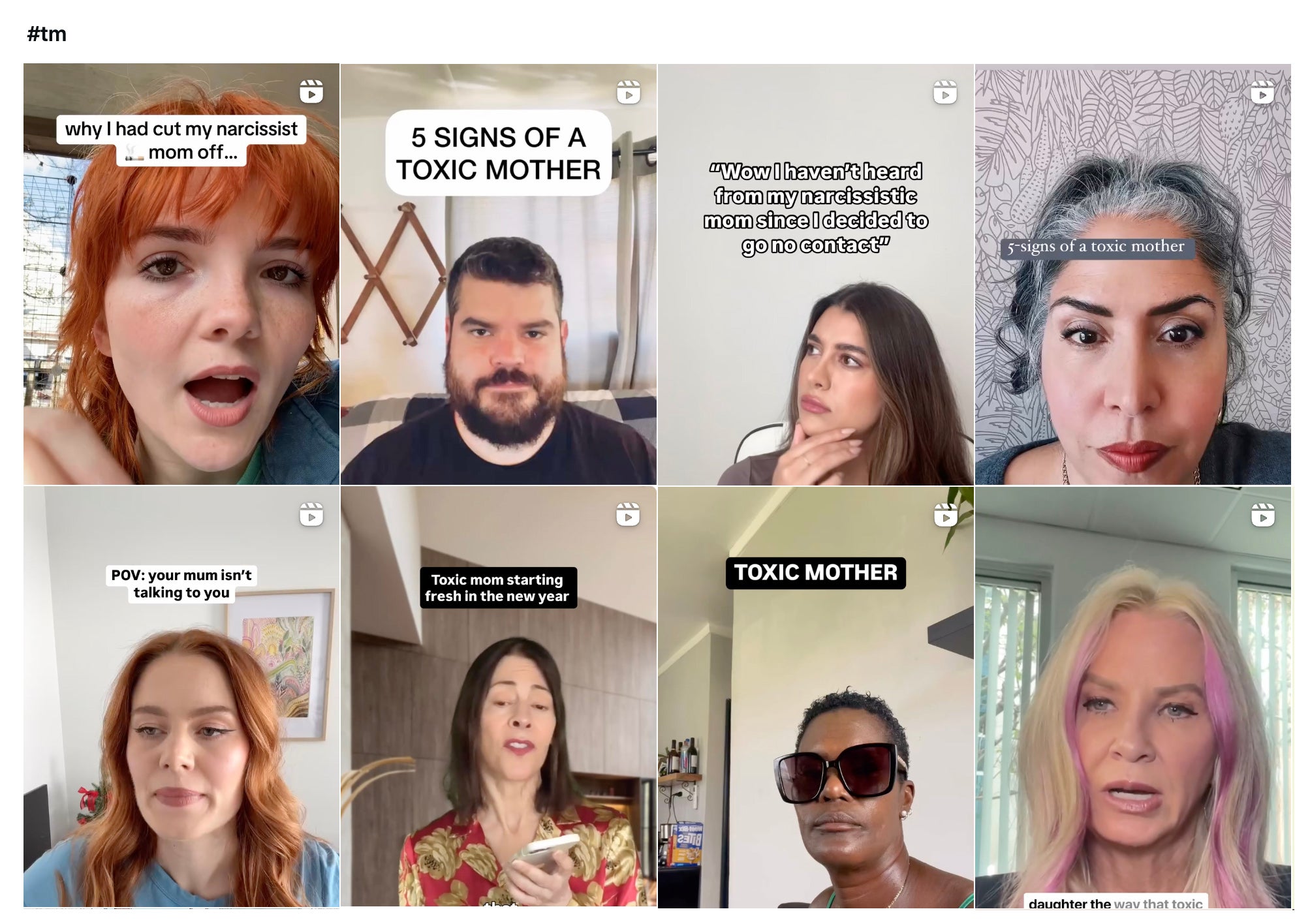
But Victoria isn’t alone in being publicly mum-shamed in this way. There is a whole swathe of the internet devoted to outing “toxic boy mums”, complete with their own special hashtag, #TBM. Discussions about toxic dads exist, too, but they are far less prominent and far less furious in tone.
And while the vast majority of criticisms from Gen Alpha and Gen Z on platforms like TikTok and Instagram about toxic parenting skew towards mothers, mothers-in-law come under heavy fire, too. Alongside #TBM (Toxic Boy Mum) there is #TMIL (Toxic Mother-in-Law) – two hashtags that have generated billions of discussions and videos across social media.


Famous mums are portrayed as ruthlessly money- and fame-hungry at the expense of their sons and families, while non-famous mothers come in for pretty brutal exposés too. All sorts of ugly secrets and stories about hijacking or spoiling weddings, births and relationships are being splashed across TikTok and Instagram, where the “toxic” behaviour of boy mums is revealed and viciously dissected. The dominant narrative is “weird boy mums” being proud to be “weird boy mums” by displaying overprotective and “emotionally abusive” behaviour.
While sometimes just being a mother of a son seems to be enough to be mocked and derided, the mums who are seen to have monetised and become famous through her children – and whose children are now grown – come in for the most heat. “Momager” and “mum-fluencer” are the focus of the many of the comments, reflecting a broader generational shift towards calling out toxic parenting.
The vast majority of criticisms centre on “sharenting” – a modern social media phenomenon in which parents excessively share often very images and videos of their children growing up. While Brooklyn Beckham’s complaints about his childhood being turned into content are at the extreme end, the broader complaint from this generation – that every part of their childhood has been captured and shared without their consent – is a very real one.

Apple Martin (the daughter of Gwyneth Paltrow and Chris Martin) led the charge against mums sharing pictures with her infamous scolding – delivered, naturally, via a comment on social media – underscoring her and her generation’s right to privacy: “Mom, we have discussed this. You may not post anything without my consent.”
While much sharenting comes from a parent’s innocent desire to celebrate their children, it can become problematic if the intention from parents is to grow their own social media followings with a view to monetising family life in some way.
Grant (21)* had a major falling out with his mother, though he still speaks to his father and two sisters. He explains: “My mum tracked and shared my ‘coming out’ story (as gay) to her 150,000 followers when I was 15.
“At the time I thought it was sort of cool, and my dad was fine with it too and got slightly involved. But now that I’m older, I think it was exploitative and intrusive. She absolutely did it to get followers and make herself look a specific way, like the cool and inclusive mum. I’m absolutely furious with her about it, but she still won’t apologise or take a lot of the very personal material down.”
Society has always been antagonistic towards perceived gossipy and opportunistic women – and what is social media but gossip and opportunism on a grand scale? In early modern Europe between the 16th and 18th centuries, women who gossiped or scolded were brutally punished by being forced to wear a scold’s bridle, which enforced silence, publicly humiliated them and deterred others from partaking in gossip.
But even non-gossipy mothers who dare to step beyond gentle, maternalistic parameters of behaviour have historically been viewed with suspicion – none more so if that behaviour appears to be ambitious, with social climbing on behalf of their children viewed particularly harshly. There’s a reason Mrs Bennet in Pride and Prejudice is viewed with derision, while the quiet and passive Mr Bennet, happy to let come what may for his socially and economically vulnerable daughters, is treated more charitably.
For anyone following the evolution of sharenting and the “parent-influencer” phenomenon, Generation Z are the first cohort to have grown up online, and Gen Alpha are now the second. For millions of young adults today, growing up online wasn’t a choice but something imposed on them without their consent by parents or family members over many years.

We are only now seeing the consequences of this, especially among those children who were used to boost social media followers and were raised to deliver clicks and likes. For those parents, the golden goose has truly come home to roost, as many of them, like Brooklyn, are deeply unhappy with what they believe to be social media exploitation.
Having unconsented pictures and videos shared – sometimes to millions – from baby “poonamis” and first periods to early dates and dances, and on to much more serious experiences such as eating disorders, bullying and mental health diagnoses, has proved extremely traumatic for a generation who understand that the internet is forever, and who feel their parents should have known better.
But why is so much anger being directed at mothers per se, especially if both parents are equally guilty of treating their children as content?
Linda Blair, a chartered clinical psychologist and author of numerous books on family dynamics, explains why children of sharenting families – and the general public viewing the spectacle – may be more critical of mothers: “Without realising it, we have a non-conscious bias to look first at mother–child relationships rather than father–child ones. Unconsciously, we are attuned to notice the woman’s behaviour first.”
However, the real losers in this very real modern crisis are the children – many now grown – who feel their right to privacy has been compromised and who carry genuine trauma about their most intimate moments being splashed across the internet for all to see, in perpetuity.

As millennials and the older end of Gen Z come of age and become parents themselves, they do not have the excuse older parents perhaps had of not knowing what being forced to grow up online for a hungry and often cruel public can do to children and teenagers. The hope is that this next generation will start asking whether getting 10,000 likes on a Reel is really worth the future wellbeing and happiness of their children – and potentially their future relationship with them.
One of the criticisms levelled at Brooklyn Beckham has been that he is spoiled and ungrateful because his parents, David and Victoria, gave him everything. To me, this isn’t true. It seems they didn’t give him the right to privacy, or the opportunity to grow up, make mistakes and find himself without the scrutiny of an unforgiving public gaze. On that point, I think he is right – whether he was fair to single out his mum, however, the jury remains out.
Join our commenting forum
Join thought-provoking conversations, follow other Independent readers and see their replies
Comments
Bookmark popover
Removed from bookmarks