Newly discovered fingerprint could unlock 2,000-year-old mystery
The Hjortspring boat was found ‘remarkably well preserved’ after being sunk in a bog

A newly discovered fingerprint could hold the key to unlock a 2,000-year-old mystery surrounding an ancient attack, scientists have said.
Historians have long been puzzled by the identities of a group of unknown attackers whose boats ambushed Als, an island off the coast of Denmark, during the 4th century BC.
The remains of one of their boats was first uncovered in the 1880s - but academics have struggled to understand who would have been on board and why.
“Where these sea raiders might have come from, and why they attacked the island of Als has long been a mystery,” said Mikael Fauvelle, archaeologist at Lund University.
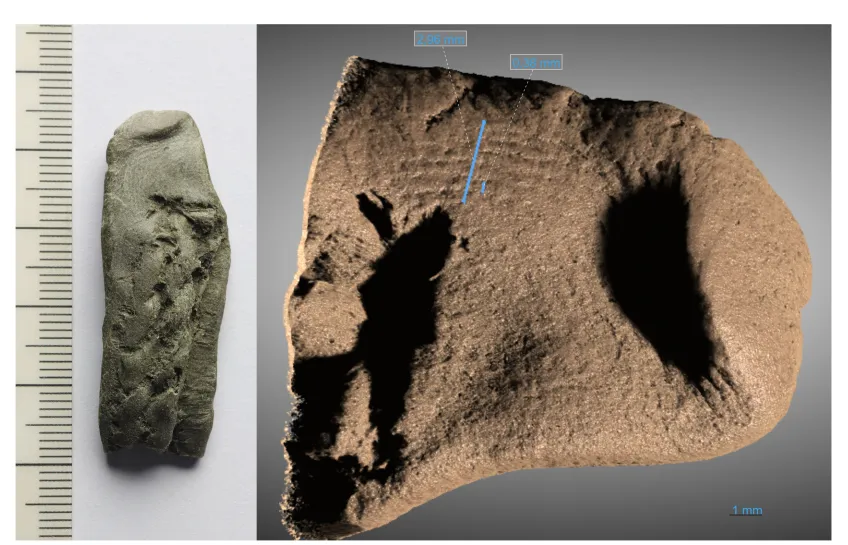
New analysis has now identified a fingerprint in the tar which could lead to DNA evidence leading directly back to the assailants.
It is believed the mystery attackers were defeated before the victorious islanders sunk their foes’ weapons into a bog surrounding them.
The vessel, now known as the Hjortspring boat due to its discovery in the bog of Hjortspring Mose, was “exceptionally well preserved” thanks to its protection in the bog, allowing archaeologists to use a series of modern techniques to analyse it.
Teams were able to carbon date some of the lime bast cordage used on the boat, confirming it pre-dated the Roman Iron Age. They also used x-ray tomography to make high resolution scans of the caulking and cordage material found on the boat, including a digital 3D model of the fingerprint found in some of the tar.
Experts now hope analysis of the fingerprint will reveal clues as to the sailor’s origins.
Academics previously found it was waterproofed with pine pitch, leading them to believe the boat was built somewhere with abundant pine forests.
Several scholars had previously suggested that the boat and its crew came from the region around modern-day Hamburg in Germany. Instead, the researchers now believe they came from the Baltic Sea region.
“If the boat came from the pine forest-rich coastal regions of the Baltic Sea, it means that the warriors who attacked the island of Als chose to launch a maritime raid over hundreds of kilometres of open sea,” said Mr Fauvelle.
The boat is currently displayed at the National Museum of Denmark.
It comes after archaeologists uncovered over 30 graves from the Viking era near Aarhus, including a “very rare” coffin of an “important woman” who lived in the 10th century.
The graves contained teeth and bones of the dead as well as spectacular objects, like a box with pearls, indicating a connection to the Danish monarchy.
Join our commenting forum
Join thought-provoking conversations, follow other Independent readers and see their replies
Comments
Bookmark popover
Removed from bookmarks