‘At my university, people are afraid to show any signs that they are Jewish’
For many British Jews, university life feels like the front line of ‘new antisemitism’ – never more so than on the anniversary of 7 October, when ‘Time for dessert’ bake sales and demonstrations are being organised by their fellow students. Nicole Lampert reports


At the University of Liverpool, a student group was busy planning what appeared to be a celebratory “Palestine bake sale”. The poster, adorned in the red, black and green of the Palestinian flag, was made to promote the event on 7 October – titled “Time for Dessert”.
A group called Goldsmiths for Palestine will host a night of “remembrance and resistance” in The Feminist Library, away from campus. There will be a film as well as tea and cakes. Groups at other University of London sites, including King’s College London and the London School of Economics, will be organising a 2pm walkout. In Edinburgh, there will be a rally outside the library under the slogan “Divestment today, liberation tomorrow”.
On the anniversary of a massacre in which more Jews were killed than on any other day since the Holocaust, many students will not be lending their support to the Jewish community. They won’t be holding a vigil. Their events feel closer to celebrations. At least in the case of the bake sale, the organisers finally “agreed to move this fundraising activity to an alternative date, following an intervention by Jewish News”.

On Monday, Keir Starmer condemned the students planning protests on the anniversary of the atrocities committed by Hamas on 7 October 2023. He wrote in The Times: “It’s un-British to have so little respect for others. And that’s before some of them decide to start chanting hatred towards Jewish people all over again.”
But this state of affairs has been two years in the making, and similar protests have taken place across the UK during that time. Ruth Deech, a crossbench peer and a former principal of St Anne’s College, Oxford, said: “As a new academic year begins at British universities, it is painfully clear that authorities have failed to tackle extremist events and ideology on campus.


“The tragic events in Manchester have shown us what can happen when such hateful, violent rhetoric is normalised, and it is now incumbent on university leaders to enforce a zero-tolerance policy to ensure the safety of its frightened Jewish students.”
Ah yes, remember them? The Jewish students – a minority on any British university campus. Jewish students who routinely hide symbols of their faith, in constant fear of attack; of being harangued, abused and “punished” for the decisions of the Israeli government.
Abi Hass, who runs Sheffield University’s Jewish Society, tried to speak up against the “student rally for Palestine” that is due to take place on Sheffield’s main student union concourse. “I have become extremely used to people’s ignorance and casual antisemitism,” she says of her university experience, which she has described as “nevertheless enjoyable”.
But things have been difficult in the lead-up to the second anniversary of the 7 October massacre, which sparked the war that has so far led to the deaths of an estimated 66,000 people in Gaza – civilians and terrorists.

“In the last couple of weeks, the student union contacted me to see if I would be open to discussing with the Communist Society to see if I could change their minds on the date of a rally they were organising. I agreed, as I felt that maybe hearing the side of actual students could help them sympathise.
“Jewish students may know family and friends who were murdered or taken hostage, but I was simply told that the date was irrelevant, the rallies were welcoming spaces for Jewish students too, and it was impossible to change the date because all the posters and flyers had been sent out.
“The student union even offered to reprint the posters so they wouldn’t lose any money, but they refused.”
Universities are aware that the rallies are seen as insensitive, but many students feel that not enough is being done to challenge the groups who are creating an atmosphere that allows this sort of protest to thrive.
The University of Edinburgh, for example, put out a statement saying: “Our community should not attempt to justify or glorify acts of gratuitous violence against innocents. It is important that anyone participating in demonstrations against what is happening in Gaza does not fall into this trap.” Yet according to one Edinburgh student, a main university building recently had posters displayed in the window that read “We want 1948” – an expression, they explain, of a desire to eradicate the state of Israel.
Shadow justice secretary Robert Jenrick made a last-minute plea for the rallies to be banned. “University chancellors need to stamp out the virulently anti-Jewish hatred running amok on their campuses,” he said. “These groups are showing their true colours by holding rallies celebrating their heroes in Hamas two years on from the sickening murder of 1,200 people in what was the worst single massacre of Jews since the Nazi Holocaust. Any student attending ought to be kicked off their courses.”
But for most Jewish students who have attended a British university in the past two years, this is nothing unusual. They have become cesspits of hatred since the attacks were carried out. One Jewish student, Rose* – who this year moved to an American university in Florida to escape the antisemitism – described what happened to her at UCL within days of the 7 October attack. “Brainwashed Zionist genocide supporter,” whispered one of her classmates after a lecture. That was just the start of a campaign of horrendous bullying.

People shouted “psychopathic” and “genocidal” at her as she walked across campus. People pointed and said: “That’s her, that’s the Zionist.” Her photo was taken and circulated among pro-Palestine WhatsApp groups, who were concerned that she would try to infiltrate them.
Students at the university initiated “apartheid-free zones” to ban Jewish students. Once, when Rose was on a bus on the way home from a nightclub, talk turned to the war, and a crowd aggressively started shouting at her, “We are anti-genocidal.” She had been told that people who compared Israel’s stance on gay rights with that of other countries in the Middle East were guilty of Islamophobia.
Ironically, the person who has been most sympathetic towards Rose is her Palestinian flatmate – because most of the people screaming pro-Hamas chants and demanding the globalisation of the intifada don’t understand that these things harm Palestinians, too.
While legitimate protest is a basic human right, and many Jewish people support the calls for a ceasefire and an end to the war in Gaza – especially now there is a peace plan in place –what some Jewish students have found is that too often they are held accountable for the actions of the IDF, by people who are parroting anti-Israel rhetoric that frequently mirrors much older antisemitic tropes.
“We are walking on eggshells, wondering if there will be more hatred to come,” says Nick*, a mature student doing a master’s at the University of Manchester.
“There is this feeling in your stomach, a sickening feeling, because you never truly feel safe. I try to avoid campus, but if I do go in, I hide my Magen David [star of David] necklace and then feel angry that I feel I have to hide it.”

For British Jews like David, universities have often felt like the front line of what is known as “new antisemitism”.
Throughout the 1980s and 90s, various groups tried to ban Jewish societies at universities because their members were Zionists (around 80 per cent of British Jews believe that the state of Israel should exist), and, in their parlance – paraphrasing a UN resolution that was later rescinded – “Zionism is racism”.
“People are afraid to show any signs that they are Jewish,” says a student at the University of Birmingham – where the Jewish Society, numbering 1,000, represents one of the biggest Jewish student bodies in the country. “I heard about one incident where a guy who had a kippah on was shouted at for ‘supporting genocide’.”
She adds: “There was an Israeli flag left outside a Jewish flat, with non-kosher food left on top of it. The aim is to say ‘We know where you live’ and to make Jewish students feel unsafe and intimidated.”
At Birmingham, an Islam Week hosted on campus in February last year sparked more tension. “There was a big tent in the middle of the campus with some really interesting stands, and it was all going fine until suddenly it wasn’t,” recalls Natasha. “There was a demonstration that turned nasty; visibly Jewish people who walked past were heckled [by people saying] things like ‘Israelis should burn in hell’.”
Rachel is another Jewish student. She is both pro-Palestine and pro-Israel, and has joined marches against the war. But as someone who believes the state of Israel has the right to exist, she struggles with slogans like “From the river to the sea” and “Intifada everywhere”.
“An intifada is a call for the perpetuation of violence, which is the fundamental thing I want to stop,” she says. “The hardest thing [about] being a Jewish person like me since 7 October is feeling like you are straddling the fence, and like you don’t belong in either party. You are not welcome.”
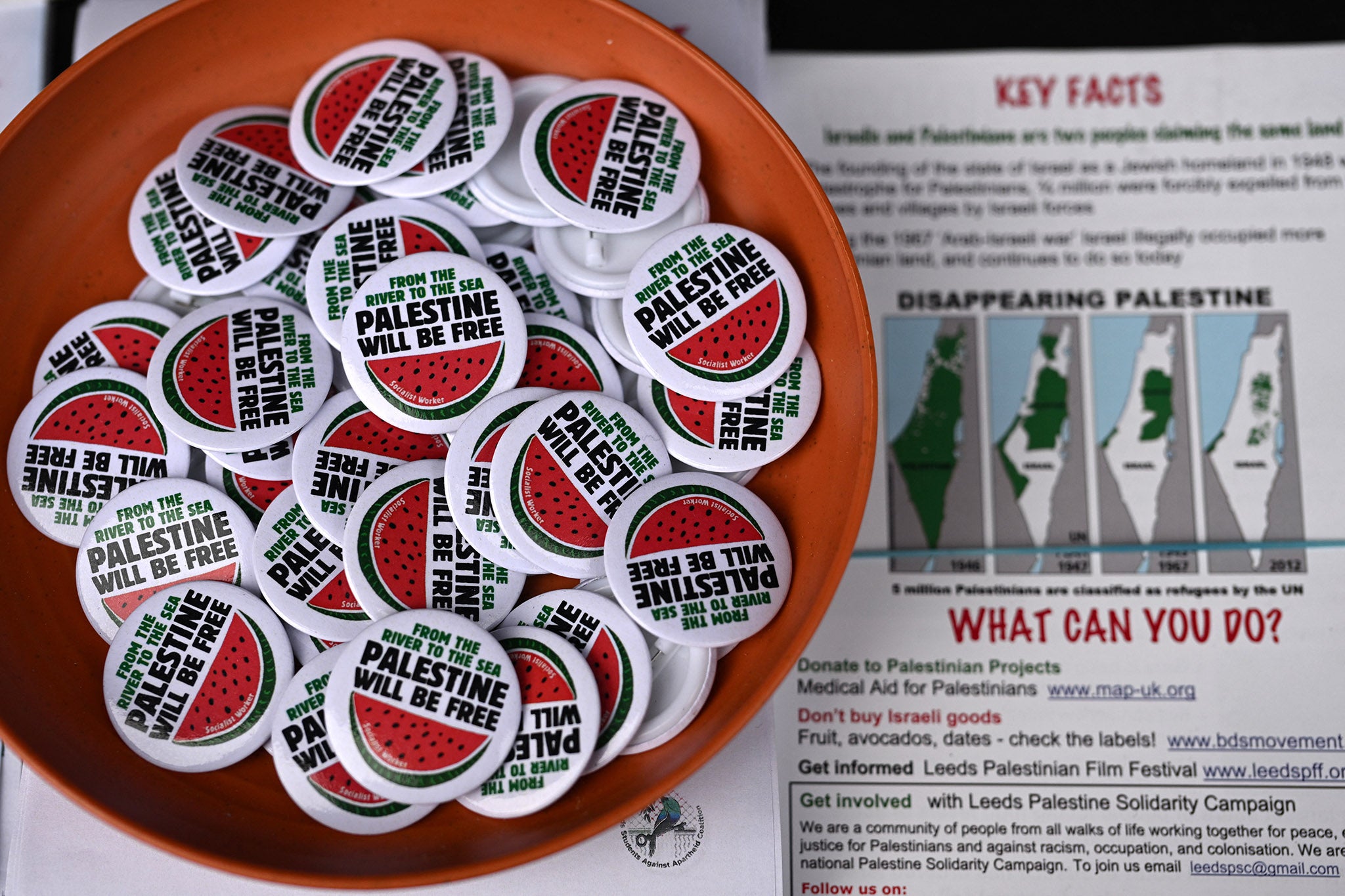
The hostile atmosphere can extend to lectures, too – even if the Israel-Palestine conflict has nothing to do with a teacher’s subject. While debate and discussion should be welcomed in any academic setting, for many Jewish students it has often felt one-sided, or that it was done in an insensitive way.
One Jewish student I spoke to was asked by a drama teacher, shortly after 7 October, to imagine themselves as “part of the Palestinian resistance”. Other examples reported to me by students include a psychology lecturer asking students to consider whether the Stanford Prison experiment was “something like the genocide going on in Gaza”; a history teacher including on a reading list a book that claimed Israelis harvested the organs of Palestinians; an American studies tutor asking students, shortly after the 7 October attack, to debate whether what had happened on that day was “justifiable resistance”; a geography lecturer pointing to a map of Israel and calling it Palestine; and an African Studies lecturer claiming that Israel had deliberately “destabilised” the continent.
“It feels like it is a discourse that has become completely normalised, with more and more sit-ins and ‘occupations’ for Palestine,” says Professor David Hirsh, who looks at contemporary antisemitism in academic settings. “This new antisemitism not only allows people to hate the overwhelming majority of Jews, but says they are right to do it.”
Starmer wrote in his column in The Times, which followed the murderous attack on a synagogue last week, that more needs to be done to stop antisemitism, saying: “Driving antisemitism out of our society is a challenge for our whole country. Everyone must play their part. It will not be solved with quick fixes but with painstaking partnership work across communities, faiths, in schools, hospitals and workplaces, in every part of our country and every part of our society.”
For the Jewish students who have felt ignored, abandoned and under attack for the last two years, that work needs to start on campuses today. Many are tired of words and no action.
*Like several of the students I spoke with, Rose and Nick did not want their real names used as they feared repercussions
This article was amended on the day of publication. It previously said that the ‘Evening of Remembrance and Resistance’ was being held at Goldsmiths. This was not the case, and the event is being held away from the campus.
Join our commenting forum
Join thought-provoking conversations, follow other Independent readers and see their replies
Comments
Bookmark popover
Removed from bookmarks