Hour-long queues in Prague airport as EU entry-exit system comes into effect
Exclusive: Czech Republic vowed to introduce 100 per cent EES checks on day one
Long queues have built up at one of the few EU airports where the new entry-exit system was planned to take effect on day one.
The Schengen area digital borders scheme is being gradually rolled out across Europe, but three countries have said they will start fingerprinting and photographing all “third-country nationals” from the outset: the Czech Republic, Estonia and Luxembourg.
Prague airport is by far the busiest location intending to apply the entry-exit system in full to arrivals. Passengers from the first few UK flights to touch down in the Czech capital on Sunday morning told The Independent they had gone through the normal analogue checks without a significant wait.
Dozens of border registration machines have been installed at Terminal 1 of Prague airport to record biometrics. The aim is that arriving travellers will provide their fingerprints and facial biometrics ahead of the passport control desks.
But the authorities ordered passport staff to start recording the biometrics at their posts rather than using the kiosks.
Queues quickly built up as arrivals from British airports, as well as Turkey, Egypt and the UAE, converged on the passport desks.
At the terminal, arriving and departing passengers mingled. Stuart Linden Rhodes, who was at the airport to fly to Leeds Bradford, observed the queues. He told The Independent: “All machines still switched off, heading to an hour now. Fingers and eyes being done at the passport control desk.”
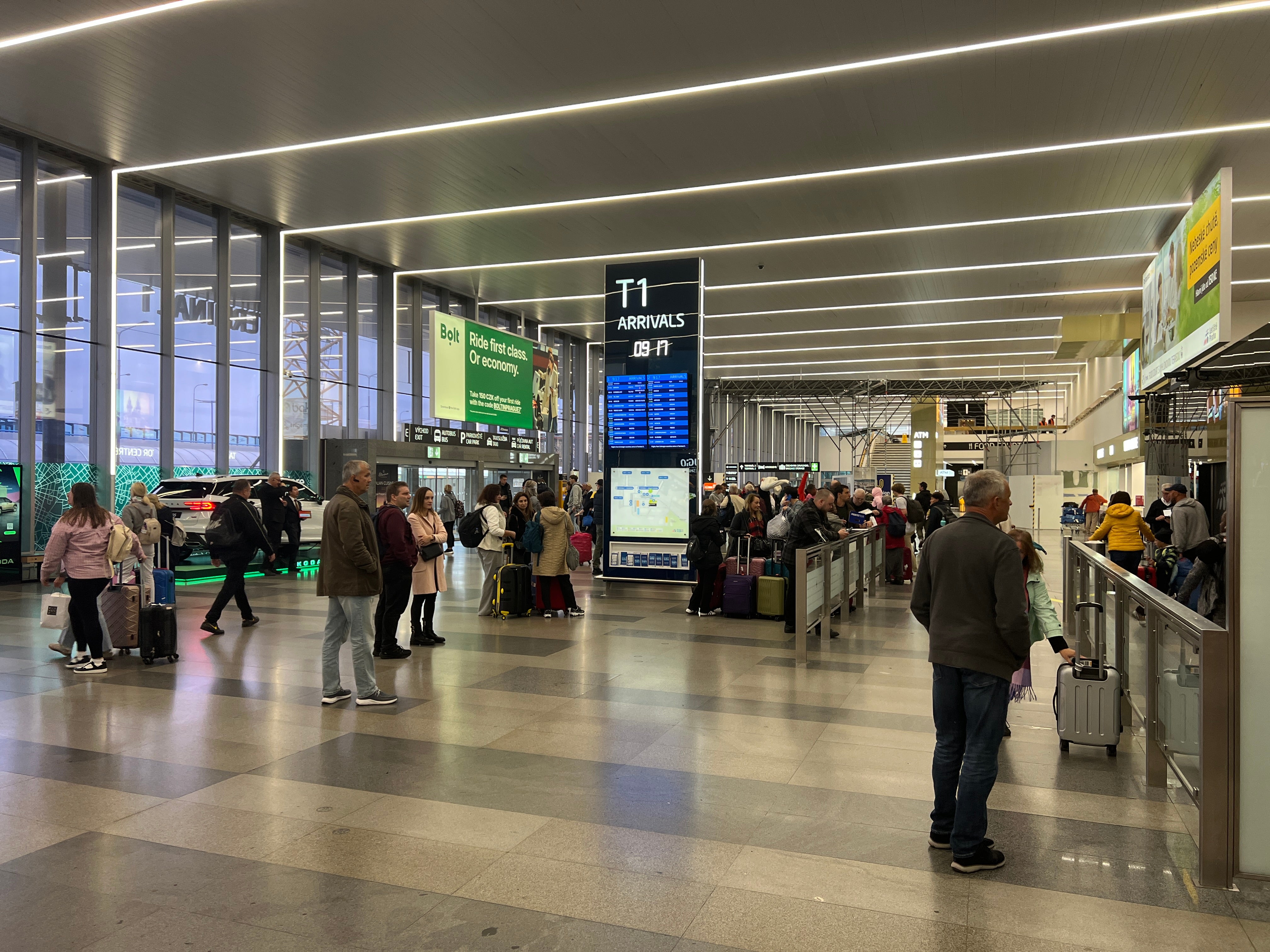
Passengers from London initially reported waiting about an hour for their biometrics to be collected, and for their passports to be inspected and stamped.
But Hamilton Nash, who arrived later from London, said: “Just fought through the queues. No machines operating. It’s an hour to 90-minute-long queue.
“They just started allowing Australian and British passport holders to use the EU channel to ease the congestion in the airport.”
The entry-exit system applies to travellers leaving the Schengen area as well as arriving. But Mr Linden Rhodes reported that his biometrics were not recorded on departure. “Usual exit, glare at you and then your passport before stamping it,” he said.
Starting on Sunday 12 October, Schengen area member states have 180 days to make all their frontiers EES-compliant. The faces and fingerprints of third-country nationals, including British passport holders, are stored on a central EU database.
Senior travel figures have warned of long waits. Michael O’Leary, chief executive of Ryanair, told The Independent: “I’m pretty certain it’s going to go wrong.” But he added: “We’re moving into the winter period, so there’s a lot less pressure on, but I think it will be bumpy and lumpy through the winter.”

Mark Tanzer, chief executive of Abta, the travel association, said: “I’m afraid there will undoubtedly be some delays as this new entry and exit system for the Schengen area comes into effect.”
Julia Lo Bue-Said, chief executive of Advantage Travel Partnership, advised “leaving yourself between three and four hours from the point of entry” before continuing with travel plans.
She told the BBC Today programme: “If you’re not leaving yourself enough time and you unfortunately arrive at an airport where there is a bottleneck, which in a lot of places there are already, this is going to add another layer of frustration and delay.”
The Schengen area – comprising most of the EU plus Iceland, Norway and Switzerland – has 1,800 border crossings, with more than 500 million entries and exits a year.
Join our commenting forum
Join thought-provoking conversations, follow other Independent readers and see their replies
Comments
Bookmark popover
Removed from bookmarks